



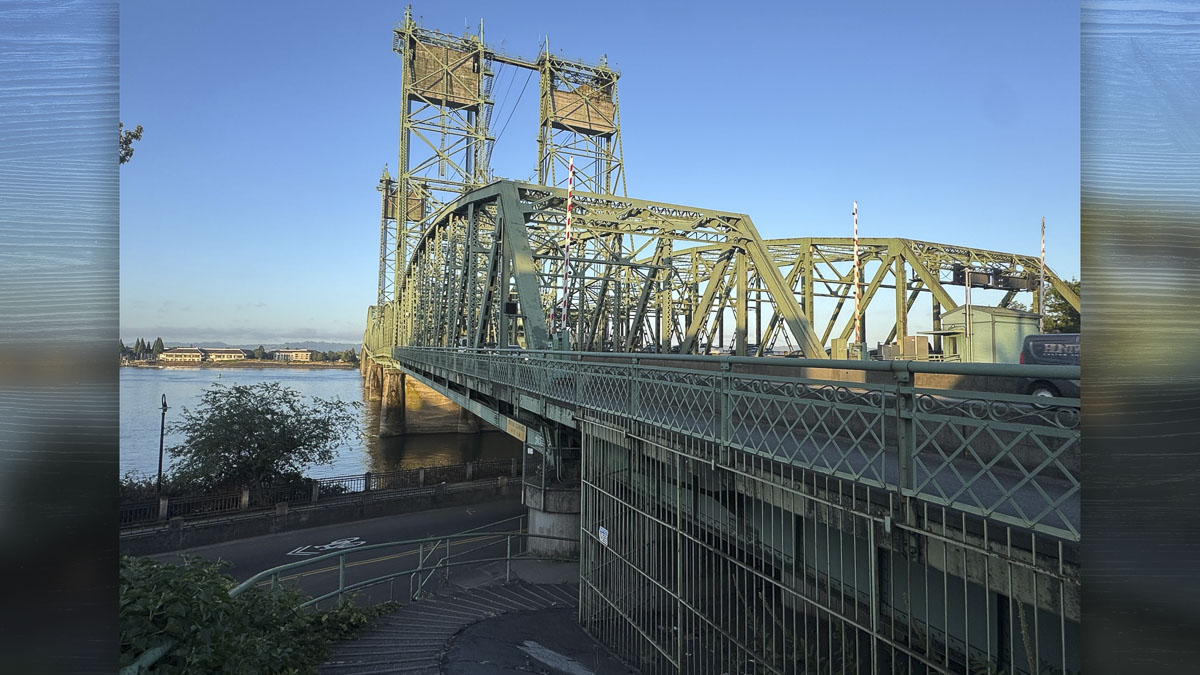
Clark County Today Editor Ken Vance discusses the idea of a new high-capacity transit sub-district and how the boundary should be drawn
Ken Vance, editor
Clark County Today
I’ve got a message for those of you who are proponents of the light rail element of the I-5 Bridge replacement project: If you want it, then you get to pay for it – at least the maintenance and operations cost.

I’ve been consistent and clear when expressing my thoughts about the proposed project to replace the I-5 Bridge. I acknowledge the bridge needs to be replaced. I don’t believe it’s as urgent as some of our elected officials are telling us it is, and I would like to see a third or even a fourth crossing constructed over the Columbia River before the I-5 Bridge is replaced. I would also like to see a more economically feasible project rather than the current proposal from the Interstate Bridge Replacement Program (IBR), which could cost taxpayers as much as $17.7 billion. In a perfect world, a more scaled-down project would not include the 1.83-mile extension of TriMet’s Yellow Line, which will amount to more than $2 billion of the cost of the project.
If proponents of the proposed project get their way, and the replacement proceeds without significant change – including the light rail element – then I think those who are champions for the light rail should be the ones who pay for as much of it as possible.
The possible creation of a high-capacity transit sub-district
Scott Patterson, the deputy chief executive officer for C-TRAN, gave a presentation Wednesday morning during a Work Session with the Clark County Council. His goal was to inform the council of the options to pay for light rail O&M costs, including the possibility of forming what is described as a sub-district within the C-TRAN boundary.
As we know from three previous advisory votes, there is little support in Clark County, outside of the city of Vancouver, to pay for the extension of Oregon’s light rail system into Vancouver. A high-capacity transit sub-district could be created, asking those who live and/or have businesses in that sub-district to pay for O&M through an increase of the sales tax and/or employer tax. Patterson noted that creating a sub-district and getting it ready to go to a vote of the people could take anywhere from 18 months to two years.
That means an increase to the sales tax for light rail O&M or an employer tax — whether in a sub-district or within the entire C-TRAN boundary — would have to be passed by a vote of the people, Patterson said. Proponents of light rail would likely be in favor of creating a sub-district, with downtown Vancouver being the center of that sub-district.
Clark County Today reporter Paul Valencia accurately pointed out that almost everyone agrees that if the entire C-TRAN boundary — which includes Camas, Washougal, Battle Ground, Ridgefield, La Center, and Yacolt — was asked to vote yes or no to O&M costs for light rail, that would be a resounding no.
Patterson noted that C-TRAN understands what an increase in a sales tax for its entire boundary would collect, but he does not know how much revenue would be generated by a sub-district. That could only be determined after the focus is narrowed down into what would actually comprise the sub-district.
Let Vancouver pay
Most of us concede that the majority of residents and business owners in downtown Vancouver are in favor of the light rail extension into their city. There is no louder proponent of the project than Vancouver Mayor Anne McEnerny-Ogle, and she has the current members of the City Council firmly under her thumb. I can’t understand why, but those council members never step out from under the mayor’s command, nor do they even speak in opposition to her. I don’t understand that dynamic, but that’s the reality of our current situation.
As unpalatable as light rail is for me, I concede there are folks who are in favor of it and many of those people live in downtown Vancouver. So, it makes sense to me that if this high-capacity transit sub-district is created, the boundary should be drawn around downtown Vancouver. I wouldn’t even say that it should include the city of Vancouver because I’m confident that once we travel outside the downtown Vancouver area, the support for light rail diminishes. The residents in those areas of Clark County that don’t want light rail, and won’t reap much of the benefit of light rail, should not have to pay for it.
I remind you, we are only talking about the maintenance and operations expense. We are not talking about the more than $2 billion cost in the overall project. And, if the boundary was drawn around just the Downtown Vancouver area, I doubt that would generate enough revenue to pay for the maintenance and operations.
Oregon has already agreed to pay for 55 percent of the O&M costs, and organizers are looking for ways Washington will pay for the other 45 percent. In November 2024, C-TRAN changed language in its policy, allowing C-TRAN to potentially pay for O&M costs. The previous language said C-TRAN shall not pay for those costs.
The old estimate for O&M was $21.8 million for both states. The new estimate — based on a little less than half the service — is at $10.3 million. After fare recovery and Washington’s 45-percent share, the new estimate for Washington is $4.1 million.
But, I stand by the principle. If they want light rail, they should be the ones who pay for it.
Also read:
- Opinion: ‘If they want light rail, they should be the ones who pay for it’
 Clark County Today Editor Ken Vance argues that supporters of light rail tied to the I-5 Bridge replacement should bear the local cost of operating and maintaining the system through a narrowly drawn sub-district.
 - Opinion: IBR falsely blaming inflation
 Joe Cortright argues that inflation explains only a small portion of the IBR project’s cost increases and that rising consultant and staff expenses are the primary drivers.
 - Letter: The Interstate Bridge Replacement Program’s $141 million bribe can be better spent on sandwich steel-concrete tubes
 Bob Ortblad argues that an immersed tunnel using sandwich steel-concrete tubes would be a more cost-effective alternative to the current Interstate Bridge Replacement Program design.
 - A sub-district vote could be a way to go to pay O&M costs associated with light rail
 Clark County Council members heard details on how a voter-approved C-TRAN sub-district could be created to fund long-term operations and maintenance costs for light rail tied to a new Interstate Bridge.
 - Letter: British Columbia’s new immersed tunnel can solve Interstate Bridge Replacement Program’s $17.7 billion problem
 Bob Ortblad argues that an immersed tunnel similar to a project underway in British Columbia could significantly reduce costs and impacts associated with the Interstate Bridge Replacement Program.

Gold plated Light rail is NOT justified and will drain the finances of Clark County residents and businesses thru an employer tax, higher sales taxes, and TOLLS. Fewer bus riders across Columbia River on public transit buses today than 20 years ago!
2006=3300 weekday average trips across the bridge, 2025=~~1500 weekday average trips across the bridge. The cost to build the light rail component estimated in 2022 at $2 BILLION, is projected to at least double. In keeping with other similar project costs in in West Seattle, costs easily escalate to triple or more, making the TOLLS much higher too.
Thank you, Margaret, for adding some relevant facts to Ken’s excellent column.
Aside from all the basic economic arguments which clearly say this is an overpriced transportation mode, let me point out it provides no useful transportation. Billions to just cross the river to Oregon’s Expo Center–it will not even go to the Jantzen shopping area. Someone should say it plainly, it will not provide transportation to downtown Portland. C-Tran’s express busses do that in half the time it will take on this train. The train cannot improve their times because they have all these stops which make it locked in as a slow train.