



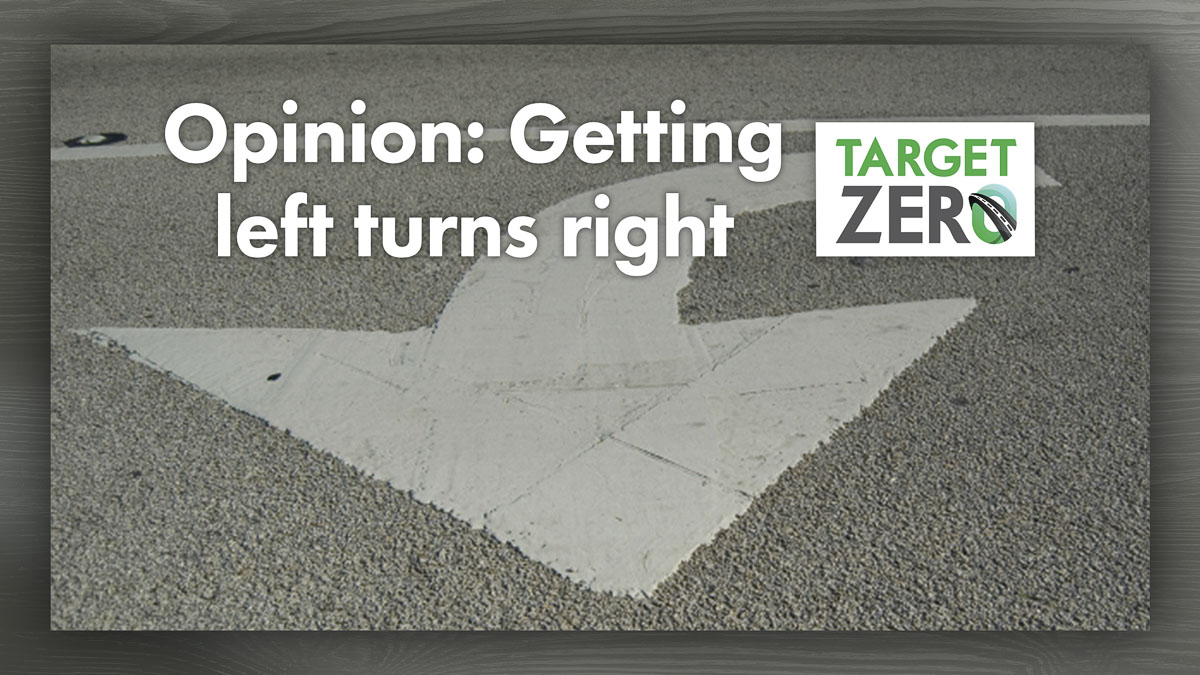
Target Zero Manager Doug Dahl addresses a potentially dangerous traffic maneuver
Doug Dahl
The Wise Drive
Q: I was taught when turning left at an intersection onto a street with two lanes in each direction, to turn into the left (and closest) of the two lanes. If I want to eventually be in the right-hand lane, I signal and move right when it’s safe to do so. Sometimes a car behind me immediately speeds into the right-hand lane, cutting me off from moving there myself after the turn. Is that legal?
A: Maybe this is a bigger problem than traffic. I’m a traffic safety nerd, not a social anthropologist, and unqualified to speculate on this, but I’ll do it anyway. Here’s my premise: life is too convenient. I was going to say easy, but that’s not right. Life can be hard sometimes, but even then, it’s still too convenient. We can summon almost anything we need in seconds with a pocket-sized device that makes the computer NASA used to land a lunar module on the moon look downright primitive. This convenience has manifested itself in our lack of patience. Over a third of us are unwilling to wait five seconds for a webpage to load.

Is it any wonder that we don’t have the patience to properly make a left turn? Why turn to the correct lane and then signal before moving over one lane when we could save the effort of moving our left hand a few inches to engage the turn signal? I have an answer.
About a quarter of all traffic fatalities and over a third of serious injury crashes in Washington occur in and around intersections. Maybe you think that’s not so bad; most serious crashes aren’t happening at intersections. That’s true, but intersections make up a small percentage of the miles we drive, and we travel at comparatively lower speeds through them. Per mile traveled, intersection crashes are way over-represented. The problem is all the opportunities for conflict.
How do you minimize conflict in an inherently risky bit of transportation infrastructure? Be predictable; do what other drivers expect you to do. When making a left turn, stay in your lane all the way through the intersection. Or as it says in the law, “A vehicle shall be driven as nearly as practicable entirely within a single lane and shall not be moved from such lane until the driver has first ascertained that such movement can be made with safety,” and when turning left, the driver should leave the intersection in “the extreme left-hand lane lawfully available to traffic moving in the same direction as the vehicle on the roadway being entered.”
Even if you were to argue that the extreme left-hand lane isn’t available because the car in front of you is in it (a weak argument in my opinion), you still have a problem. Let’s work this out: Say I’m approaching an intersection and I want to turn left. I signal my intent for at least the last 100 feet prior to making a turn. Once I’m in the intersection, if I want to move to over I’d need to signal to the right, again for at least 100 feet. Street lanes are typically about 10 feet wide, so if we do the math it’s unlikely that you’ll find an intersection that takes more than 100 feet to get through. Practically then, it’s not really possible to change lanes during a left turn while complying with the law.
The Washington Driver Guide agrees with me, saying, “stay in your original lane as you turn,” and, “Once you complete your turn, you can change to another lane if you need to.”
Also read:
- VIDEO: WA diesel hits record $6.53, crushing truckers and school budgets
 With diesel nearing $6.53 per gallon in Washington, trucking businesses and school districts now confront sharply higher fuel expenses affecting budgets and workers.
 - Opinion: In plain sight – yielding to pedestrians
 Drivers often fail to see pedestrians due to inattentional blindness, which highlights the need for more focused awareness at intersections and stronger safety practices.
 - Expect delays on SR 14 in Vancouver for guardrail repairs Wednesday
 State Route 14 travelers in Vancouver should plan for morning delays as WSDOT will close two eastbound lanes for guardrail repairs, affecting mileposts 6.0 to 7.0.
 - Overnight closure planned on westbound SR 14 Camas Slough Bridge Tuesday
 WSDOT crews will close westbound SR 14 at Exit 14 in Camas to collect bridge deck samples and plan future repairs; detours will be in effect.
 - Opinion: Stay in your lane – seriously, it’s the law
 Drivers must choose the nearest lane when turning in Washington, and left turns bring added risk. Even with signals, every driver must help prevent crashes by following law.
