


🎧 C-TRAN’s Wins and Warning Signs for Clark County
Rep. John Ley says C-TRAN’s leadership should have a clear mandate: control expenses, optimize capacity, and keep delivering value to the riding public and taxpayers alike
Rep. John Ley
for Clark County Today
Last month, C-TRAN released its 2025 annual report, and the numbers paint a picture of a transit agency that’s doing far better than many of its peers — especially compared to Portland’s struggling TriMet. While TriMet stares down a cash crisis projected to hit by 2029, slashes bus service, and even cuts a light rail line in half, C-TRAN is posting solid gains and sitting on a remarkably healthy balance sheet. But before we break out the applause, a word of caution: unchecked cost growth could erode these advantages if the board doesn’t act.
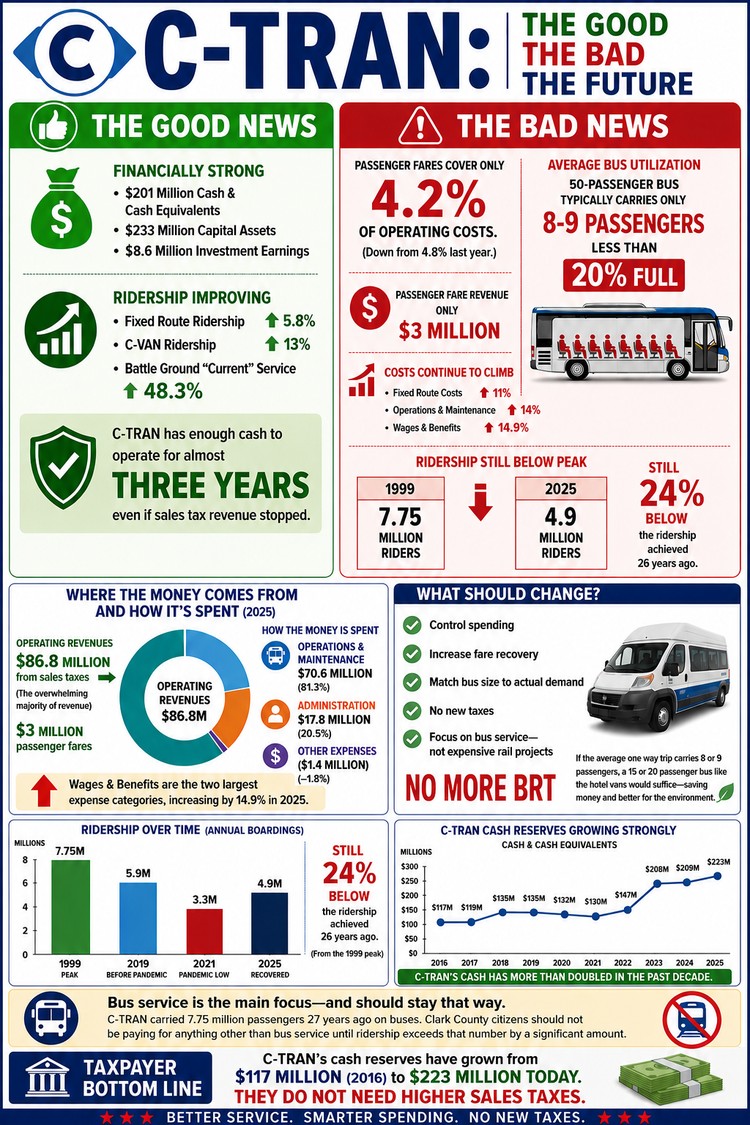
Ridership is clearly rebounding. Fixed-route boardings rose about 5.8 percent in 2025, C-Van service jumped nearly 13 percent, and on-demand The Current service exploded with a 48.3 percent increase after expanding into Battle Ground. Systemwide, C-TRAN logged roughly 4.9 million boardings — still well below the 1999 peak of 7.75 million, but a strong recovery from the pandemic low of 3.3 million in 2021.
Financially, C-TRAN looks rock solid. The agency holds $201 million in cash and equivalents — enough to keep buses on the road for nearly three years even if sales tax revenue vanished tomorrow. Add another $233 million in capital assets and $8.6 million earned in investment interest, and you have a transit operator with genuine staying power. That’s a stark contrast to TriMet’s reliance on hefty payroll taxes and its ongoing service reductions.
Yet here’s where the caution flag comes in. C-TRAN’s costs are rising much faster than its revenue or ridership. Fixed-route operating expenses grew 11 percent, while systemwide operations and maintenance costs surged over 14 percent. Wages and benefits, the largest expense categories, jumped 14.9 percent.
CFO Julie Syring told the board the agency’s expenses will likely grow by 7.3 percent annually. Since 2023, salaries and wages exploded over 55 percent from $30 million to $46.7 million in 2026.
Passenger fares now cover just 4.2 percent of operating costs (down from 4.8 percent the prior year), with fare revenue dipping 1 percent to only $3 million. In 2017, farebox recovery was 17 percent. The cost per passenger mile has tripled over the past decade.
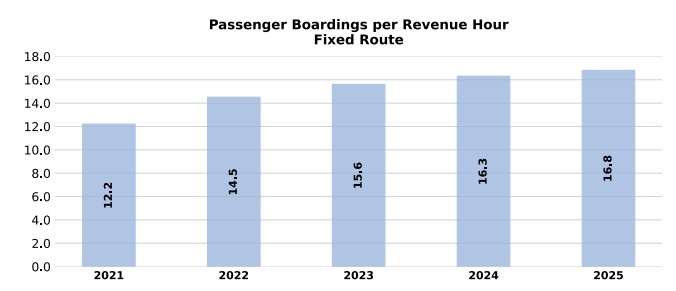
Utilization reveals an even more telling story. An average C-TRAN bus carries just 16.8 passengers per hour on fixed routes. On a typical 30- to 40-minute route, that means a 50-passenger bus (with about 40 seats) is often running with only 8-9 riders in each direction — less than 20 percent of capacity.
Despite this, the agency continues investing in larger articulated buses for its third Bus Rapid Transit line. These million dollar vehicles save a few minutes per trip thanks to fewer stops and all-door boarding, but they underscore a mismatch between capacity and actual demand.
C-TRAN relies overwhelmingly on sales taxes — $86.8 million last year — while operations and maintenance totaled $70.6 million and administration another $17.8 million. The agency’s cash reserves have more than doubled over the past decade, even through the pandemic. That’s impressive fiscal stewardship, (federal and state dollars), but it also means there’s no pressing need for sales tax increases, despite long-term plans hinting at them.
As Clark County taxpayers look ahead, C-TRAN’s board should prioritize financial discipline. Passenger fares should cover a larger share of costs. Vehicle sizing should better match demand. Smaller 15- or 20-passenger vans could work well on many routes, cutting fuel, maintenance, and environmental impacts while still serving riders effectively.
The 2025-2030 Capital Budget allocates $32.7 million for new BRT service along the Highway 99 corridor. The 2025-2030 Capital Budget includes $56.5 million for an east-side extension of the existing Fourth Plain BRT connecting to the 164th Transit Center. This funding also covers the purchase of eight articulated buses.
The talk of rail service in Vancouver scares voters. C-TRAN successfully handled 50 percent more ridership with buses decades ago. There’s no need to chase expensive rail until bus-based ridership substantially surpasses those historic highs.
C-TRAN is proving that prudent management and a sales-tax-based funding model can deliver stability where others falter. But strong reserves shouldn’t become an excuse for inefficiency.
With costs climbing and buses running three quarters empty, the agency’s leadership should have a clear mandate: control expenses, optimize capacity, and keep delivering value to the riding public and taxpayers alike. Get that right, and C-TRAN’s success story will have legs for years to come.

Also read:
- Opinion: Were Republican voters just sleeping during the August primary election?
 CCRP Chairman Matt Bumala says 60% of primary no-shows in the 17th and 18th districts were Republicans.
 - Opinion: WA Cares’ launch showcased care WA Cares did not provide
 Gov. Ferguson showcased a caregiving arrangement at the WA Cares launch that the program had not paid for a single day of.
 - Opinion: Portland’s War on Cars Part 4 – A smarter automobile strategy to end gridlock
 O’Toole argues fuel wasted in Portland-area congestion has sextupled since 1982, generating 250,000 tons of extra greenhouse gases annually.
 - Opinion: The Tooth Fairy’s secrets to making brushing & flossing magical
 Delta Dental of Washington’s Tooth Fairy Experience offers free resources to help children build lifelong brushing and flossing habits.
 - Opinion: Transit ridership trends are dismal but regional plans are oblivious
 Puget Sound transit passenger-miles fell 31% from 2015 to 2024 despite a half-million-resident population increase.
 wpDiscuz