
Rep. John Ley for Clark County Today
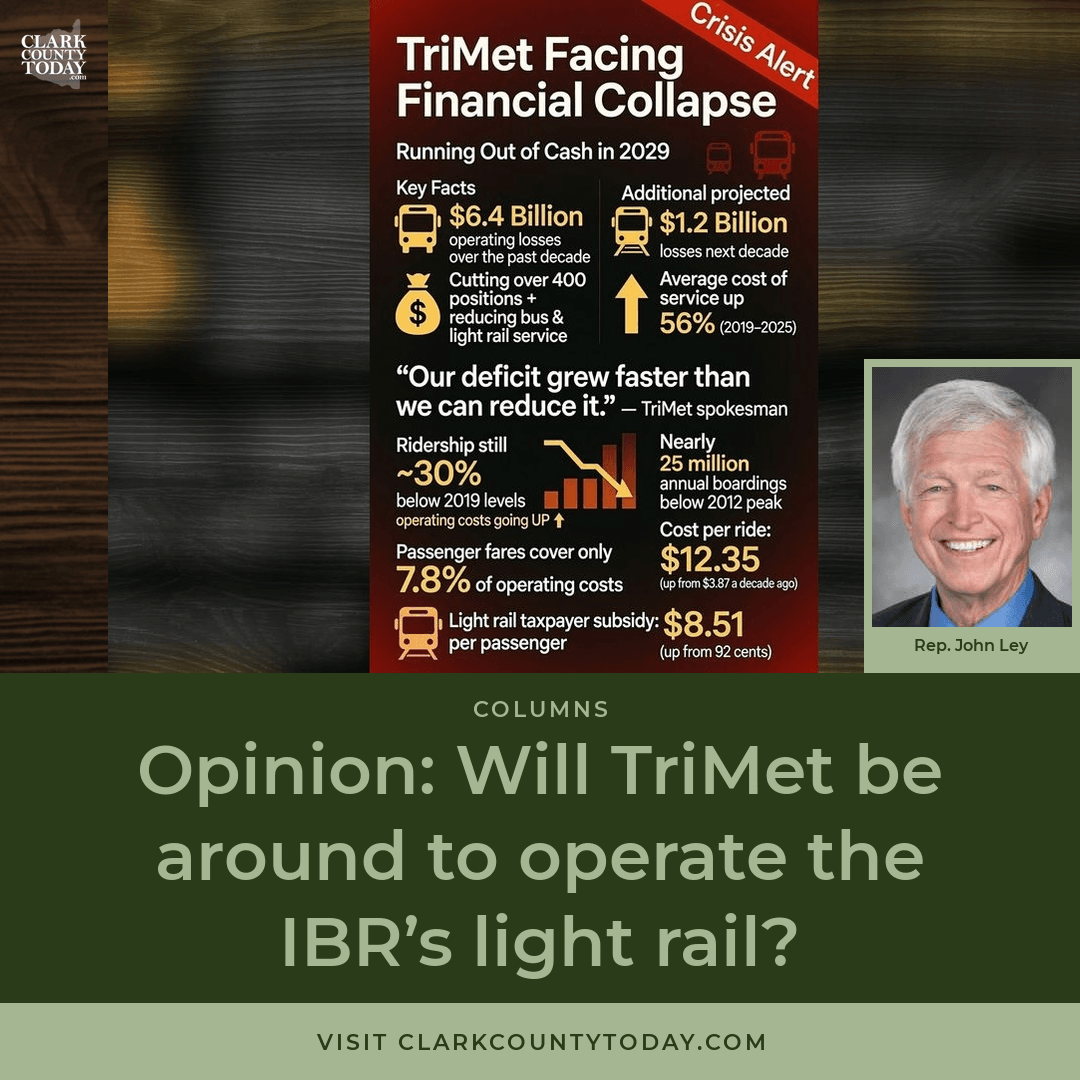
Costs are up substantially and ridership is significantly down. The bank account is almost empty. That is how one could describe Portland’s TriMet.

Rep. John Ley
Portland’s transit agency is attempting to cut $300 million in operating expenses, allegedly to get their financial house in order. Yet they had an operating loss of $850 million last year, with a larger loss expected when they announce FY 2026 results in October or November. Oregon voters rejected a taxpayer bailout at the polls in May by an 83-17 percent margin.
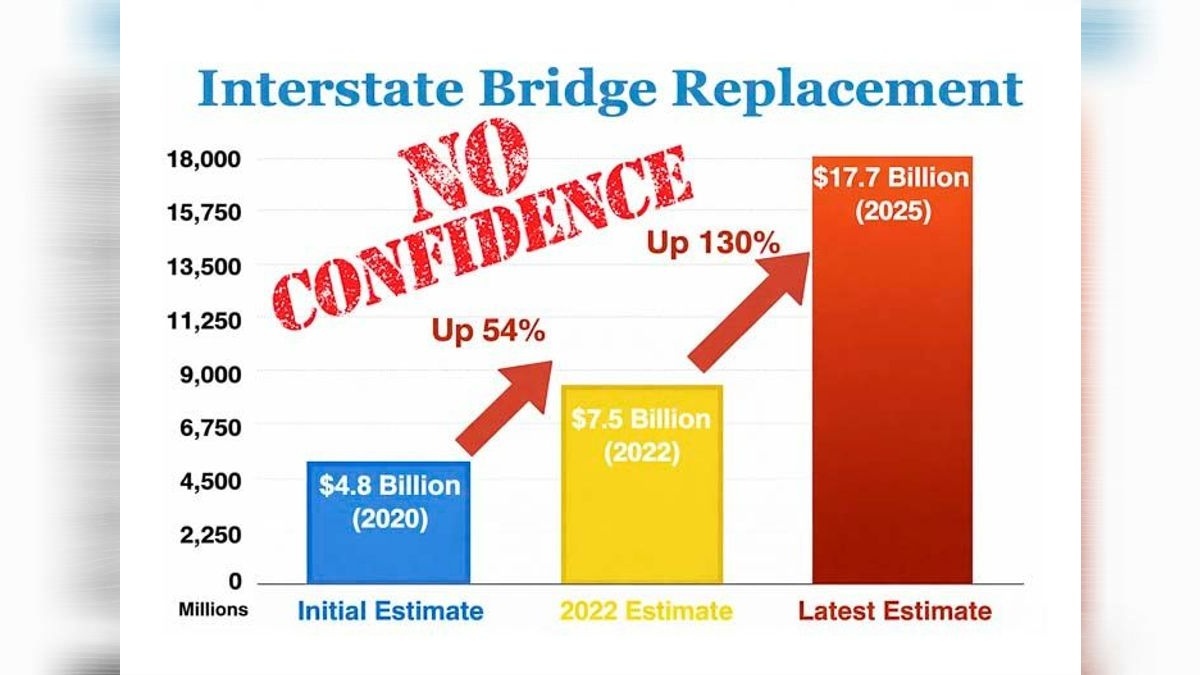
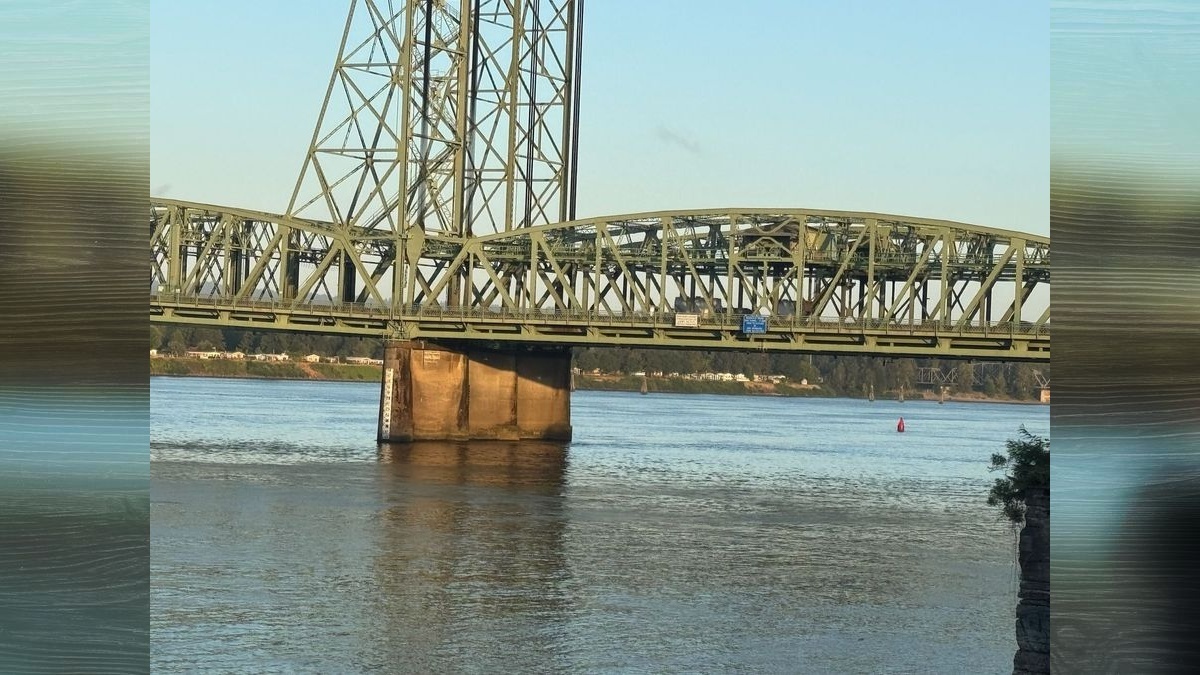
Against this backdrop, the I-5 Interstate Bridge Replacement Program (IBR) looms. The financially ailing program has about $5.5 billion in funding, well short of the $13-$15 billion leaders say they need. The project will therefore be phased, with phase one not including light rail, but simply space for light rail on the bridge. Phase two will happen if and when they find the cash.
A question looms large for the federal agencies providing oversight, as well as Oregon and Washington citizens. Will TriMet be around in a decade to operate the IBR’s $3.5 billion light rail component? “We must now resize our agency to reflect our current financial reality,” said TriMet General Manager Sam Desue Jr.
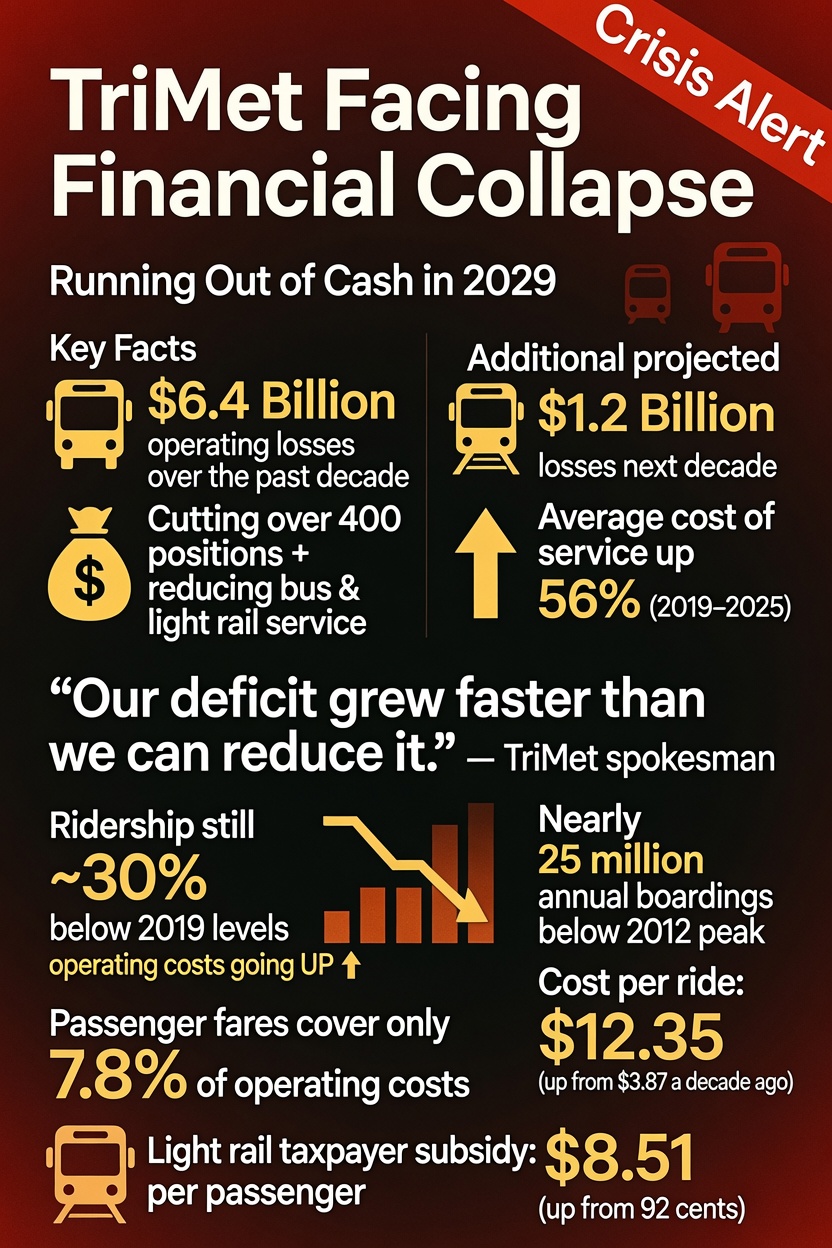
TriMet officials just announced they will cut over 400 positions, and reduce bus and light rail service to reduce costs. Their average cost of providing service has gone up 56 percent between 2019 and 2025, reports Roberta Altstadt, TriMet’s director of communications. This year’s budget spends down agency reserves by $187.4 million, as “our deficit grew faster than we can reduce it.”
“The cuts will not be enough,” said Altstadt. “We need to increase our revenue, and that really does mean identifying with our state and regional partners, sustainable revenue sources for public transit.” Clark County residents do not want to become a “revenue source” nor a “regional partner” for TriMet.
(TriMet financial mess 2026.jpg)
This comes after voters rejected a temporary 2-year, 0.1 percent increase in the employee payroll tax that would have raised roughly $50 - $60 million a year.
TriMet has had about $6.4 billion in operating losses over the past decade. Last year revenue came in $48 million lower than planned. Its 2027 budget spends their cash reserves down to $606 million.
Ridership remains about 30 percent below 2019 figures, and nearly 25 million annual boardings below the agency’s 2012 peak ridership. Passenger fares only cover 7.8 percent of operating costs. System costs per ride are $12.35, up from $3.87 a decade ago. Light rail passenger subsidy by taxpayers has jumped more than nine-fold, from 92 cents to $8.51 per passenger in the last decade.
The IBR
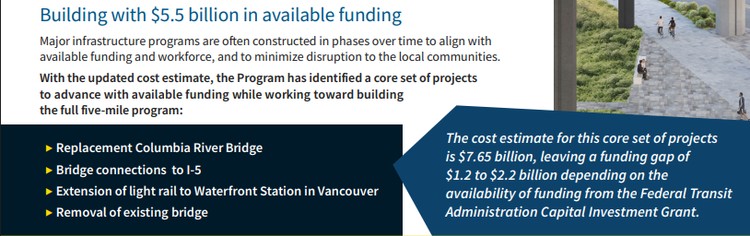
The IBR doesn’t have enough money to complete phase one of the project. “The cost estimate for this core set of projects is $7.65 billion, leaving a funding gap of $1.2 to $2.2 billion depending on the availability of funding from the Federal Transit Administration (FTA) Capital Investment Grant,” they report.
Phase one does not include trains, tracks, or overhead electric lines. It doesn’t include light rail stations, including the one 91 feet above the ground at the Vancouver waterfront or the extension to Library Square at Evergreen. Carley Francis told the C-TRAN Board phase one will have $2 billion in transit-related costs, but hasn’t revealed any details.
That still leaves an additional $1.5 billion to be found in the future for transit and roughly $6 billion for the rest of phase two.
(IBR funding gap 2026.png)
But with TriMet running out of cash in May 2029, and voters rejecting a taxpayer bailout of ODOT and TriMet, there doesn’t appear to be a light at the end of the tunnel for the transit agency. They also have an unfunded employee pension and retiree healthcare liability of about $845 million.
ODOT has an estimated $2 to $3 billion funding shortfall for major projects like completing the Abernethy Bridge and the I-5 Rose Quarter project. The legislature must allocate $500 million in their next two biennial budgets just to meet their $1 billion promised contribution to the IBR.
Will there be a TriMet in 2029 to apply for a $1 billion capital grant from the FTA? What will it look like? The IBR has not shown taxpayers their updated financial plan.
TriMet doesn’t have a long term viable financial solution. The agency’s 2027 budget includes a 10-year forward looking projection: “expenditures are expected to exceed revenues in every year of the forecast, creating annual operating deficits ranging from $87 million to $140 million.” The agency projects cumulative operating losses of an additional $1.2 billion over the next decade. It hasn’t found a solution yet.


Comments
Loading comments…