
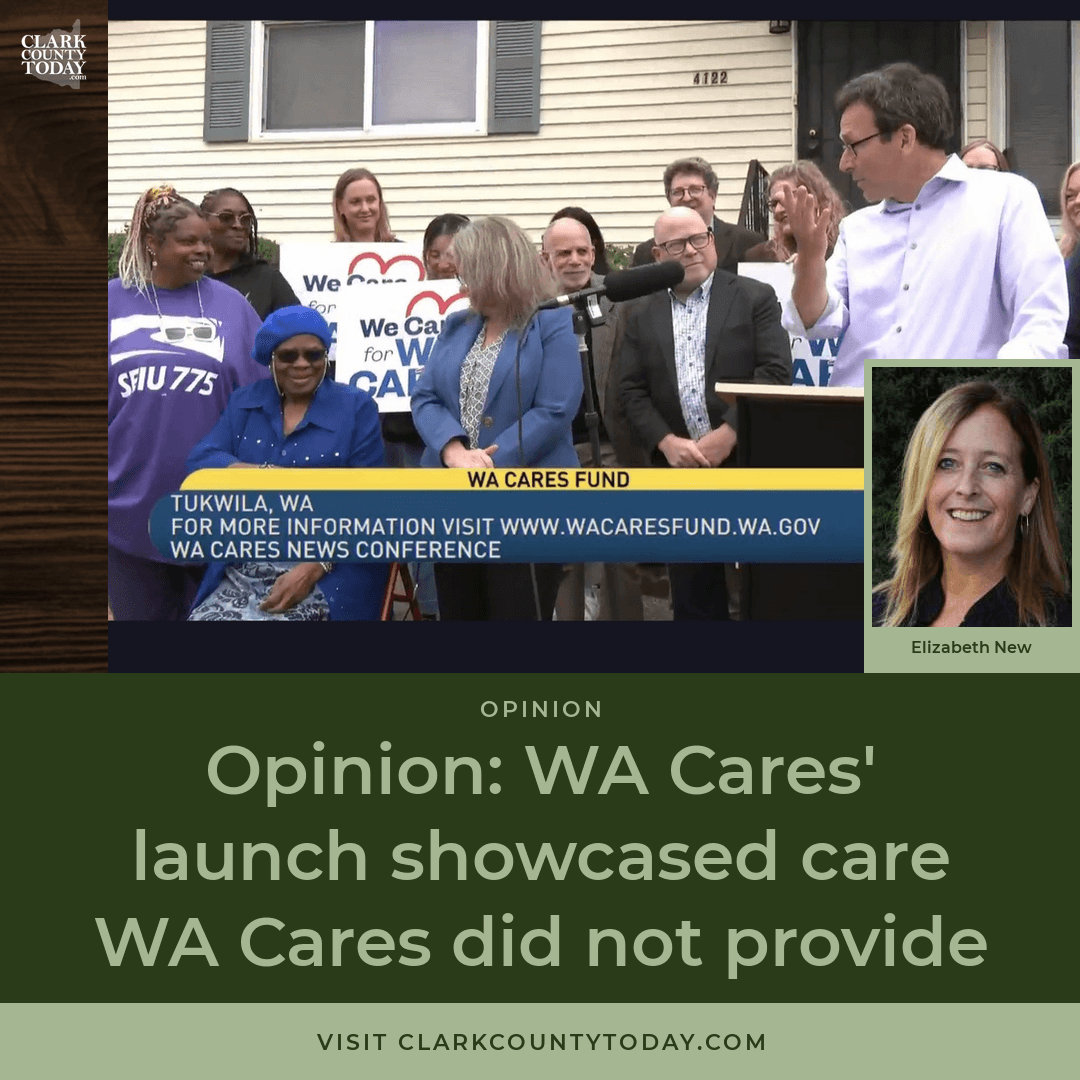
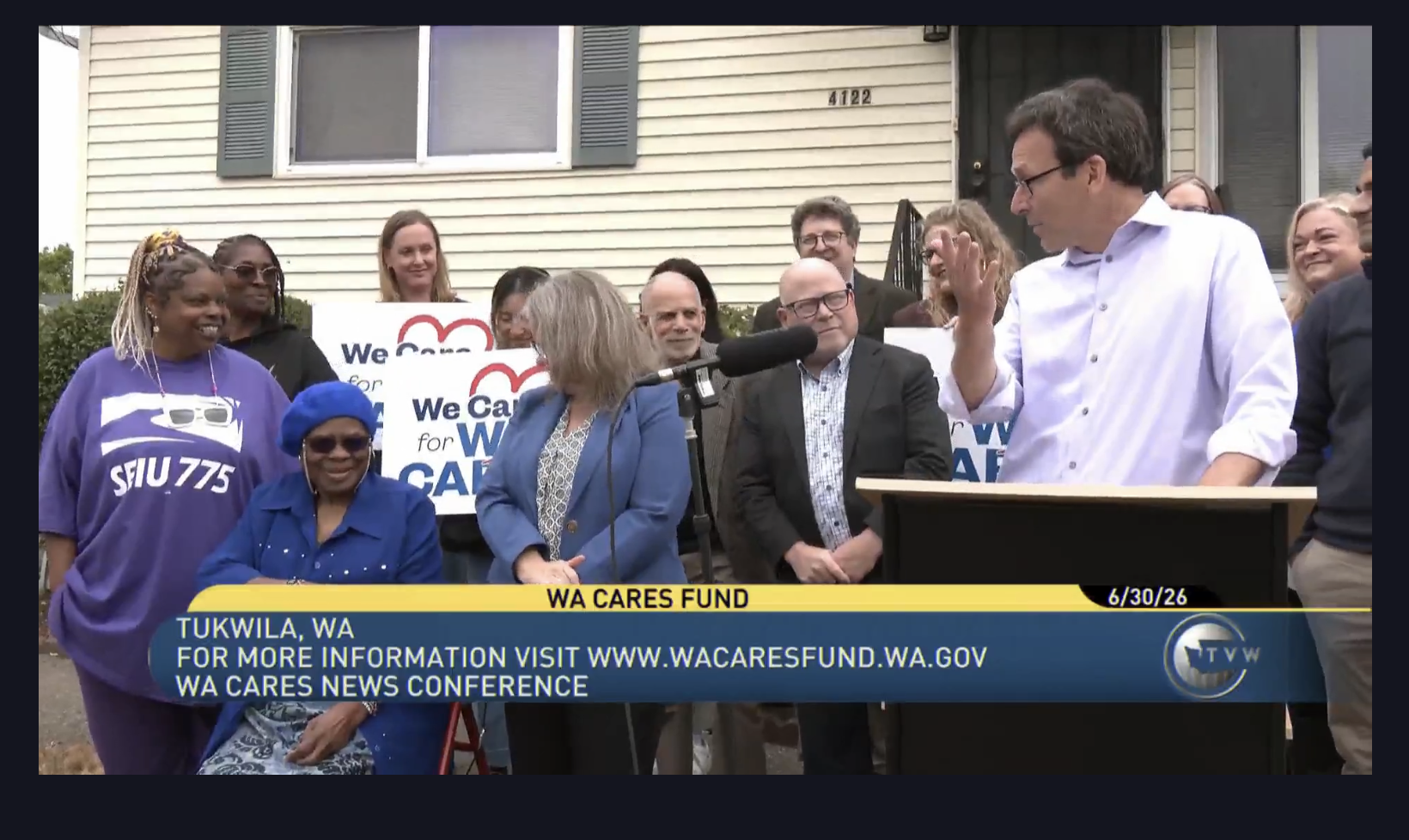
At the June 30 launch of WA Cares, Gov. Bob Ferguson stood outside the home of 87-year-old Evelyn Wade and described the care she receives from her niece, Sonja Thomas, as “what this program is all about.”

Elizabeth New
But Thomas, a professional home-care aide and Service Employees International Union 775 member, said she had been caring for Wade for a “couple of years.” So while the scene illustrated the importance of long-term care, it did not illustrate WA Cares providing it.
WA Cares benefits did not become available until the following day. Whatever program or payment arrangement supported Wade’s care during the preceding two years, it was not WA Cares. Yet placing that existing caregiving relationship at the center of the launch invited viewers to associate it with the new benefit.
That matters because the state is already struggling to explain who qualifies. At a June 24 meeting of the Long-Term Services and Supports Trust Commission, officials described a roughly 50% denial rate among early applicants, with many applicants failing to meet the contribution requirement. Commissioners identified clearer eligibility information as an action item.
WA Cares has two central eligibility gates. The first is contribution history, which workers can satisfy through one of three routes.
Workers can gain lasting access to the full benefit after 10 qualifying contribution years. Reaching that mark does not end the payroll tax: Unless exempt, workers continue paying it on their wages for as long as they remain in covered employment. A person can also qualify sooner by having worked at least 500 hours and having paid premiums in three of the six years immediately before applying. People born before Jan. 1, 1968, have an additional route: They can receive 10% of the maximum benefit for each qualifying contribution year, beginning with one year.
That means people eligible today could include workers of any age with three qualifying contribution years, as well as workers born before 1968 with only one or two qualifying years.
All applicants must also pass the second gate: They must need assistance with at least three activities of daily living for at least 90 days. Those activities include bathing, bed mobility, eating, medication management, mobility, toileting and transferring.
Nothing presented at the launch established that Wade met either requirement. I asked the governor’s office and the state Department of Social and Health Services about this 87-year-old woman’s contribution or eligibility status a week ago. Neither responded.
The caregiving arrangement that was displayed appears more consistent with Washington state’s existing Medicaid long-term-care system. Medicaid can pay a qualifying person’s relative to provide authorized in-home care. Wade’s personal Medicaid status is not public, but the state should explain why it used her existing care arrangement to showcase WA Cares without clarifying that WA Cares had neither provided nor paid for that care.
Medicaid is a means-tested safety net for people who meet financial and functional eligibility standards. WA Cares is available to qualifying workers regardless of income or assets. Lower-income workers are required to pay payroll taxes that will help finance benefits available to people with considerably greater financial resources.
While Ferguson and the other speakers never expressly said Wade had received WA Cares benefits, the staging encouraged that conclusion. That was not merely unclear messaging. The state borrowed the human face of an existing caregiving arrangement to sell a benefit that had not paid for a single day of it. Washington already had a means-tested, long-term-care safety net. What WA Cares added was a payroll tax and a benefit untethered to financial need.
Elizabeth New (Hovde) is the director of the Centers for Health Care and Worker Rights at the Washington Policy Center. She is a Clark County resident.




Comments
Loading comments…