


🎧 Clark County’s Light Rail Fight: Votes Ignored, Costs Soar
Margaret Tweet encourages support for County Council candidates with a proven track record of cost-effective solutions
Editor’s note: Opinions expressed in this letter to the editor are those of the author alone and may not reflect the editorial position of ClarkCountyToday.com
Clark County Councilor Michelle Belkot (District 2) respects the votes of Clark County citizens, has consistently opposed new and unnecessary taxes, and rejects expensive public transit options such as light rail in favor of affordable bus service. Belkot deserves re-election. Clark County Councilor Glen Yung (District 1) has relentlessly pushed for light rail, no matter the cost or the higher tax impact on residents, and businesses. Citizens should consider Bryan Shull for Council District 1 instead. Shull promotes full transparency in IBR I-5 Bridge costs, and brings renewable energy research, design, and development experience, solving complex problems with real world results. Peter Silliman is well qualified to serve North County Council District 5 with decades of telecommunications experience as well as serving as a Clark County policy analyst, and a current County Charter Review Commission member. Below is a recap of local politicians pushing costly, voter-rejected light rail on Clark County residents and businesses.
The I-5 Replacement Bridge Updated Cost Estimate has doubled, from $7.5 Billion in 2023 up to $15.2 Billion in 2026. Light Rail cost estimates are not even shown.
At the April 21, 2026 C-TRAN board meeting, IBR shared that extending TriMet MAX light rail – 1.82 miles over the I-5 Bridge from Portland to Vancouver is estimated to cost – $3.5 Billion of total project costs. This cost estimate includes three MAX stations: Hayden Island, OR., Vancouver Waterfront elevated MAX station over 90-foot tall, and Vancouver Library Square MAX station, trains, tracks, overhead lines that freeze in winter and overheat in summer, etc. The Vine Bus Rapid Transit (BRT) on Highway 99 estimated costs are – $42 Million, vastly lower than light rail.
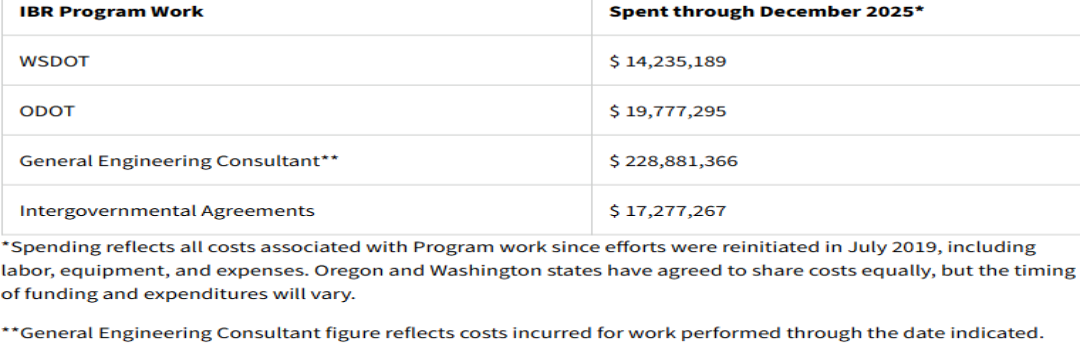
IBR’s Accountability Dashboard states, “Cost estimates and financial plans will continue to be updated as the Program is refined.” “Contracting and expenditure data is updated two times a year,” yet the usual June update is not posted as of July 13, 2026. The last expenditure update is $280,171,117 spent, as of December 2025. General Engineering Contracts for $393,500,000 were signed as of April 25, 2025.How high are expenditures and contracts now?
In 2012, every city in Clark County plus limited county areas in the unusual C-TRAN boundary REJECTED the C-TRAN ballot proposition to extend Oregon’s TriMet Max light rail into Clark County over an I-5 Bridge replacement.
In 2013, an advisory vote to oppose any light rail project in Clark County unless it is first supported by a majority of voters in a county-wide vote of the people was passed, by 68% of voters.
That 2013 vote is reflected in a 2022 Clark County Resolution to oppose every light rail project in Clark County unless it is first approved by a majority of voters in a county-wide advisory vote of the people. The resolution is posted at the Clark County website, and is supposed to direct policy decisions, yet has been ignored by County Councilors Yung, Fuentes, and Marshall. County Councilor Michelle Belkot supports the resolution.
Belkot served on the C-TRAN board in 2024, and 2025 until the March 11, 2025 C-TRAN board meeting where she proposed reinstating the 2022 conditions to not fund operations and maintenance costs of MAX light rail. A majority of the C-TRAN board was poised to back Belkot’s action, until County Councilor Sue Marshall and Vancouver Mayor Anne McEnerny-Ogle acted to table the scheduled vote!
Previously, members of the Battle Ground City Council voted not to fund MAX light rail, in spite of Troy McCoy’s strong support for light rail. McCoy as the 2025 C-TRAN Board representative for Battle Ground said he would vote to not fund MAX light rail, yet instead, he voted to table Belkot’s motion, a complete failure to fulfill his commitment. McCoy is now running for County Councilor in Position 5 against Peter Silliman.
The next day, March 12, 2025, Councilors Yung, Fuentes, Marshall and Little removed Belkot from the C-TRAN board and replaced her with Councilor Fuentes, an ardent light rail supporter from County District 3, mostly in Vancouver. In 2022, former County Councilor Temple Lentz voted to extend MAX light rail into Clark County, although the council majority was opposed to light rail. She was not removed from the C-TRAN board.
Also in 2025, WSDOT directed C-TRAN to change the board composition to 4 Vancouver Representatives, 3 Clark County Representatives, and 2 Representatives from other cities in Clark County. Ostensibly, this was to reflect population distribution, but it doesn’t.
The state Office of Financial Management published an April 1, 2025 population estimate: Unincorporated Clark County – 245,750 Vancouver – 205,100
All citizens in Clark County have a vote for a Clark County councilor; most have no vote in Vancouver. Thus, four County Council seats, three Vancouver seats, and two small city reps is a much fairer composition.
The County Council majority then chose Councilor Yung (District 1) in Vancouver – for the third position on the new C-TRAN board instead of Councilor Michelle Belkot (District 2) in a mostly county area. Yung admitted at his first C-TRAN meeting that he was new to C-TRAN issues, and not as familiar with the issues as the board members are. With Councilor Fuentes (District 3) in Vancouver, now Vancouver essentially has six seats on the nine-member C-TRAN board and completely controls C-TRAN funds and taxation powers. Meanwhile, County Districts 2 and District 4 in east county are under-represented on the CTRAN Board.
Light rail without a vote of the people has been pushed by Clark County Councilors Yung, Fuentes, and Marshall, as well as the Vancouver mayor and council. C-TRAN sales tax increases are planned to pay for it. Charles Prestrud reports, “The average household in the Sound Transit district now pays over $1,700 per year to Sound Transit in sales tax, motor vehicle excise tax and property tax. Prestrud notes, “Sound Transit’s light rail lines carry less than one percent of all the trips residents take around the region each day, and total transit ridership in the region is lower now than it was ten years ago.”
Margaret Tweet
Camas

Also read:
- Opinion: Were Republican voters just sleeping during the August primary election?
 CCRP Chairman Matt Bumala says 60% of primary no-shows in the 17th and 18th districts were Republicans.
 - Opinion: WA Cares’ launch showcased care WA Cares did not provide
 Gov. Ferguson showcased a caregiving arrangement at the WA Cares launch that the program had not paid for a single day of.
 - Auditor, auditor candidate address scrutiny over job title
 Greg Kimsey says roughly 40 county employees hold the deputy county auditor designation Kelly used in his campaign.
 - Opinion: Is Mitchell Kelly misleading voters with his ‘deputy auditor’ claim?
 Clark County HR records show no position called “Deputy County Auditor” has ever existed, Anderson argues.
 - Opinion: Democrats rig the ballot to save their income tax
 Churchill argues the ballot disclosure warning voters of education cuts describes revenue never collected and not yet allocated.
 wpDiscuz