
Editor’s note: Opinions expressed in this letter to the editor are those of the author alone and may not reflect the editorial position of ClarkCountyToday.com
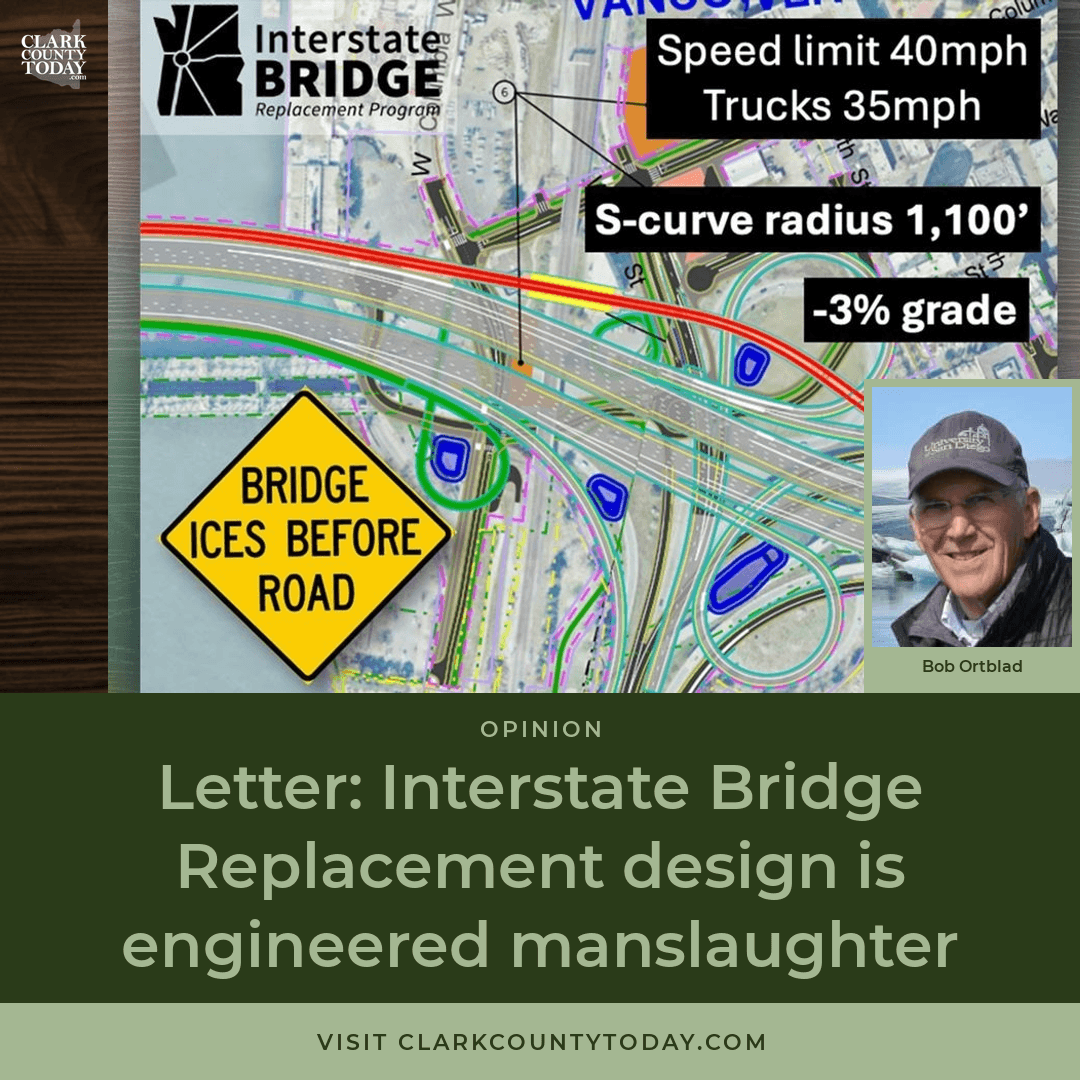
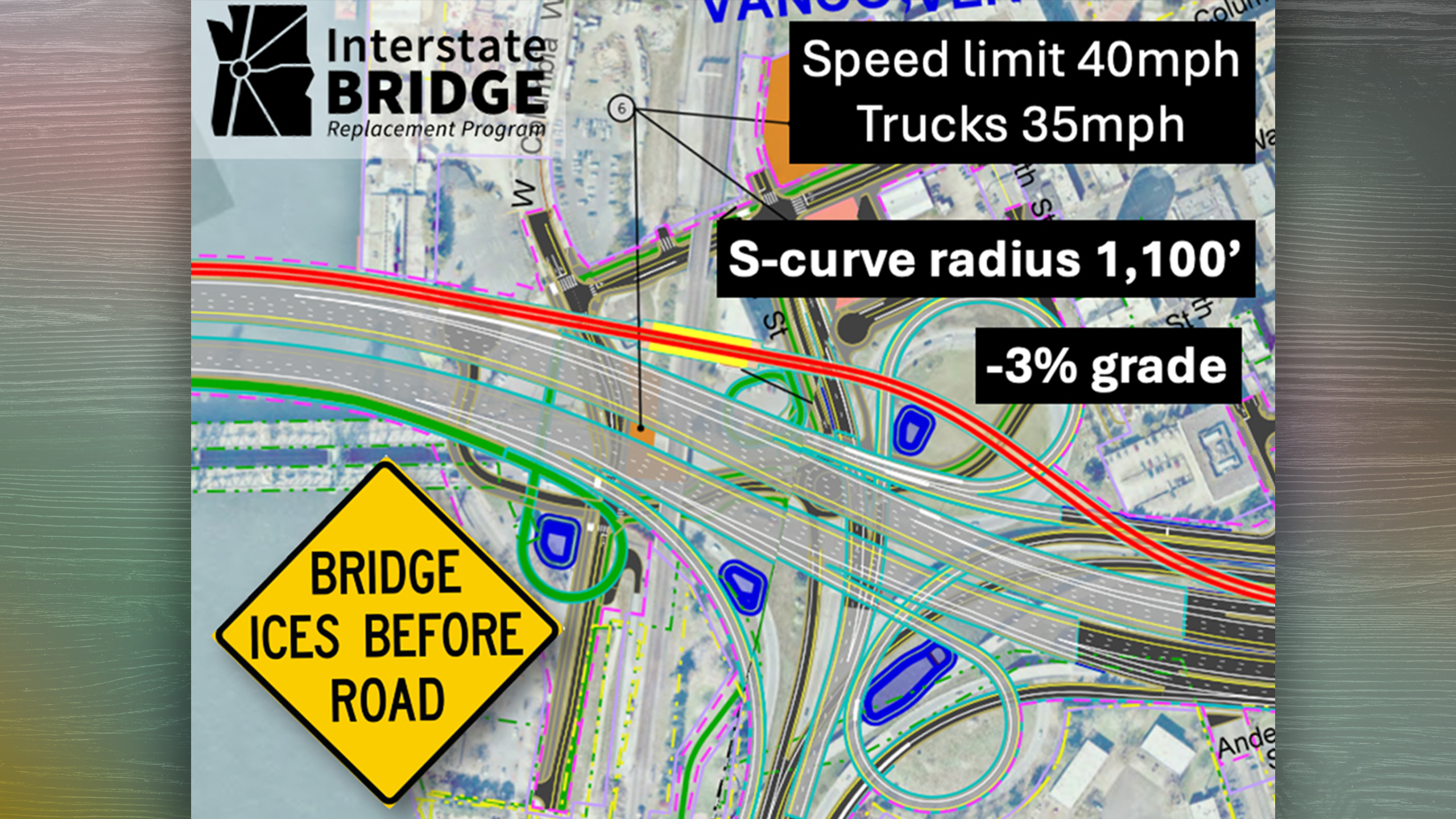
Driving north on the current I-5 Bridge on the Vancouver riverbank, a driver must make a slight right turn, followed by a slight left turn, completing a gentle S-curve on the ground. The IBR’s new bridge will be about 300 feet west of the current bridge. To connect a new bridge to the existing freeway, an elevated approach with a -3% grade and an extreme S-curve must be built. This S-curve will be dangerous and restrict speed to about 40 mph.
Bob Ortblad
During the construction of San Francisco’s new Bay Bridge, a very similar temporary S-curve detour was built. Opened Sept. 8, 2009, in the first two months, there were 48 accidents, including an overturned Safeway semi-truck and another semi-truck that plunged 200 feet, killing the driver. Many additional safety measures were taken to reduce this carnage. A speed limit of 40 mph and 35 mph for trucks was strictly enforced for the four years of the detour. This S-curve had a tight radius of only 1,200 feet, a -3% grade, and 365 frost-free days.
The IBR plans a permanent S-curve on the Vancouver bridge approach that will have a tighter radius of 1,100 feet, also have a -3% grade, and have only 200 frost-free days, resulting in frequent icy conditions. This perfect storm of conditions will made IBR’s S-curve much more dangerous than the Bay Bridge’s deadly record. Cool air circulating on both top and bottom of the road deck will freeze fog and rain on the north-facing bridge approach. A northbound car or truck may drive up an ice-free Hayden Island approach, its south-facing roadway melted by the sun’s radiation. Cresting the bridge at 60 mph, a driver may hit black ice on the S-curve with a -3% grade. It will be almost impossible for a semi-truck to avoid jackknifing. Vancouver residents can only pray that the first truck to fly off the bridge is not a gasoline tanker.
The IBR has not yet set a speed limit for its planned bridge, but with its extremely tight S-curve and possible icy roadway, anything over 40 mph and 35 mph for trucks will be considered engineered manslaughter.
An immersed tunnel alternative to the east of the current bridge will avoid a tight S-curve and be weather-protected. An immersed tunnel is more earthquake resistant, can be built in half the time and cost, and protects Vancouver, Hayden Island, and Fort Vancouver from massive, environmentally damaging bridge approaches. Unfortunately, the IBR has not retracted its fraudulent “Tunnel Concept Assessment” and continues to lie about the feasibility of an immersed tunnel. The “Tunnel Concept Assessment” inflated excavation by four times and was issued illegally without a professional engineer’s stamp, WAC 196-23-020.
Bob Ortblad MSCE, MBA
Seattle, WA
Comments
Loading comments…