

Editor’s note: Opinions expressed in this letter to the editor are those of the author alone and may not reflect the editorial position of ClarkCountyToday.com
Peter Bracchi’s letter to the editor raises an important question about whether Vancouver’s current approach is creating real long-term stability for either neighborhoods or the individuals living on the street.
 Sarah Mittelman
Vancouver
As a medical provider working alongside outreach teams in Clark County, I see this issue from more than one angle. I see it as a provider working directly with people experiencing homelessness, addiction, untreated mental illness, and chronic instability. I also see it as a downtown Vancouver neighbor who experiences the impact of these conditions in daily life. That dual perspective matters.
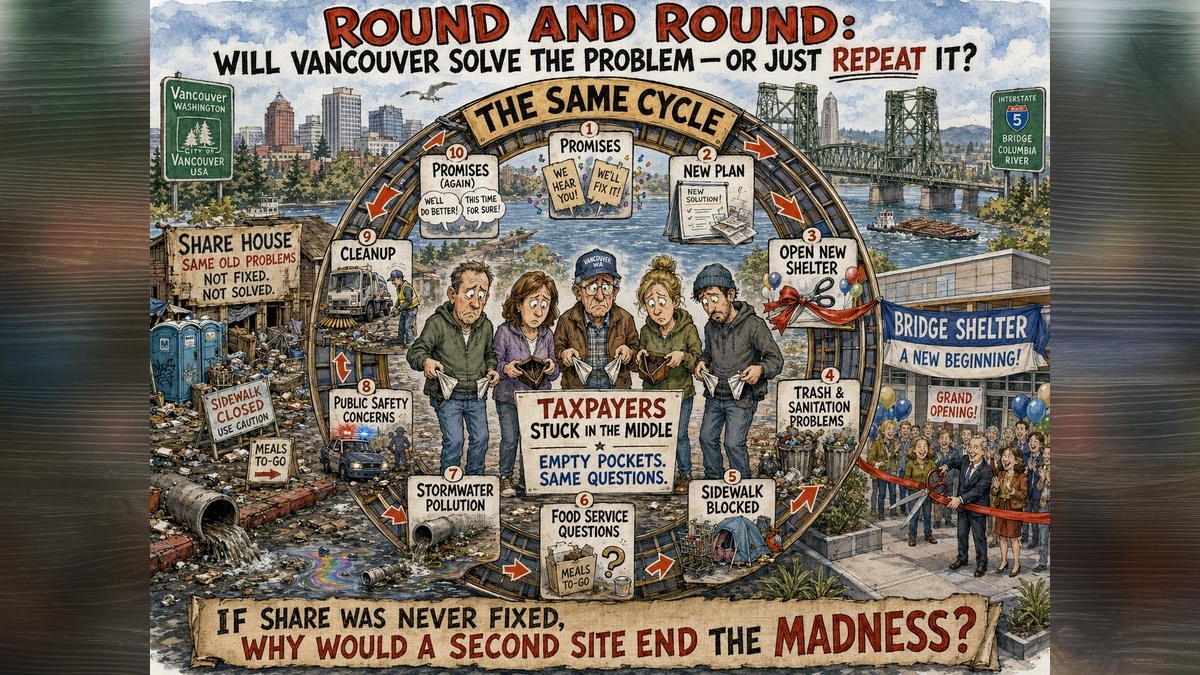
Too often, outreach teams are pulled into an endless cycle of encampment response, crisis management, cleanup coordination, and supply redistribution. These efforts may help people survive one more night, and sometimes that matters. But survival support alone is not the same as a plan of care. When encampments are cleared, the same conditions often return. Sidewalks become blocked again. Garbage piles up again. Residents and businesses become frustrated again. Outreach teams respond again. Supplies are replaced again. And many vulnerable people remain stuck in the same unsafe conditions, with no clear path toward stability.
Clark County and Vancouver have invested enormous amounts of public resources, outreach funding, emergency response, cleanup efforts, staffing, and taxpayer dollars into addressing homelessness. Yet many residents look around and understandably ask a difficult question: what measurable progress are we actually making?
My nursing background taught me a basic process: assess the problem, identify the goal, implement interventions, and then evaluate whether those interventions are actually achieving the intended outcome. If they are not achieving the outcome, the next step is to reassess. Is the goal realistic? Are the interventions appropriate? Does the plan need to change? The answer is never to keep doing the same thing and simply hope the results improve.
Public policy should be held to the same standard. If our goal is fewer people living in dangerous street conditions, fewer overdoses, safer neighborhoods, and real movement toward treatment and stability, then we have to ask whether current policies are getting us there. Current leaders are failing our community when they treat repeated activity as success instead of asking whether people are actually moving toward treatment, stability, recovery, and safer neighborhoods.
With another election approaching, voters have a choice. We can continue supporting the same feel-good policies that sound compassionate but fail to produce measurable results, or we can choose voices willing to ask harder questions, demand accountability, and push for policies that work in real life. That accountability should be directed at the systems and decision-makers shaping policy, not at the outreach workers doing the daily work on the ground.
Many outreach workers are doing difficult work with limited tools. The problem is a system that too often measures activity instead of long-term outcomes. Compassion should mean more than helping people survive indefinitely outdoors. It should include treatment, accountability, stability, recovery, and real pathways off the street.
Residents should not have to choose between compassion and functional public spaces. A healthy community should be capable of both.
Sarah Mittelman
Vancouver



Comments
Loading comments…