




$40 million federal funding will create a rail underpass at busy 32nd St.
John Ley
for Clark County Today
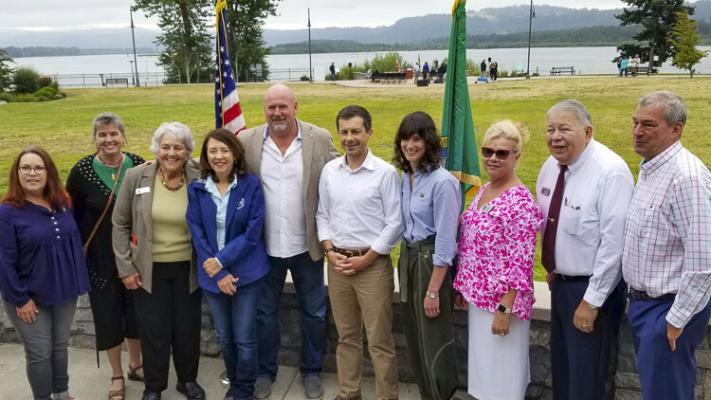
U.S. Department of Transportation Secretary Pete Buttigieg visited Washougal Friday morning, as part of a Pacific Northwest tour allocating funds from a federal Railroad Crossing Elimination Grant Program. Washougal Mayor Dave Steube was on hand to talk with Buttigieg about the importance of the $40 million federal contribution for the 32nd Street Underpass Project.
Senator Maria Cantwell and Congresswoman Marie Gluesenkamp Perez were in attendance at the Port of Camas-Washougal. Each of the officials spoke to safety issues for first responders at the nation’s busiest rail crossing, as well as the time lost to citizens, freight haulers and the economy.
In May, Steube and Washougal City Manager Dave Scott went to the nation’s capital to lobby for funding. They met with Buttigieg, both Washington senators and the congresswoman. The project has been a top priority of the city for over a decade. Later in the month, Stuebe got a phone call from Buttigieg, informing him they had been awarded the federal grant.
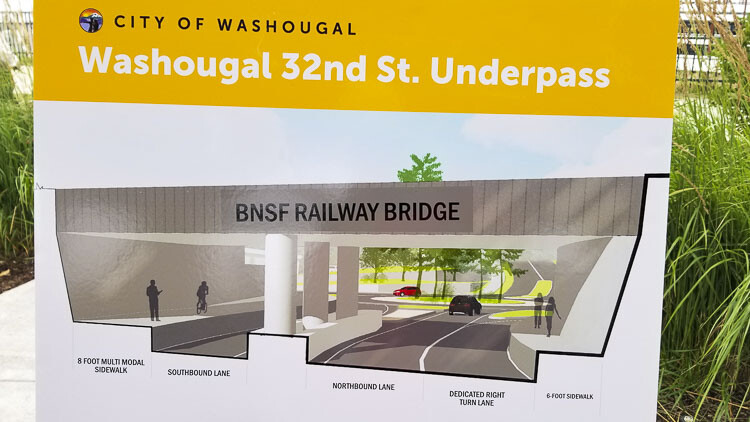
The 32nd Street intersection has approximately 45 trains a day that cross, shutting down traffic flow. According to Cantwell, it’s the busiest BNSF rail line in Washington. The project will construct an underpass to eliminate both the safety risk and the traffic congestion that occur each time a train passes. There will be separate paths for pedestrians and bicyclists.
“I want to recognize the mayor and thank you for that warm welcome,” Buttigieg said. “I know exactly what it feels like to be a mayor knocking on the door of the US Department of Transportation, trying to get funding for something important to your community. I have no idea what it feels like to come out of that with $40 million. But I gotta think that’s pretty good.”
Senator Cantwell mentioned that a 2017 study reported a 50 percent increase in freight trains on this line. Buttigieg spoke about trains being able to travel at normal speed instead of having to slow down for that intersection.
The first round of federal funding was announced in May, with grants being awarded to 32 states. The Washougal project received $40.4 million – the largest of those grants.The $3 billion federal program is designed to eliminate at-grade railroad crossings that block traffic and delay first responders.
In May 2023, the U.S. Department of Transportation announced it had awarded more than $570
million from a brand new program created in President Biden’s Bipartisan Infrastructure Law – the Railroad Crossing Elimination Grant Program. Last year, there were more than 2,000 highway-rail crossing collisions in the U.S., and more than 30,000 reports of blocked crossings submitted to FRA’s public complaint portal.
Also read:
- Opinion: Half the road, full stop – Understanding pedestrian right-of-way
 Doug Dahl explains how Washington’s law requires drivers to stop when a pedestrian is within one lane of their half of the road, not just when directly in front.
 - Opinion: What is the cost of a bridge?
 John Ley argues the I-5 Bridge replacement’s soaring cost stems from costly extras like light rail, noting other states deliver larger, toll-free bridges for much less.
 - Letter: Vancouver Mayor Anne McEnerny-Ogle makes several serious and incorrect engineering statements
 Bob Ortblad critiques engineering claims by Vancouver Mayor Anne McEnerny-Ogle, highlighting cost and safety advantages of an immersed tunnel for the I-5 crossing.
 - Washington’s studded tire deadline is March 31
 Drivers must remove studded tires by March 31 or face a $137 fine, with WSDOT urging early action due to busy service centers and no planned deadline extension.
 - VIDEO: WA diesel hits record $6.53, crushing truckers and school budgets
 With diesel nearing $6.53 per gallon in Washington, trucking businesses and school districts now confront sharply higher fuel expenses affecting budgets and workers.
 wpDiscuz
