



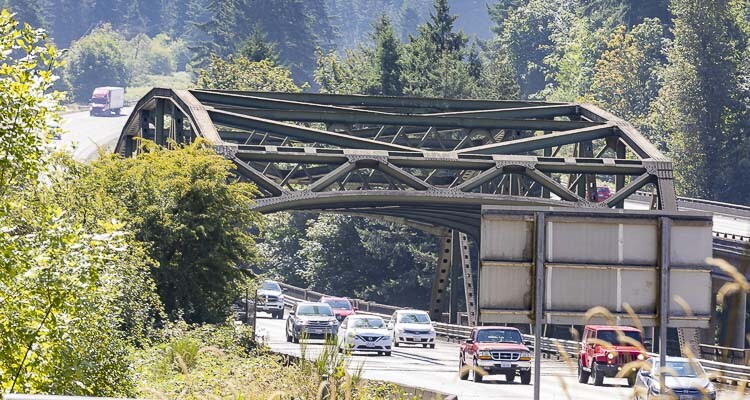
Expect significant delays with traffic reduced to two lanes around the clock
WOODLAND – Travelers heading northbound on Interstate 5 in Clark County should prepare for two months of significant delays and long backups during bridge construction.
On Friday, Sept. 8, Washington State Department of Transportation’s contractor, M.J. Hughes Construction, Inc., will begin work to repair the northbound I-5 North Fork Lewis River Bridge, just south of Woodland at the Clark and Cowlitz county line.
What can travelers expect
Beginning at 9 p.m. Friday, Sept. 8, and continuing around the clock for two months, three travel lanes will be reduced to two approaching the North Fork Lewis River Bridge with reduced speed limits leading into and through the work zone.
During the traffic shift, half of the bridge deck will be worked on at a time. This configuration creates a safe work zone for contractor crews and enables them to work more efficiently.
“We understand reducing three travel lanes down to two narrow lanes will cause substantial backups and significantly increase travel times,” said WSDOT Project Engineer Susan Fell. “However, this construction staging approach prioritizes safety, efficiency and prompt execution of the work. Given the deteriorating condition of this bridge deck and its importance as a crucial west coast connection on I-5, this project is vital to enhance structural integrity, maintain smooth travel for commuters and goods, and when complete, will minimize the need for emergency bridge closures.”
Delays and backups will vary depending on the time and day of the week. Friday evenings will likely have the most significant delays, exceeding 50 minutes and causing backups of over 7 miles or more. Travelers are encouraged to reschedule non-essential trips and avoid peak travel times.
Smart work zone system
To improve safety and traffic flow, contractor crews will use a temporary smart work zone system. This dynamic system provides travelers real-time traffic information on “smart” reader board signs which will be placed at about 1-mile intervals leading up to the work zone. As congestion builds, different messages will be displayed to inform travelers of slowing traffic ahead and to assist with zipper merging, which occurs when drivers use all lanes of traffic until reaching the defined merge area. At that point, vehicles alternate in a “zipper” fashion to merge. The early merger who is trying to be polite and wait in the queue is often making congestion worse than the driver who merges closer to the end of the travel lane. Using all open lanes and zipper merging helps keep traffic moving.
About the project
This $17.4 million dollar bridge project includes repairing the deck, modifying expansion joints and installing new bridge joint seals on both northbound and southbound spans of I-5. Once complete, travelers will experience a smoother, safer driving surface and fewer unplanned, emergency lane closures to repair bridge holes. The current northbound weight restriction will be lifted and freight truck drivers will no longer be required to move to the center lane when crossing the bridge. Work on the southbound span of the North Fork Lewis River Bridge is scheduled for summer 2024.
For the most up-to-date construction information on this project and others, travelers can visit the WSDOT real-time travel map website, sign up for county-specific email updates or upload the WSDOT mobile app .
Also read:
- VIDEO: WA diesel hits record $6.53, crushing truckers and school budgets
 With diesel nearing $6.53 per gallon in Washington, trucking businesses and school districts now confront sharply higher fuel expenses affecting budgets and workers.
 - Opinion: In plain sight – yielding to pedestrians
 Drivers often fail to see pedestrians due to inattentional blindness, which highlights the need for more focused awareness at intersections and stronger safety practices.
 - Expect delays on SR 14 in Vancouver for guardrail repairs Wednesday
 State Route 14 travelers in Vancouver should plan for morning delays as WSDOT will close two eastbound lanes for guardrail repairs, affecting mileposts 6.0 to 7.0.
 - Overnight closure planned on westbound SR 14 Camas Slough Bridge Tuesday
 WSDOT crews will close westbound SR 14 at Exit 14 in Camas to collect bridge deck samples and plan future repairs; detours will be in effect.
 - Opinion: Stay in your lane – seriously, it’s the law
 Drivers must choose the nearest lane when turning in Washington, and left turns bring added risk. Even with signals, every driver must help prevent crashes by following law.
