



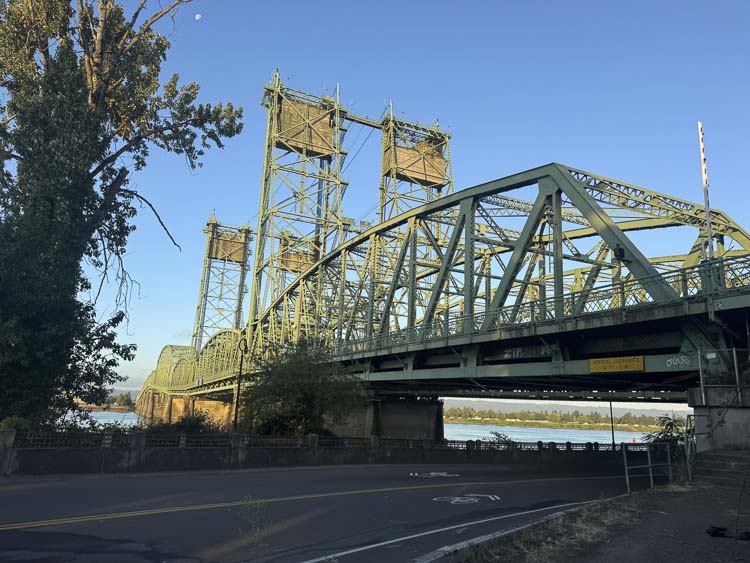
Gov. Bob Ferguson and Vancouver Mayor Anne McEnerny-Ogle waffle over exactly how vulnerable the Interstate Bridge actually is
Paul Valencia
Clark County Today
They keep telling us how bad it is, this current bridge.
They spread fear.
Today’s Interstate Bridge between Vancouver and Portland on Interstate 5 is a disaster waiting to happen, they say.
Politicians in favor of taxpayers putting up $14.4 billion for the entire Interstate Bridge Replacement Program (IBR) never miss out on a chance to scare the public.
After all, they claim 140,000 vehicles cross this dangerous bridge every day.
Washington Governor Bob Ferguson said at Tuesday’s IBR press conference that the current bridge is “not built to modern standards and is at risk of collapse in an earthquake. According to the Environmental Impact Statement, quote, ‘This collapse potential is due to the fact that hundreds of timber bridge support piles sit within loose sand that can liquefy during an earthquake.’ That’s unacceptable.”
The mayor of Vancouver continued the theme.
“It’s outdated, it’s vulnerable to earthquakes, and it was built on timber pilings down in the sand,” Anne McEnerny-Ogle said. “We like to say it’s like pretzels in chocolate pudding.”
For what it’s worth, there were a couple of chuckles in the room when she said that.
Well, on Tuesday, a reporter from another news outlet listened to the governor of Washington and the mayor of Vancouver talk about liquefied support piles and pretzels in pudding, prompting a couple of interesting questions.
“Should people be concerned when they’re driving across this bridge right now?” the reporter asked. “Should people be taking the 205?”
After all, even if things go perfectly for the IBR from this date forward, construction on the replacement bridge would not start until 2028. IBR officials said it would take another six to seven years before the replacement bridge would be ready for traffic.
So, if the current bridge is so “vulnerable” as one of the other guest speakers said at Tuesday’s press conference, should it be shut down right now? Just send every motorist to the Glenn Jackson Bridge on Interstate 205?
Whoa there, the governor pretty much said in response.
“I don’t think that’s where we’re at, but I think it’s fair to say we can’t wait any longer to replace this bridge,” Ferguson said. “It’s old, it’s vulnerable, and needs to be replaced.”
He added that it is the state’s responsibility to say “we know we have some vulnerabilities and we need to move as quickly as possible to fix those.”
The reporter attempted a follow-up question.
“Is it vulnerable enough …”
The governor cut off the inquiry.
“I think I’ve answered that,” he said.
Taxpayers from Clark County have a few questions, though.
If it is all about safety, why wasn’t the replacement bridge constructed decades ago?
The Columbia River Crossing project started in 2005, and politicians back then talked about the dangerous Interstate Bridge and its vulnerabilities.
There are several theories on why the CRC failed, shutting down in 2013 without any construction. The cost of tolls was a big reason. Another major factor, though, was the backlash from Clark County residents who wanted nothing to do with the extension of light rail into Vancouver. At the time, the light rail extension was going to add more than $1 billion to the cost of the project.
It was a light rail project in search of a bridge — a line that has become famous in describing the CRC’s failure.
How much is light rail’s extension into Vancouver going to add to the IBR project? Clark County Today asked that on Tuesday and got an answer with no specifics.
Back in the CRC days, if light rail was taken off the table and replaced with a less expensive alternative — maybe bus rapid transit, for example — would Clark County citizens be traveling on a new bridge by now?
That is impossible to answer.
Governor Ferguson is new to the job as governor, but he sounded very much like the CRC leaders and supporters from 2005-2013 when he was asked by Clark County Today why light rail has to be part of the project when most Clark County residents are still against light rail.
The government knows better.
“I know how important light rail is,” Ferguson said. “That literal and figurative train has left the station. We’re going forward, and we’re going forward with light rail.”
Light rail adds costs, and it adds opposition. Opposition adds delays to any major project. The governor himself said we cannot afford any more delays.
Very few people are suggesting that the 109-year-old bridge does not need to be replaced. Having a modern structure, with safety upgrades, is a common goal from all sides of the issue.
If the Big One hits — the 8.0 earthquake — the region will be devastated. Having a bridge that survives such an event would benefit everyone.
If safety truly is the issue, though, then why the “extras” such as light rail? It can be argued that the fight regarding light rail (and tolls) has added decades to a proposed new bridge.
Perhaps we got the answer to that question from the general manager of TriMet, an Oregon public transit agency that has a $300 million budget shortfall. Sam Desue Jr. was asked to speak at Tuesday’s IBR press conference.
“Together, we are building more than a bridge. We are building a transportation system that connects people, supports economic growth, and strengthens (the) future of an entire region,” Desue said.
A transportation system. Light rail. That’s the priority.
Safety is a benefit of a new bridge, no doubt. But the top priority for the CRC and now the IBR has always been light rail.
Greg Johnson, the former program administrator of the IBR, said as much to Clark County Today last summer when he was still the leader of the program.
“The legislature in Washington, and the governor, and the legislature in Oregon, and the governor said … ‘Put light rail across this river,’” Johnson said.
As of Tuesday, the IBR team, the governor, and the mayor celebrated a milestone. They are looking forward to construction starting in 2028. With light rail.
No need to avoid the current Interstate Bridge right now, though. It is vulnerable to collapse, but apparently not that vulnerable.
Also read:
- Opinion: ‘When are we going to get the full and complete details of the Interstate Bridge Replacement Program’s I-5 Bridge replacement project?’
 IBR team buried key details about light rail ending at waterfront with massive elevator system required.
 - POLL: Do you support extending light rail beyond the waterfront to connect with C-TRAN at Library Square?
 Readers can weigh in on Anne McEnerny-Ogle’s proposal to extend light rail beyond the waterfront to Library Square for improved C-TRAN connections.
 - Opinion: Passing a cyclist – Law, myth and a little patience
 Most drivers can’t legally pass cyclists in-lane due to vehicle width versus road measurements.
 - Vancouver mayor counters IBR’s proposal for the only light rail stop to be at the waterfront
 Vancouver’s mayor wants light rail extended beyond the waterfront to connect with C-TRAN buses at Library Square.
 - Letter: ‘This is the worst thing that ever happened to the region’
 A Hayden Island resident Sam Churchill is criticized in a letter calling the $14 billion Interstate Bridge Replacement project a “boondoggle” that destroys local businesses.
 wpDiscuz
