



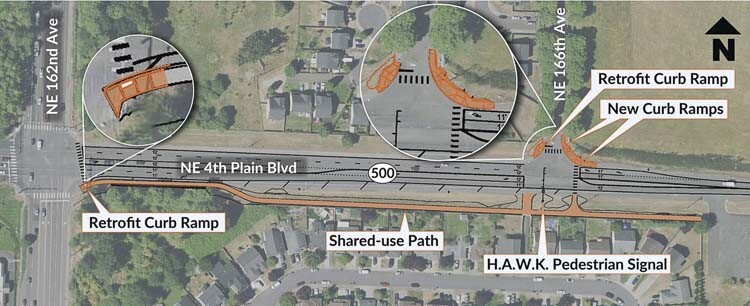
VANCOUVER – Families in the Orchards neighborhood in Vancouver now have a safer path for walking, biking or using mobility devices to travel to school, courtesy of funding from the Safe Routes to Schools Project.
On Thursday (Feb. 15), the Washington State Department of Transportation will activate the HAWK signal as the final phase of the recently constructed shared-use path, located on the south side of State Route 500, also known as Northeast Fourth Plain Boulevard, between Northeast 162nd and Northeast 166th Avenues.
What is a HAWK signal?
The HAWK (High intensity Activated crossWalk) signal is a traffic control device used to facilitate safer pedestrian crossings without disrupting traffic flow. Unlike a traditional traffic signal, a HAWK signal is activated and operates only when a pedestrian pushes the crossing button. When there are no pedestrians, vehicles move without interruption.
An activated HAWK signal will operate in a yellow-red-flashing red sequence. When drivers encounter the yellow and red flashing lights, they should treat them just like any other traffic signal. During the flashing red interval, drivers may proceed through the crossing area only if it is completely safe to do so without posing any risk to pedestrians.
Pedestrians can activate the HAWK signal by pushing the button at either end of the crossing. The lights on the HAWK signal will indicate when it is safe to cross. A visual traffic signal aids both drivers and pedestrians in determining when it’s safe to proceed along their chosen route.
In late summer 2023, contractor crews completed the permanent roadway striping along this route, offering additional visual and reflective lane guidance for drivers and enhancing safety for all road users.
Know before you go.
Get real-time travel information via the WSDOT mobile app, the real-time travel map, or by signing up for email updates and alerts.
Also read:
- Washington’s studded tire deadline is March 31
 Drivers must remove studded tires by March 31 or face a $137 fine, with WSDOT urging early action due to busy service centers and no planned deadline extension.
 - VIDEO: WA diesel hits record $6.53, crushing truckers and school budgets
 With diesel nearing $6.53 per gallon in Washington, trucking businesses and school districts now confront sharply higher fuel expenses affecting budgets and workers.
 - Opinion: In plain sight – yielding to pedestrians
 Drivers often fail to see pedestrians due to inattentional blindness, which highlights the need for more focused awareness at intersections and stronger safety practices.
 - Expect delays on SR 14 in Vancouver for guardrail repairs Wednesday
 State Route 14 travelers in Vancouver should plan for morning delays as WSDOT will close two eastbound lanes for guardrail repairs, affecting mileposts 6.0 to 7.0.
 - Overnight closure planned on westbound SR 14 Camas Slough Bridge Tuesday
 WSDOT crews will close westbound SR 14 at Exit 14 in Camas to collect bridge deck samples and plan future repairs; detours will be in effect.
