



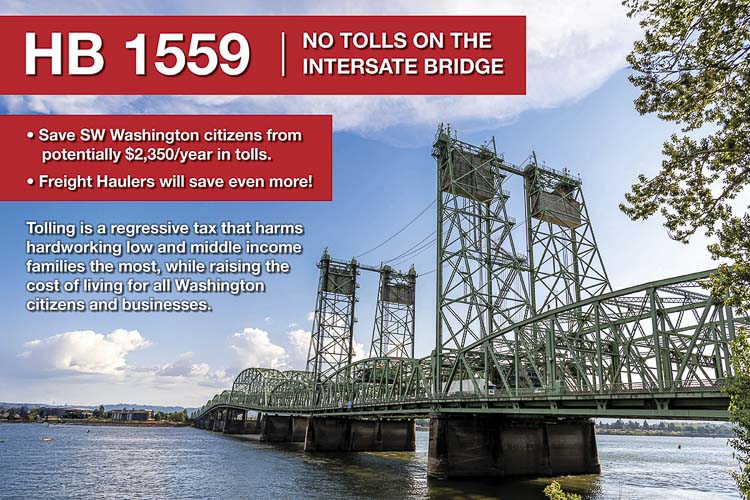
House Bill 1559 would repeal legislation that passed along party lines in 2023
Rep. John Ley filed his first bill as a new Washington state legislator on Wednesday. It aims to prevent tolling as part of the I-5 Bridge Replacement Project. House Bill 1559 would repeal legislation that passed along party lines in 2023. Senate Bill 5765 authorized the Legislature to impose tolls to help pay for the project.
Proponents argue tolls are an important way to pay for a new bridge. However, the exact mechanisms have yet to be determined, and opponents argue tolling has many downsides.
“Tolling is a hugely regressive tax, harming hard-working, low- and middle-income families the most,” said Ley, R-Vancouver, who represents the 18th District. “It is currently estimated tolls could cost $2,350 per year for an individual crossing the bridge two times a day. Freight haulers and businesses crossing multiple times a day would pay much more.
“We don’t need to create ‘roads for the rich’ or ‘Lexus lanes’ where only wealthy people can afford to use the tolled bridge.”
The total cost of the bridge project is expected to be between $5 billion and $7.5 billion, with tolls anticipated to cover between $1.1 and $1.6 billion of the project.
If HB 1559 were to become law, it would remove tolling authority on Interstate 5 bridges spanning the Columbia River.
In addition to the cost, there are also huge concerns regarding traffic diversion. In the failed Columbia River Crossing project in 2014, it was estimated that 35,000 vehicles a day would divert to the un-tolled I-205 Glenn Jackson Bridge.
“That bridge is already congested and will become a parking lot, as people naturally will seek to avoid paying the tolls,” said Ley. “East-west corridors will become even more congested, including SR-14, Mill Plain, and SR-500 on the Vancouver side. Marine Drive, I-84, and US 30B/Lombard streets in Portland will be affected as well. Public safety and the quality of life in many neighborhoods on both sides of the Columbia River will be negatively impacted.”
Additionally, the cost of collecting the money for tolls is estimated to be between 19 and 68 cents per dollar paid.
“Tolls are an extremely inefficient means of raising money for transportation projects,” noted Ley. “The gas tax has a less than one percent cost of collection. Clearly, if we are going to take money from family budgets, we want to do it in the most efficient manner possible.”
Ley provided the example of the Tacoma Narrows Bridge, built in 2007. The state borrowed roughly 87 percent of the $786 million cost. Toll rates increased, and citizens became angry, causing the Legislature to intervene five times. Most recently, the Legislature has allocated $130 million to lower tolling charges. After 17 years, the principal loan balance has been paid down only about $98 million, according to one news report.
One analysis indicated the final amount paid would be triple the amount borrowed-extremely expensive for taxpayers, whether they’re paying tolls or the rest of the taxpayers bailing out the toll system.
Toll rates are another significant concern. The initial authorization in SB 5765 allowed the toll rate to be set up to the maximum toll charged in the state. At the time of passage, the maximum toll rate on I-405 in Seattle was $10. Today, it’s $15 and there is discussion of raising it to $18, all within three years.
“The proposed tolls will significantly impact Southwest Washington citizens,” added Ley. “We have roughly 75,000 Clark County residents who commute to work in Oregon. They pay roughly $250 million in Oregon income taxes each year. This bill will prevent all the negative financial impacts on hard-working Washington families while rejecting an extremely inefficient means of raising money for transportation projects.”
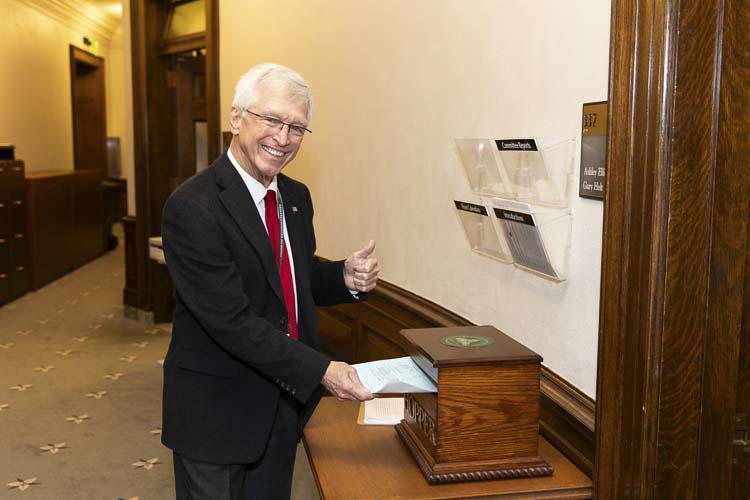
In addition to Ley, eight other representatives are co-sponsoring the bill, including five from Southwest Washington: Rep. Stephanie McClintock, R-Vancouver, also from the 18th District; Reps. Kevin Waters, R-Stevenson, and David Stuebe, R-Washougal from the 17th District; and Reps. Ed Orcutt, R-Kalama, and Peter Abbarno, R-Centralia, from the 20th District.
The next step for HB 1559 would be a public hearing in the House Transportation Committee.
Information provided by Washington State House Republicans,
houserepublicans.wa.gov
Also read:
- Opinion: Half the road, full stop – Understanding pedestrian right-of-way
 Doug Dahl explains how Washington’s law requires drivers to stop when a pedestrian is within one lane of their half of the road, not just when directly in front.
 - Opinion: What is the cost of a bridge?
 John Ley argues the I-5 Bridge replacement’s soaring cost stems from costly extras like light rail, noting other states deliver larger, toll-free bridges for much less.
 - Letter: Vancouver Mayor Anne McEnerny-Ogle makes several serious and incorrect engineering statements
 Bob Ortblad critiques engineering claims by Vancouver Mayor Anne McEnerny-Ogle, highlighting cost and safety advantages of an immersed tunnel for the I-5 crossing.
 - Washington’s studded tire deadline is March 31
 Drivers must remove studded tires by March 31 or face a $137 fine, with WSDOT urging early action due to busy service centers and no planned deadline extension.
 - VIDEO: WA diesel hits record $6.53, crushing truckers and school budgets
 With diesel nearing $6.53 per gallon in Washington, trucking businesses and school districts now confront sharply higher fuel expenses affecting budgets and workers.
 wpDiscuz
