



Twenty-six vehicles were ordered months before I-5 Bridge replacement project was initiated begun by governors
John Ley
for Clark County Today
What is the cost of a new light rail vehicle? How many, if any, are needed for a 1.83-mile extension of the TriMet Yellow Line? Are any truly needed as part of the Interstate Bridge Replacement Program (IBR) effort? Is any “high capacity” transit truly needed for a new bridge over the Columbia River?
In December 2022, IBR Administrator Greg Johnson updated cost estimates to the current range of $5 billion to $7.5 billion, targeting $6 billion. The transit component’s high-end cost was $2 billion. TriMet later revealed the agency was demanding 19 new light rail vehicles at a cost range of $190 million to $290 million.
A public record request of TriMet has a stark revelation. Four months before the Washington and Oregon governors resurrected the failed Columbia River Crossing (CRC) project, TriMet had placed an order for 26 new Siemens light rail vehicles (LRV). The average price was under $5 million per vehicle as parts, manuals and training were included in the $147 million contract.
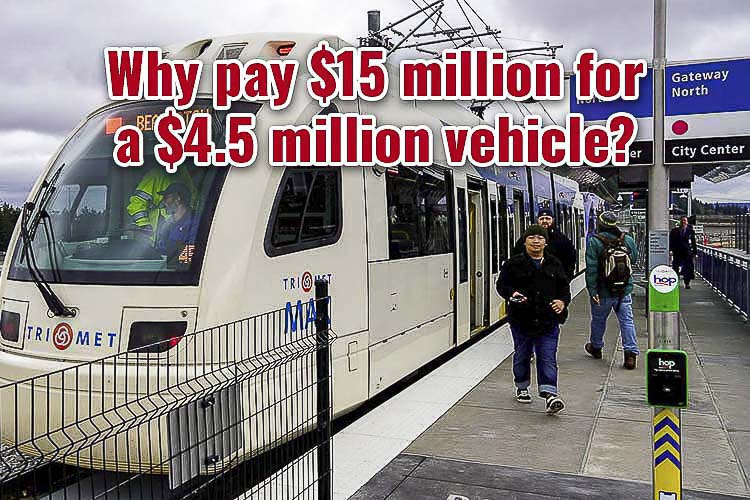
A March 2019 memo “allows options for up to 60 additional LRVs, including 8 vehicles needed for the Red Line Extension to Fair Complex (Hillsboro), up to 36 vehicles for the Southwest Corridor, up to 14 vehicles for possible service expansions, and additional spare parts and warranties.” TriMet officials had made the request for proposal in June 2018, 17 months before the governors signed their agreement.
A June 2021 memo states: “The Type 1s are the oldest LRVs in TriMet’s fleet, are nearing the end of their useful life.” It also allowed an option “to purchase as many as 46 additional LRVs, which would include provide (sic) additional LRVs for the expanded MAX Red Line service when the MAX Red Line Extension and Reliability Improvements Project is completed.”
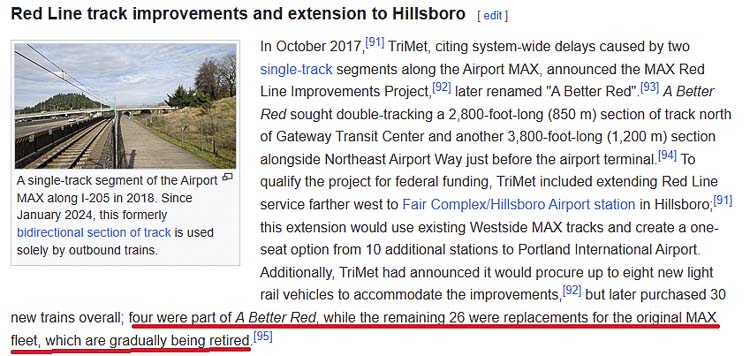
Last summer, TriMet completed its $215 million “Better Red.” An important component was a 10-mile extension of the Red Line from Beaverton to Hillsboro for which they ordered four additional vehicles; not the 8 mentioned in the 2019 memo. The cost of those were $4.5 million each.
Other cities around the country appear to have purchased Siemens light rail vehicles over the past two decades for $3 to $4.5 million per LRV. In 2007, Charlotte purchased 16 S70 vehicles for $3.12 million each; Salt Lake City purchased 77 S70’s for $3.6 million each a year later.
Minneapolis bought 5 for $20 million in 2015. Seattle’s Sound Transit purchased 30 LRVs in 2017 for $4.36 million each and Sacramento purchased 28 S700 LRVs in 2020, the final 8 were just $2.95 million per vehicle.
MAX vehicle purchase history
Between 1984 and 1986, TriMet ordered 26 LRVs from Bombardier to begin service on the Blue Line from Gresham to downtown Portland. They were expected to last about three decades. In fact the Federal Transit Administration (FTA) in 2016 reported a useful life of 31 years.
In 1992, TriMet ordered 39 model SD660 cars from Siemens which entered service in 1997. With the creation of the Yellow Line in 2003, 27 Type 3 vehicles were procured from Siemens.
Today, TriMet has 26 vehicles beyond the FTA’s expected useful lifespan; plus another 66 LRVs within 10 years of needing to be replaced. In total, 92 of their 145 MAX vehicles should be replaced by the time the Interstate Bridge project may be completed from 2035-2040.
The reality is that 63 percent of TriMet’s current fleet needs to be replaced within the next decade, regardless of whether or not a new MAX line is created (Southwest line to Tigard rejected by voters in 2020) or a 1.83-mile extension of the Yellow Line happens. One hundred percent of that financial obligation is on TriMet – not Clark County or Washington taxpayers.
Based on their 2019 contract price of $4.5 million each, TriMet would require $414 million to replace all 92 LRVs. The $290 million their officials are telling Greg Johnson and his team they must have for the Interstate Bridge project, would cover 70 percent of TriMet’s systemwide need for replacing worn out vehicles.
From the beginning of the current project in November 2019, citizens have wondered what would be different and how much it might cost taxpayers. The CRC was deemed “a light rail project in search of a bridge” by an Oregon Supreme Court Justice.
Clark County residents feared this is the same thing. Unrealistically high transit ridership projections of 26,000 to 33,000 daily riders have been created to justify the need for both TriMet’s MAX light rail and new C-TRAN bus on shoulder (BOS) express bus service into Portland. Currently less than 1,000 people a day use transit over the Columbia River.
TriMet’s financial problems
The fleecing of taxpayers on both sides of the river is underway, according to popular radio personality Lars Larson. TriMet burned through $850 million in cash last year. The taxpayer subsidy per ride has jumped from $1.77 in 2014 to $7.88 last year. Transit riders pay less than 10 percent of operating costs.
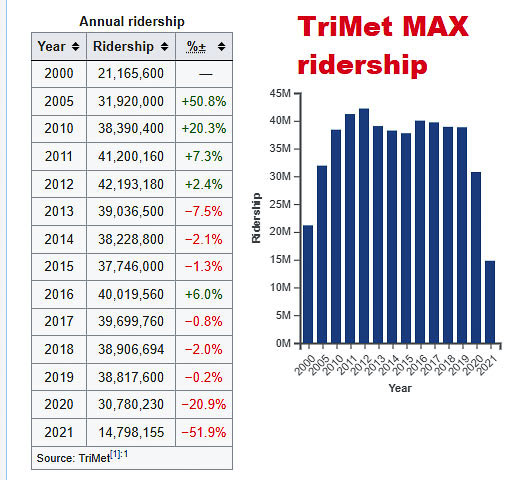
TriMet ridership is down by 30 million boardings. Ridership peaked over a decade ago in 2012. Operating costs are up 53 percent since 2019, allegedly due to inflation.
This is part of a national trend described as a “doom loop” by the Washington Times. “A recent Bloomberg News analysis found that the nation’s largest mass transit systems have a $6 billion budget deficit. At the same time, rural systems in states such as North Dakota and Oregon are encountering roadblocks as they request more state and federal funding to offset rising maintenance and payroll costs.”
Portland’s transit agency is claiming it must get a 500 percent increase in a statewide Oregon head tax paid by employers, in order to remain financially viable. If it doesn’t, it will cut 65 percent of bus routes by 2031. They call it a “fiscal cliff.”
Elected officials on the Washington side of the river should reject the current demands by TriMet that we bail out this financially ailing organization. Clearly, there is no need for any high capacity transit over the Columbia River, with less than 1,000 boardings a day currently, and a national trend of declining transit ridership.
In June 2022, TriMet’s JC Vanetta told the 16 legislators of the Bi-state Bridge Committee that his agency would not be responsible for operations and maintenance costs of the light rail extension. Three years later, the agency is demanding the IBR replace its worn out vehicles and Clark County taxpayers cover O&M costs.
C-TRAN said the following in 2023, in response to a public records request. “C-TRAN’s position has consistently been that C-TRAN will not be responsible for costs related to operations and maintenance of light rail in Clark County, including any park and ride facilities that may be constructed as part of the project. C-TRAN CEO Shawn Donaghy has stated this publicly on numerous occasions, and the C-TRAN Board of Directors included this among its conditions for approval of the modified LPA (locally preferred alternative) in 2022.”
The Vancouver City Council, the C-TRAN Board, the Port of Vancouver, or the Regional Transportation Council (RTC) Board can withdraw their approval of the Locally Preferred Alternative. Only one needs to take action to stop this.
It is not Clark County taxpayers’ responsibility to replace TriMet LRVs. Since TriMet appears to be fleecing taxpayers, it’s past time to pull the plug on the light rail component of the IBR. That would save $2 billion from the project, eliminating the need for additional Washington taxpayer funds.
Also read:
- Opinion: What is the cost of a bridge?
 John Ley argues the I-5 Bridge replacement’s soaring cost stems from costly extras like light rail, noting other states deliver larger, toll-free bridges for much less.
 - Letter: Vancouver Mayor Anne McEnerny-Ogle makes several serious and incorrect engineering statements
 Bob Ortblad critiques engineering claims by Vancouver Mayor Anne McEnerny-Ogle, highlighting cost and safety advantages of an immersed tunnel for the I-5 crossing.
 - Washington’s studded tire deadline is March 31
 Drivers must remove studded tires by March 31 or face a $137 fine, with WSDOT urging early action due to busy service centers and no planned deadline extension.
 - VIDEO: WA diesel hits record $6.53, crushing truckers and school budgets
 With diesel nearing $6.53 per gallon in Washington, trucking businesses and school districts now confront sharply higher fuel expenses affecting budgets and workers.
 - Opinion: In plain sight – yielding to pedestrians
 Drivers often fail to see pedestrians due to inattentional blindness, which highlights the need for more focused awareness at intersections and stronger safety practices.
 wpDiscuz
