



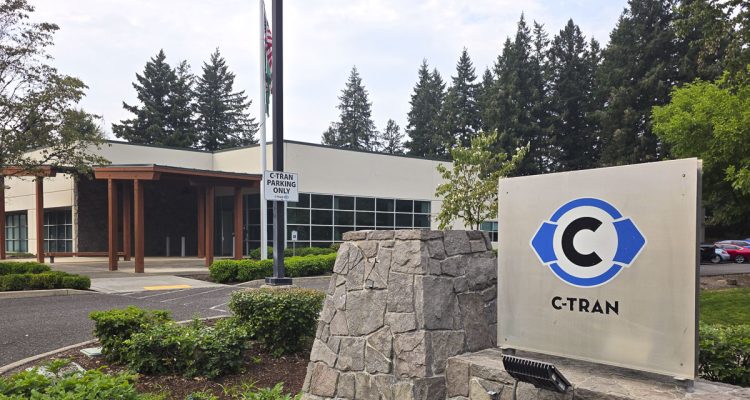
WSDOT threatened to take away millions of dollars in grants from C-TRAN, but a judge ruled that WSDOT cannot do that while the C-TRAN Board Composition Review Committee works on a solution to WSDOT’s claim that the C-TRAN board is out of compliance with state law
Paul Valencia
Clark County Today
A judge granted a preliminary injunction Friday, ruling that the Washington State Department of Transportation cannot withhold grants from C-TRAN while the C-TRAN Board Composition Review Committee works to come into compliance with a state law in regard to representation based on population.
In June, WSDOT informed C-TRAN that the composition of its board of directors was out of compliance, giving too much representation to smaller cities and not enough for Vancouver and unincorporated Clark County.
The BCRC recommended a 3-3-3 format, with three seats to the City of Vancouver, three to Clark County, and three to be shared by the smaller cities. The current composition has three for Vancouver, two for Clark County, and four seats shared by the smaller cities.
That recommendation was initially denied by WSDOT, which had given C-TRAN until Oct. 1 to remedy the situation. After Oct 1, WSDOT threatened to withhold grants, up to an estimated $10 million.
WSDOT officials led review committee members to believe it wanted a 4-3-2 format, with four seats going to Vancouver, three to Clark County, and only two for the smaller cities.
The review committee met again, and once again offered the 3-3-3 format, with a new argument presented by the city of Ridgefield.
With that decision still in the air, and the deadline approaching, C-TRAN asked for an injunction, to put on pause any threatened action by WSDOT.
C-TRAN, it argued, has no control over the review committee and cannot adopt any board composition without the review committee’s approval.
It would be unfair, C-TRAN argued, for WSDOT to penalize C-TRAN while the review committee and WSDOT are working to find a solution.
Thurston County Superior Court Judge John Skinder agreed with C-TRAN.
“Based on the pleadings and papers filed in this matter, C-TRAN has established that it has a clear legal or equitable right to compete for and receive future grant funding,” Skinder wrote in his ruling.
Skinder did not take sides regarding the 3-3-3 or 4-3-2 composition debate. The ruling gives the review committee more time to determine its next move. Upon a final resolution on the matter, C-TRAN would have 45 days to move into compliance with state law, Skinder said.
C-TRAN successfully argued to Skinder that it depends on WSDOT grant funding for essential services.
“Losing WSDOT funds would impede C-TRAN’s ability to provide public transportation to its constituents who rely on C-TRAN for essential travel to work, grocery shopping, and medical appointments,” noted an argument in the ruling.
The judge listed 10 points on his conclusion of law.
One of those points reads:
“C-TRAN has demonstrated that the loss of future grant funding will cause service reductions that will negatively impact riders and the communities C-TRAN serves.”
Skinder ordered that WSDOT is prohibited from withdrawing grants pending a final resolution to the board composition.
Also read:
- Final Supplemental Environmental Impact Statement published for Interstate Bridge Replacement Program
 Federal agencies published the final environmental impact statement for the Interstate Bridge replacement project.
 - Speed cameras designed to bring added safety to work zones
 WSP issued 65,000 infractions in first year, with 59,000 being penalty-free first offenses as program expands statewide.
 - Marie Gluesenkamp Perez seeks federal assistance in combating sea lion predation of salmon & steelhead fishing stock
 Congresswoman pushes for expanded lethal removal authority as sea lions devour Columbia River fish stocks.
 - Opinion: The high cost of hiding – Why IBR’s delayed revenue study is a $15 billion warning sign
 IBR delays critical toll revenue analysis until June 2027, hiding financial details until after project approval.
 - Opinion: The high cost of hiding – Why IBR’s delayed revenue study is a $15 billion warning sign
 IBR delays critical toll revenue analysis until June 2027, hiding financial details until after project approval.
