



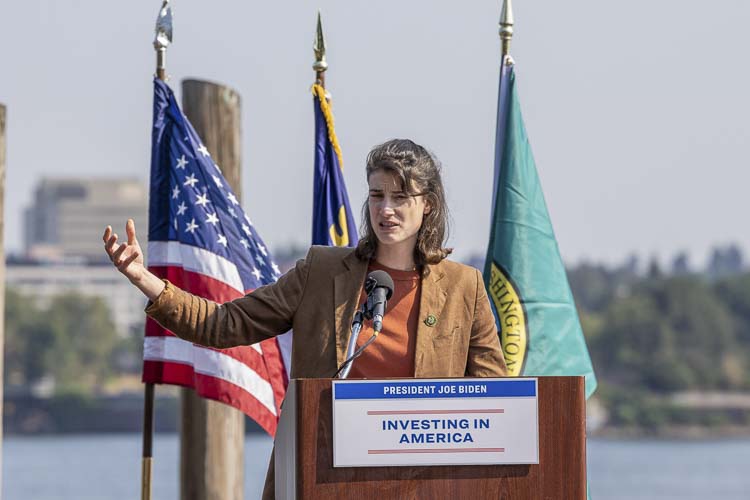
Congresswoman sends letter to IBR, WSDOT and ODOT officials calling for the cost-effective use of resources to limit tolling and increased vehicular capacity to reduce congestion
On Thursday (Sept. 12), Rep. Marie Gluesenkamp Perez (WA-03) sent a letter to the Interstate Bridge Replacement (IBR) Program, WSDOT, and ODOT calling for the prioritization of Southwest Washington bridge users’ concerns in the final project design – both through the cost-effective use of resources to limit tolling and increased vehicular capacity to reduce congestion.
The effort comes after Rep. Gluesenkamp Perez helped secure $2.099 in federal funding for the project, including a $1.499 billion Bridge Investment Program (BIP) grant in July and a $600 million Mega grant in December. The Congresswoman has spoken with Southwest Washington commuters, business owners, and tradespeople about the necessity of this project – and by being good stewards of federal dollars, burdens can be reduced for local drivers.
The I-5 Bridge is a crucial linchpin in both the regional and national economy and plays a vital role in transporting freight along the I-5 corridor. $132 million worth of freight crossed the I-5 Bridge daily in 2020 and 131,747 vehicles crossed each weekday in 2021.
Despite the bridge’s importance, the I-5 Bridge is rated the worst truck bottleneck in Washington and Oregon and the fifth-worst on the West Coast. With seven to 10 hours of traffic daily and a crash rate more than three times higher than Washington averages, it is critical that the final project design effectively and economically addresses congestion for local drivers, commuters, and truckers.
“Both my constituents and bridge users from across the Pacific Northwest list traffic congestion relief as their top transportation priority. The final I-5 Bridge design must prioritize increasing vehicular capacity and easing existing bottleneck conditions to move goods to stimulate our economy, and get folks home faster so they can coach their kid’s Little League team,” wrote Rep. Gluesenkamp Perez in the letter. “We also must ensure that the bridge design is cost-effective and that the final design makes the best use of the significant existing resources secured from federal and state funding. This is a project of national and regional importance, and it is critical that the burden of paying for this project does not fall on local users. I urge you to explore every option to hold down construction costs, reduce congestion, and limit the need for tolling which will disproportionately impact the people I serve.”
Full text of Rep. Gluesenkamp Perez’s letter can be found here.
Also read:
- 49th Legislative District Democrats share their reasons for backing state income tax at Town Hall
 Three Democrat legislators defended the new income tax affecting only those earning over $1 million annually.
 - Letter: Freeze the scope and build the bridge
 Vancouver resident calls for project discipline after 22 years of planning and nearly half a billion in costs.
 - Opinion: ‘When are we going to get the full and complete details of the Interstate Bridge Replacement Program’s I-5 Bridge replacement project?’
 IBR team buried key details about light rail ending at waterfront with massive elevator system required.
 - POLL: Do you support extending light rail beyond the waterfront to connect with C-TRAN at Library Square?
 Readers can weigh in on Anne McEnerny-Ogle’s proposal to extend light rail beyond the waterfront to Library Square for improved C-TRAN connections.
 - Opinion: Passing a cyclist – Law, myth and a little patience
 Most drivers can’t legally pass cyclists in-lane due to vehicle width versus road measurements.
 wpDiscuz
