



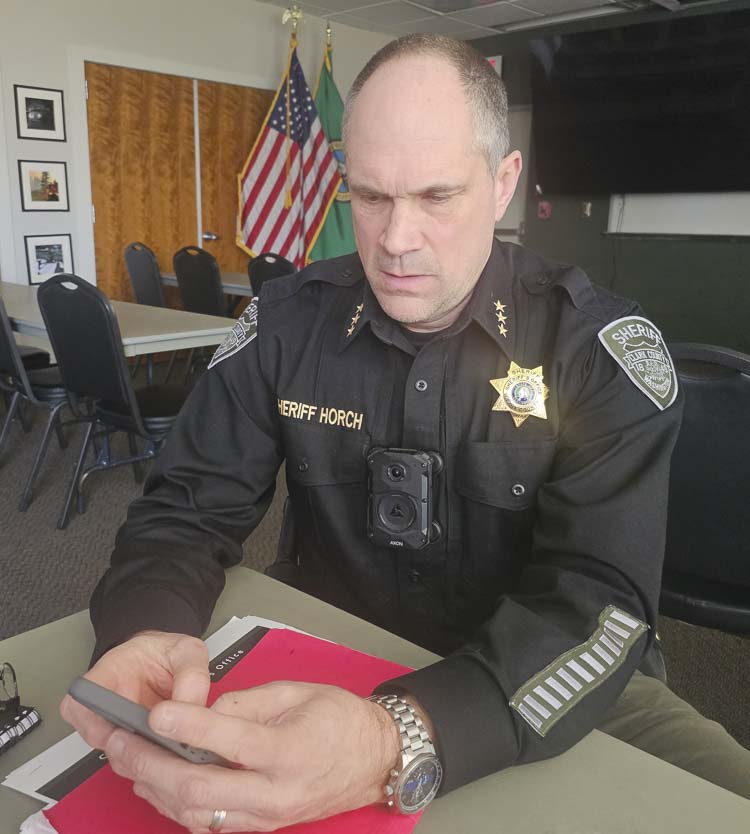
Clark County Sheriff John Horch said videos often show his deputies using proper de-escalation tactics during incidents, and he is grateful for video evidence to be transparent with the public, whether the video is ‘good or bad’
Paul Valencia
ClarkCountyToday.com
Recently, Clark County Sheriff John Horch sat down with Clark County Today to discuss a number of subjects concerning the Clark County Sheriff’s Office: Staffing issues, department morale, the office’s relationship with federal agencies, the implementation of body-worn cameras, de-escalation training in law enforcement, and more.
Clark County Today is posting several stories in his series.
In the first post, the sheriff sounded the alarm on staffing shortages.
In the second post, the sheriff detailed his office’s policy regarding federal law enforcement, such as immigration.
In this post, he talks about the implementation of body-worn cameras, and how they help the public to better understand law enforcement and help train his deputies on tactics, such as de-escalation tools.
“… if it shows good or bad, I’m going to put it out there. I want to be transparent so people can see.”
The Clark County Sheriff’s Office began testing its body-worn cameras with a few deputies in the spring of 2023. By the fall, the program expanded beyond the testing phase. And by January of 2024, all deputies and their vehicles had been equipped with Axon cameras.
“I think they’ve been great. I’ve only heard positive comments on them,” Horch said.
The cameras are tools that the sheriff’s office uses to educate the public as well as train deputies on proper procedures. That would include de-escalation tactics.
“We want to show on body cameras how much de-escalation that we do,” Horch said.
For major incidents, such as shootings, Horch has vowed to release the videos to the public, usually within a couple of weeks.
“I own that. I decide when to put it out,” Horch said. “I told the public … if it shows good or bad, I’m going to put it out there. I want to be transparent so people can see.”
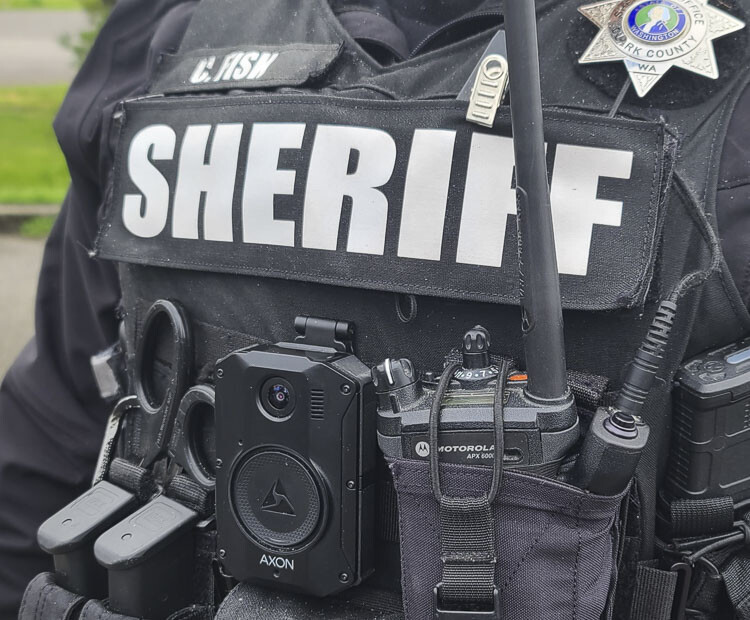
Three major incidents from 2024 have been released. They can be found on the sheriff’s page on the Clark County government’s website: https://clark.wa.gov/sheriff/body-worn-camera-bwc-program
There have been a handful of other major incidents caught on video involving nearby law enforcement agencies, such as the Vancouver Police Department, that also have gone public. Horch appreciates that his colleagues are on board with releasing pertinent videos.
“There hasn’t been one question about body-worn cameras,” Horch said regarding the public release. “We put them out there. ‘This is what we have.’”
Horch is particularly impressed with the failsafes associated with the program. There might be times when a deputy forgets to turn on the camera. But if emergency lights on a vehicle are turned on, the body worn cameras as well as the cameras on the vehicle are automatically activated. Same thing if a deputy draws a weapon. Also, when a camera is turned on, any camera worn by a colleague within 25 yards is also activated.
When the cameras are activated, the previous 30 seconds are also saved, in an effort to provide more context to how a situation escalated.
Horch called that technology phenomenal.
The videos can also show administrators how their deputies are performing their duties. No, there are no “fishing” expeditions, Horch said. Supervisors are not going over videos every day to find out if a deputy did something wrong. But if a complaint has been lodged against a deputy, there is video to observe.
Horch said he has seen a video that showed his deputy was, in fact, rude during a contact made with a resident. A written reprimand was necessary.
The videos also can exonerate a deputy.
“We have some where the deputy did everything correct,” Horch said. “In fact, the person (making the complaint) was rude.”
That is why, Horch said, most people in law enforcement appreciate the cameras.
“I would say 99 percent of officers would say, ‘Record me all day long. I don’t have any issues whatsoever.’”
That is the philosophy the sheriff wants to hear from his deputies.
Horch is also optimistic that most videos will show his deputies performing their duties to the best of their abilities, while using tactics to deescalate a situation.
“We’ve been doing de-escalation since the time I started,” said Horch, who was hired by the Clark County Sheriff’s Office in 1989. “It was just never called that.”
Now, there is specific training written in law. Law enforcement officers must have less-lethal tools with them. They all take mandatory patrol tactics training, which includes a de-escalation class.
Horch said there are many steps of de-escalation. The first could be just the presence of a deputy. Law enforcement shows up, and perhaps cooler heads prevail in an intense situation. Or maybe more conversation can ease tensions.
But Horch said videos provided by body-worn cameras have been instrumental in showing the public that sometimes a situation goes from zero to 10.
“Things can change very quickly,” Horch said.
Bottom line, Horch is grateful for the technology and his team’s implementation of body-worn cameras. He said the cameras provide an accurate account of emergency situations, bring transparency to the public, and help law enforcement improve its strategies.
Also read:
- POLL: Do you agree with requiring board members to follow council direction?
 Disagreement among county councilors centers on whether C-TRAN board members should reflect the council’s collective wishes or act independently, highlighting ongoing concerns about public accountability.
 - High-value WA home listings increase by 65% after income tax passage
 After lawmakers approved an income tax targeting millionaires, listings for homes priced at $2 million or more jumped 65 percent compared to last year, with experts urging caution about interpreting the spike.
 - 18th District lawmakers to host town hall meeting on Saturday, March 28, in Battle Ground
 Stephanie McClintock and John Ley will meet with Battle Ground constituents to answer questions, review the new income tax, and discuss the effects of the $80 billion budget.
 - Opinion: In plain sight – yielding to pedestrians
 Drivers often fail to see pedestrians due to inattentional blindness, which highlights the need for more focused awareness at intersections and stronger safety practices.
 - NBA vote clears way for expansion to Seattle
 The NBA Board of Governors has voted to explore adding teams in Seattle and Las Vegas, moving Seattle closer than ever to hosting pro basketball again.
 - Opinion: The legislature has committed $2.4 billion to recurring pension increases since 2018
 Six legislative COLAs have raised public employer costs by $2.38 billion since 2018, driving up unfunded pension liabilities and increasing burdens on county and city budgets.
 - Opinion: ‘Just because they got away with it doesn’t mean they weren’t wrong’
 A Skamania County deputy’s report found violations of county rules and the Open Public Meetings Act, but no prosecutor acted on the findings.
