



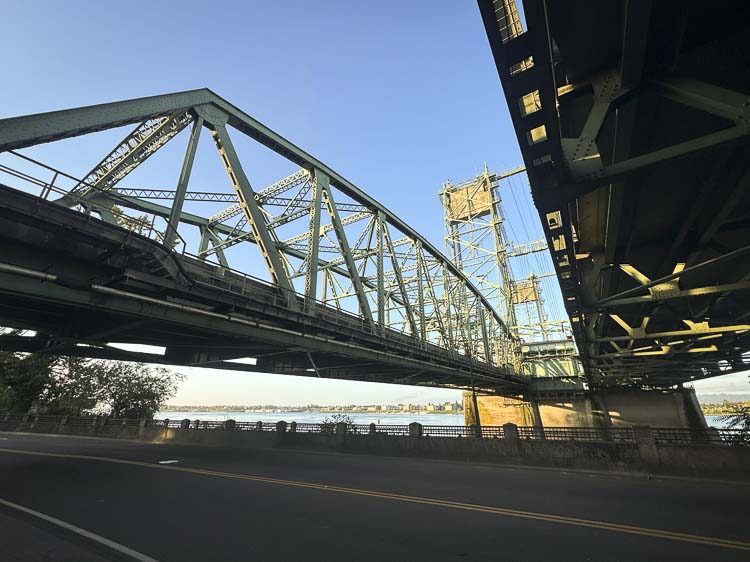
Senator Maria Cantwell announced Friday that the U.S. Coast Guard has approved the fixed-span design favored by the Interstate Bridge Replacement Project, a key step in the process to replace the I-5 Bridge over the Columbia River
The United States Coast Guard has approved the fixed-span design for the proposed new Interstate Bridge, a crucial component that could lead to the start of construction in 2026, according to U.S. Senator Maria Cantwell (D-WA).
“The Coast Guard’s decision is a major step forward towards finally completing the U.S. Department of Transportation’s environmental review and enabling construction to start later this year,” said Cantwell, ranking member of the Senate Committee on Commerce, Science, and Transportation.
Adm. Kevin E. Lunday, Commandant of the Coast Guard, announced the approval Friday. Cantwell released a statement.
“This approval means the Coast Guard determined the new bridge doesn’t need to have a lift, which will eliminate the only stoplight on Interstate-5, put an end to commute interruptions, and save millions in construction costs. The vast majority of the maritime community agrees that the new bridge design will not only allow river commerce to continue but also improve safe passage down the river. I appreciate Commandant Lunday and his team for honoring their commitment to listen to our local communities and swiftly complete their review.”
Washington and Oregon officials have already signed agreements with four businesses that would be affected by a fixed-span bridge over the Columbia River, agreeing to pay $140 million.
Interstate Bridge Replacement Program (IBR) officials have said in the past that the proposed 116-foot high replacement fixed-span bridge would continue to provide access to 99 percent of river traffic. The IBR identified four businesses that would fall into the 1 percent that operated large vessels or manufactured large projects shipped under the current Interstate Bridge.
The IBR also released a statement Friday afternoon, which included comments from the governors of Washington and Oregon.
“A fixed-span bridge has overwhelming support from the maritime industry, businesses and community groups,” Washington Governor Bob Ferguson said. “This is the right decision for our economy, and for commuters who use this bridge every day. I appreciated meeting with Coast Guard leadership to present our case in person. I look forward to continuing our progress to replace this 108-year-old bridge.”
“The IBR Program now has the clarity it needs to advance and position us to build a safer, multimodal river crossing and corridor that will serve both states for generations,” Oregon Governor Tina Kotek said.
Cantwell’s release added: The lift span over the current bridge opens an average of 250 times per year depending on river levels, with some years as high as 480 times a year, backing up traffic on an already congested corridor. The average lift stops traffic for 15–20 minutes.
The Coast Guard’s decision came after a public comment period that solicited feedback from maritime interests in the area. The proposed new fixed-span bridge will provide 116 feet of clearance. Including a lift span would have added at least $400 million to construction costs.
Lunday was confirmed to his role by a voice vote of the U.S. Senate last month. At Lunday’s Commerce Committee nomination hearing in November, Sen. Cantwell received a commitment from him to issue a decision about the bridge by January 16. She has continued to be in contact with Lunday about the I-5 Bridge proposal since his confirmation.
Last January, Cantwell secured a commitment from U.S. Department of Transportation Secretary Sean Duffy during his Commerce Committee nomination hearing to honor the federal funding allocated by the Biden administration to projects already underway, including the I-5 bridge between Vancouver and Portland.
Cantwell has been a leading national voice for replacing the I-5 bridge. She created the National Infrastructure Project Assistance program, or Mega program, with the I-5 bridge in mind.
In December 2023, the project was awarded $600 million, the largest-ever grant through the program.
Also read:
- 49th Legislative District Democrats share their reasons for backing state income tax at Town Hall
 Three Democrat legislators defended the new income tax affecting only those earning over $1 million annually.
 - Letter: Freeze the scope and build the bridge
 Vancouver resident calls for project discipline after 22 years of planning and nearly half a billion in costs.
 - Opinion: ‘When are we going to get the full and complete details of the Interstate Bridge Replacement Program’s I-5 Bridge replacement project?’
 IBR team buried key details about light rail ending at waterfront with massive elevator system required.
 - POLL: Do you support extending light rail beyond the waterfront to connect with C-TRAN at Library Square?
 Readers can weigh in on Anne McEnerny-Ogle’s proposal to extend light rail beyond the waterfront to Library Square for improved C-TRAN connections.
 - Opinion: Passing a cyclist – Law, myth and a little patience
 Most drivers can’t legally pass cyclists in-lane due to vehicle width versus road measurements.
 wpDiscuz
