



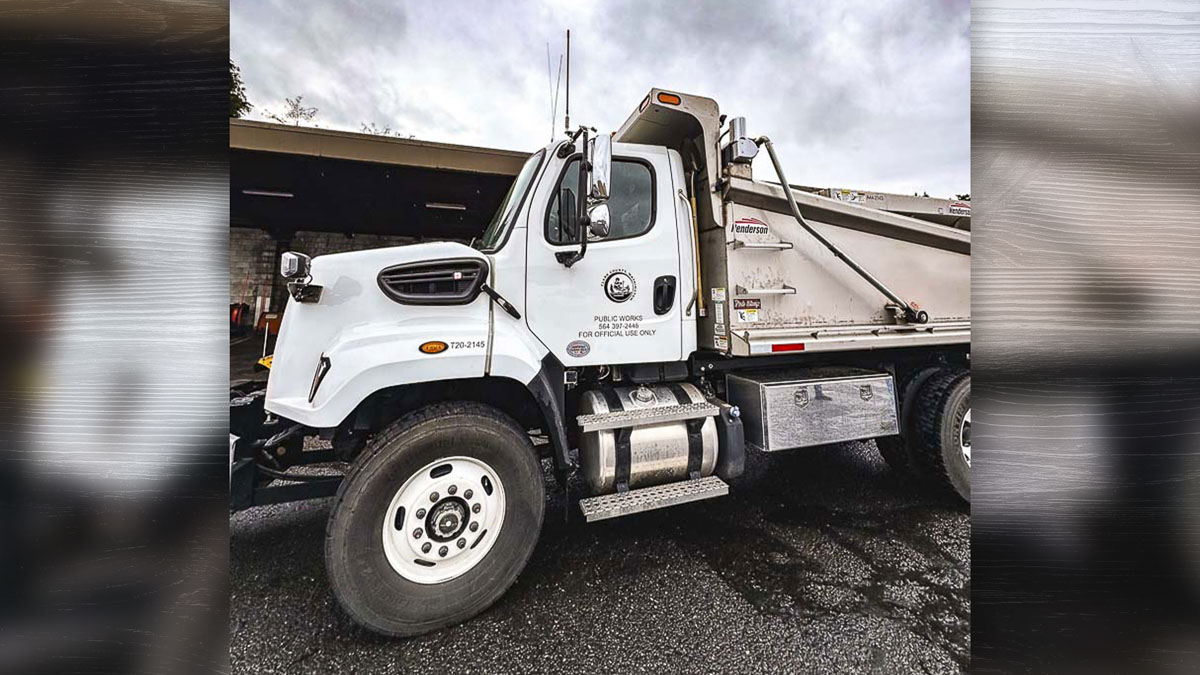
Each fall, county staff and equipment are prepared so they’re ready to respond to whatever conditions winter weather brings to Clark County
VANCOUVER – When winter weather strikes, Clark County Public Works is ready to respond. Our roads maintenance and operations crews are located at six “sheds” spread throughout the county, so they can respond quickly and efficiently to the unique conditions that may occur in different locations of the unincorporated area.
Each fall, county staff and equipment are prepared so they’re ready to respond to whatever conditions winter weather brings to Clark County. In addition to snow and ice, they are prepared to respond to water over roadways, clogged catch basins, downed trees and branches, and similar weather-related issues.
“Our crews are prepared for any weather events that our region may experience,” said Josh Lipscomb, Road Maintenance and Operations division manager.
County staff prioritizes arterials and collectors for plowing, sanding and deicing. Arterials are the main roads that provide access to highways and freeways and are our top priority. Collectors are roads that provide access to arterials and are the second priority. An interactive map of primary and secondary plowing/deicing routes can be found at clark.wa.gov/public-works/winter-snow-and-ice. Residents should report hazardous road conditions in unincorporated county at clark.wa.gov/public-works/report-park-road or by calling (564) 397-2446. Additional resources for reporting hazards in other jurisdictions in Clark County are listed on the webpage listed above. Downed power lines and trees endangering lines should be reported to Clark Public Utilities at 360.992.3000 or at clarkpublicutilties.com.
We divert traffic or close a road when necessary for the public’s safety and to protect infrastructure. We share information, including detours and closures, with the public as soon as it is available. In addition to road closures, county staff may close roads or parks and natural areas in response to rising rivers or streams, downed trees and other hazards. Residents can get information about closures and incident response on county social media profiles, on our homepage at clark.wa.gov/public-works, or by signing up for email notifications using the email signup button on our homepage. We also share closure and response information with local TV and radio stations and newspapers.
Drivers are reminded that going slow, no matter the weather, helps keep road workers, drivers and their passengers safe.
“When we are in the community responding by clearing or treating roads, the public can contribute to our success by providing room for our crews to work, reporting issues they encounter, and adhering to closures and detours,” said Lipscomb. “The most beneficial contribution is to slow down, which helps our crews focus on the issue rather than traffic and gets the public to where they are headed.”
For information about road and park projects, closures, opportunities for community input, and more, residents can follow Public Works on X (formerly known as Twitter), Facebook and Instagram and view information on Nextdoor. Residents can also visit clark.wa.gov/public-works to sign up for email notifications.
Go to clark.wa.gov/public-works/news to read this information in another language. Click the button in the top right of the page that says “Change language” next to a globe icon and choose your preferred language.
Information provided by Clark Co. WA Communications.
Also read:
- Opinion: Half the road, full stop – Understanding pedestrian right-of-way
 Doug Dahl explains how Washington’s law requires drivers to stop when a pedestrian is within one lane of their half of the road, not just when directly in front.
 - Opinion: What is the cost of a bridge?
 John Ley argues the I-5 Bridge replacement’s soaring cost stems from costly extras like light rail, noting other states deliver larger, toll-free bridges for much less.
 - Letter: Vancouver Mayor Anne McEnerny-Ogle makes several serious and incorrect engineering statements
 Bob Ortblad critiques engineering claims by Vancouver Mayor Anne McEnerny-Ogle, highlighting cost and safety advantages of an immersed tunnel for the I-5 crossing.
 - Washington’s studded tire deadline is March 31
 Drivers must remove studded tires by March 31 or face a $137 fine, with WSDOT urging early action due to busy service centers and no planned deadline extension.
 - VIDEO: WA diesel hits record $6.53, crushing truckers and school budgets
 With diesel nearing $6.53 per gallon in Washington, trucking businesses and school districts now confront sharply higher fuel expenses affecting budgets and workers.
