



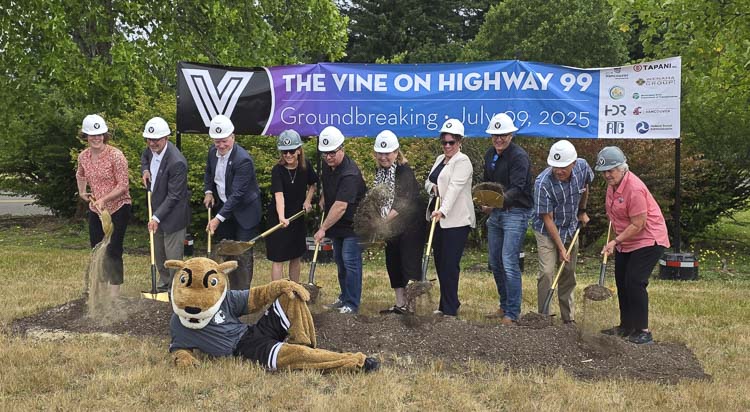
The latest Vine route, scheduled to open in 2027, will run from the Waterfront in downtown Vancouver to Washington State University Vancouver’s campus via Highway 99
Paul Valencia
Clark County Today
Leaders from C-TRAN, Washington State University Vancouver, and special guest Butch the Cougar gathered Wednesday to celebrate The Vine.
“It is a pleasure to be here today to mark this major step forward for our region, for our transit system, and for our campus community,” said Sandra Haynes, interim chancellor of Washington State University Vancouver.
She and other guest speakers stood on a podium that was on the ground that will eventually become the northernmost station on The Vine on Highway 99 — on the campus of WSU Vancouver.
Wednesday marked the groundbreaking for what will become a 9-mile north-south route from the campus in Salmon Creek to Highway 99, to downtown Vancouver and the Waterfront.
“WSU Vancouver is committed to being an institution of access, excellence, and service,” Haynes said. “For many students, and many potential students, access to higher education starts with simple but essential: the ability to get to campus.
“Today is such an important moment for WSU Vancouver. The new Vine on Highway 99 will bring fast, frequent, and reliable service to WSU Vancouver, connecting our campus to neighborhoods across Clark County.”
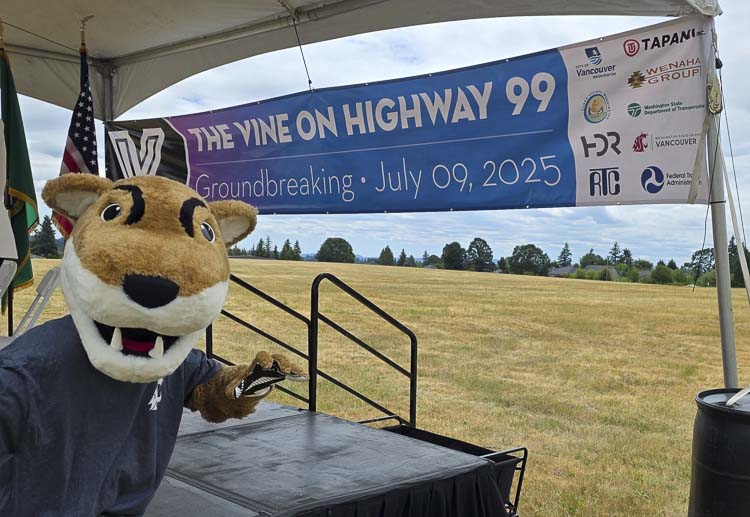
This will be the third Vine route for C-TRAN’s bus rapid transit system, following Fourth Plain Blvd. and Mill Plain Blvd. routes.
BRT “is the crown jewel of our community,” said Adrian Cortes, state senator for the 18th Legislative District.
“This project represents a milestone for all of Clark County, not just the city of Vancouver or Highway 99,” said Molly Coston, chair of the C-TRAN Board of Directors who represents Washougal on the board. “Having a strong transportation network strengthens smaller cities like mine. C-TRAN has always recognized this.”
Tod Tapani, vice president of operations for Tapani Inc., the contractor for the project, told C-TRAN leaders that his company is “proud to take your vision and turn it into something.”
Tapani was the contractor for the two previous Vine projects.
Leann Caver, chief executive officer of C-TRAN, noted that The Vine is not just a way for more efficient bus services.
“This project will deliver meaningful infrastructure and real improvements,” she said, including new sidewalks and pedestrian crossings.
There will be 32 new stations along the 9-mile route.
“It will make Highway 99 a safer, more accessible corridor,” Caver said.
C-TRAN’s timeline on its website calls for The Vine on Highway 99 to open in 2027.
Also read:
- Opinion: IBR’s systematic disinformation campaign, its demise
 Neighbors for a Better Crossing challenges IBR’s seismic claims and promotes a reuse-and-tunnel alternative they say would save billions at the I-5 crossing.
 - Opinion: Is a state income tax coming, and the latest on the I-5 Bridge project
 Rep. John Ley shares a legislative update on a proposed state income tax, the I-5 Bridge project, the Brockmann Campus and House Bill 2605.
 - Board authorizes C-TRAN to sign off on Interstate Bridge Replacement Program’s SEIS
 The C-TRAN Board approved the Final SEIS for the Interstate Bridge Replacement Program, with Camas and Washougal opposing the vote over light rail cost concerns.
 - C-TRAN ridership grows for fourth consecutive year
 C-TRAN ridership topped 5 million trips in 2025, marking the fourth straight year of growth.
 - Opinion: ‘If they want light rail, they should be the ones who pay for it’
 Clark County Today Editor Ken Vance argues that supporters of light rail tied to the I-5 Bridge replacement should bear the local cost of operating and maintaining the system through a narrowly drawn sub-district.
 wpDiscuz
