



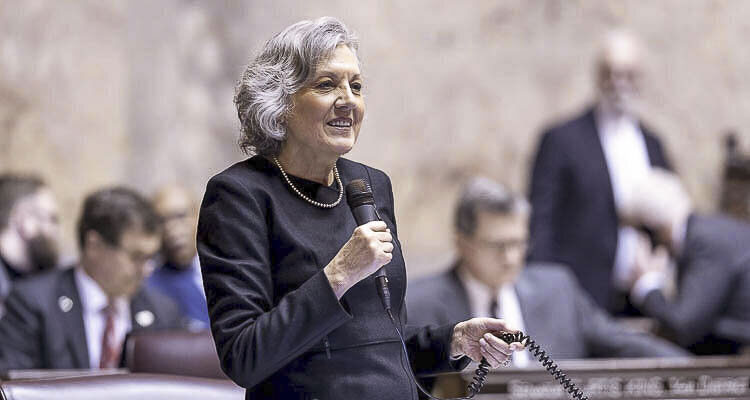
Sen. Lynda Wilson says the real concern is the many billions of dollars’ worth of new spending requests anticipated in the governor’s upcoming budget proposal
A relatively small slump in the state government’s newest revenue projection won’t affect funding for existing state services and programs, says Sen. Lynda Wilson, budget leader for Senate Republicans, adding the real concern is the many billions of dollars’ worth of new spending requests anticipated in the governor’s upcoming budget proposal.
Wilson, R-Vancouver, today attended her final meeting of the Economic and Revenue Forecast Council, which is responsible for adopting quarterly revenue forecasts prepared by the state’s chief economist. She is stepping down from the Senate at the end of this year after 10 years as a state lawmaker.
Compared to the year’s third-quarter forecast that was approved in September, the projected revenue for the 2023-25 fiscal biennium is now down $88 million. The projected decrease for the 2025-27 biennium – which will influence the operating budget lawmakers must adopt in 2025 – is $181 million compared to the previous quarterly forecast.
Wilson, who also served as council chair for the past two years, offered this assessment following the council vote to adopt the final forecast of 2024:
“The chief economist warned our council that the state’s economic growth would be slow this year, and that has been the case. But still, between projected revenue and available reserves there is more than enough to balance a 2025-27 operating budget that maintains the services and programs being provided now.
“The problem – and the reason our Democratic colleagues are already talking about tax increases – is the billions of dollars’ worth of new spending requests we are likely to see in the governor’s budget proposal. Those include $4 billion tied to new collective bargaining agreements with state workers.
“The speaker of the House recently suggested that because the voters didn’t repeal the capital-gains tax, they may be open to new taxes. I wouldn’t go there. The current two-year budget is over $71 billion, which is 82% more than the $39 billion it was after I was elected in 2014. In that same period the population has gone up nearly a million, which is less than 15%. The growth of government spending is far outpacing population growth.
“It’s one thing when revenues fall and can’t sustain the current level of services. That isn’t the case: The headline for today is that funding to continue current service levels is safe for another two years. If there’s a shortfall on the horizon, it will be the result of Democratic overspending. The taxpayers are already sending too much of their money to Olympia.”
Also read:
- PeaceHealth celebrates National Cancer Survivors Day
 Vancouver actor Myronie McKee filmed a breast cancer commercial, then received her own diagnosis the next day.
 - Washington facing sharp budget deficit, ‘significant impact’ to services expected
 OFM Director K.D. Chapman-See warns agencies the 2027-29 budget shortfall spans both operating and transportation funds.
 - Why AG Nick Brown wants the Supreme Court involved in WA’s redistricting fight
 AG Nick Brown calls Louisiana v. Callais “a horrible decision” that undermines voting power of Black and Brown communities statewide.
 - Opinion: The men who wrote the Declaration of Independence
 Five men were tasked with drafting the Declaration of Independence — and one nearly wasn’t chosen at all.
 - Opinion: IBR program’s $13-17 billion fraud and mismanagement, perpetuated by Vancouver Mayor Anne McEnerny-Ogle and Oregon Gov. Tina Kotek
 Gary Clark argues IBR hid a $17B cost estimate from lawmakers while spending up to $280M with no public benefit.
 - Opinion: The IBR shell game for TriMet at Ruby Junction
 IBR allocates $320M for a TriMet maintenance facility 20 miles from the actual bridge project.
 - Washington and Oregon transportation commissions discuss tolling options
 I-5 tolls could range from $1.55 to $4.70 depending on the plan, with final rates set in late 2027.
