



Six daily roundtrip trains will operate between Seattle and Portland
OLYMPIA – Just in time for the holidays, WSDOT and ODOT are starting two additional Amtrak Cascades daily roundtrips between Seattle and Portland. Beginning Monday, Dec. 11, more trains will run in both directions – for a total of 12 trains every day between the two most popular cities on the route.
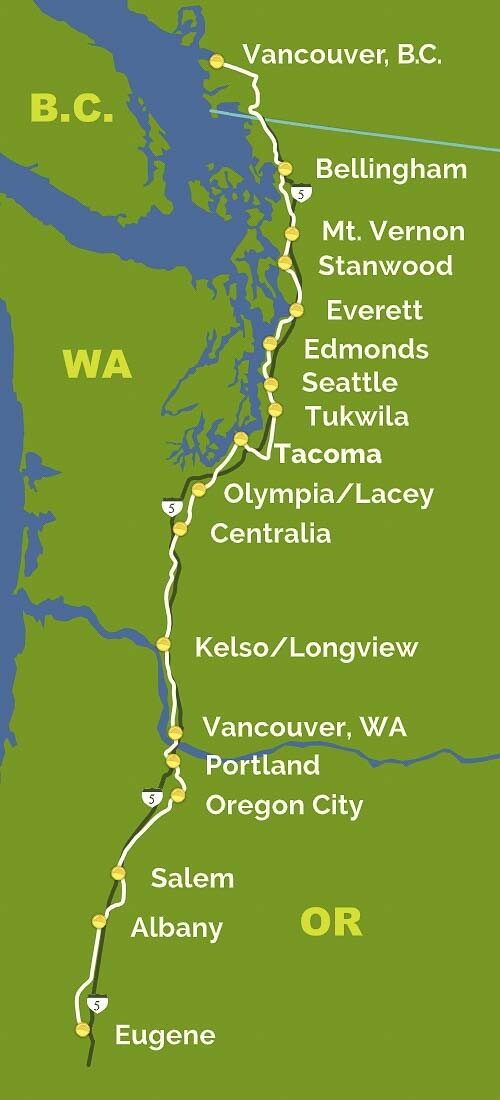
The new schedule will see trains departing Seattle at 5:52 a.m. and Portland at 6:45 a.m. The latest trains between the two cities will leave at 7:25 p.m. from Portland and 7:50 p.m. from Seattle. Station stops between the two cities include Tukwila, Tacoma, Olympia/Lacey, Centralia, Kelso/Longview, and Vancouver, Washington. Other routes serve stations south from Portland into Oregon and north of Seattle into Canada.
Dec. 11 also brings changes to the existing schedules. The northbound morning train from Eugene will leave later in the morning and allow for continuous travel on the same train all the way to Seattle. Later morning departures also will occur on trains leaving in both directions between Seattle and Vancouver, British Columbia. Afternoon trains will depart earlier from Canada to Seattle and from Portland to Seattle to Vancouver.
“The additional roundtrips and updated schedules provide more convenient travel options for Amtrak Cascades passengers,” said Jason Biggs, director of WSDOT’s Rail, Freight and Ports Division. “Many of our trains are sold out, so the addition of these two trains between Portland and Seattle has long been awaited by our customers.”
“Amtrak Cascades passenger rail gives people a great way to move between key cities and towns in the Pacific Northwest, and now it will be easier than ever to take the train,” said Kris Strickler, ODOT director. “Taking the train is a more environmentally friendly way to travel than flying or driving, and reducing carbon emissions is one of ODOT’s top priorities.”
“Today’s announcement gives riders two more options to go from Seattle to Portland,” said Senator Maria Cantwell. “This significantly increases capacity for riders traveling between the two busiest stops on the Amtrak Cascades route every morning and evening. These cities along the I-5 corridor are interconnected, and growing fast – together, Portland and Seattle added nearly a million residents and 700,000 new jobs over the last decade.”
Tickets for the newly added trains will be available on Dec. 1 at AmtrakCascades.com. Customers are encouraged to book early, especially for the holidays, with special discounts available for children, students, seniors, military and groups.
Also read:
- Opinion: ‘If they want light rail, they should be the ones who pay for it’
 Clark County Today Editor Ken Vance argues that supporters of light rail tied to the I-5 Bridge replacement should bear the local cost of operating and maintaining the system through a narrowly drawn sub-district.
 - Opinion: IBR falsely blaming inflation
 Joe Cortright argues that inflation explains only a small portion of the IBR project’s cost increases and that rising consultant and staff expenses are the primary drivers.
 - Letter: The Interstate Bridge Replacement Program’s $141 million bribe can be better spent on sandwich steel-concrete tubes
 Bob Ortblad argues that an immersed tunnel using sandwich steel-concrete tubes would be a more cost-effective alternative to the current Interstate Bridge Replacement Program design.
 - A sub-district vote could be a way to go to pay O&M costs associated with light rail
 Clark County Council members heard details on how a voter-approved C-TRAN sub-district could be created to fund long-term operations and maintenance costs for light rail tied to a new Interstate Bridge.
 - Letter: British Columbia’s new immersed tunnel can solve Interstate Bridge Replacement Program’s $17.7 billion problem
 Bob Ortblad argues that an immersed tunnel similar to a project underway in British Columbia could significantly reduce costs and impacts associated with the Interstate Bridge Replacement Program.

Ridership has not yet recovered from the pandemic lockdowns. There is minimal demand for additional rail service. It is not economically viable.