



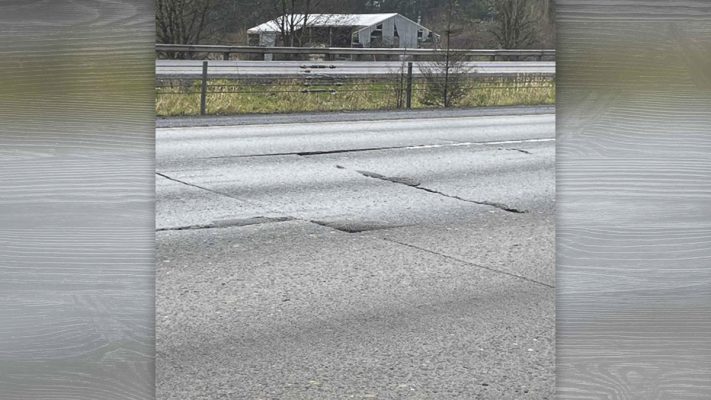
Nighttime work replaces dozens of the “worst of the worst” broken panels between Ridgefield and the I-5/I-205 split
VANCOUVER – Travelers using southbound Interstate 5 will soon see some improvement in rough road conditions after the most damaged concrete panels are replaced this summer. Travelers also will want to plan ahead during the construction.
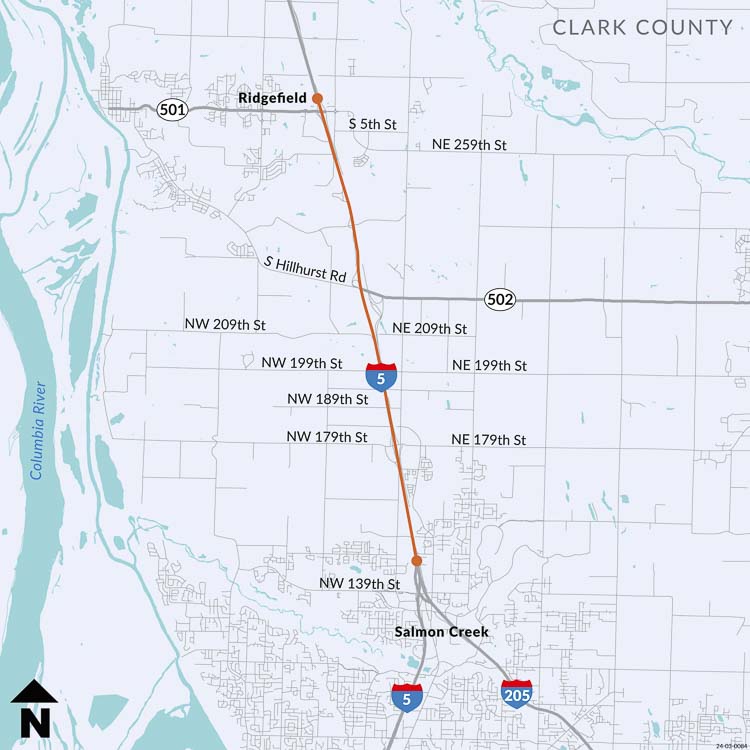
Beginning Monday, Aug. 19, contractor crews working for the Washington State Department of Transportation will use nighttime lane closures to remove broken and cracked panels, pour new concrete and allow each new panel to cure. This process will remove the worst of the failing concrete panels on southbound I-5 between Ridgefield and the I-5/I-205 split and provide improved driving surfaces for travelers. During the work, with reduced lanes, travelers may want to allow extra travel time.
What travelers can expect
- Beginning Monday, Aug. 19, contractor crews will use single and double nighttime lane closures along southbound I-5 between Ridgefield (milepost 14) and the I-5/I-205 split (milepost 8).
- Speed limits will lower to 55 mph through the work zone while workers are present. This is for the safety of crews.
- This work requires dry weather and may need to be rescheduled if it rains.
- Work is expected to be completed in October.
There are 8,400 concrete panels in this stretch of southbound I-5 between Ridgefield and the I-5/I-205 split, which are 50-70 years old. Hundreds of these panels are cracked and broken, creating a very rough ride for interstate travelers. Rougher pavements reduce fuel efficiency, which means consumers spend more on fuel, tire wear increases and repair costs rise — which also can lead to higher prices for basic goods and services. The road conditions led to WSDOT posting “Rough Road” signs in the area earlier this year, giving travelers advanced warning and suggesting lower speeds.
Future work
This summer’s contract, completed by Granite Construction Company, will address the worst of the failing concrete panels. Repairing the entire stretch of southbound I-5 will be a multi-year, multi-contract process as roadway preservation funding becomes available. WSDOT currently receives 40% of the preservation funding needed each year to maintain the roads and bridges travelers use today.
If funding is available, another approximately $12 million project will focus on fixing and smoothing out all panels on a section of southbound I-5 from 179th Street to the I-5/I-205 split. In 2026, if funding is available, a project costing approximately $25 million will tackle all panels on southbound I-5 between Ridgefield to 179th Street. At that point, the “Rough Road” signs may be removed from the interstate.
Stay informed about these projects and others across southwest Washington and throughout the state by downloading the WSDOT mobile app, checking the real-time travel map or signing up to receive email updates.
Also read:
- 49th Legislative District Democrats share their reasons for backing state income tax at Town Hall
 Three Democrat legislators defended the new income tax affecting only those earning over $1 million annually.
 - Letter: Freeze the scope and build the bridge
 Vancouver resident calls for project discipline after 22 years of planning and nearly half a billion in costs.
 - Opinion: ‘When are we going to get the full and complete details of the Interstate Bridge Replacement Program’s I-5 Bridge replacement project?’
 IBR team buried key details about light rail ending at waterfront with massive elevator system required.
 - POLL: Do you support extending light rail beyond the waterfront to connect with C-TRAN at Library Square?
 Readers can weigh in on Anne McEnerny-Ogle’s proposal to extend light rail beyond the waterfront to Library Square for improved C-TRAN connections.
 - Opinion: Passing a cyclist – Law, myth and a little patience
 Most drivers can’t legally pass cyclists in-lane due to vehicle width versus road measurements.
