



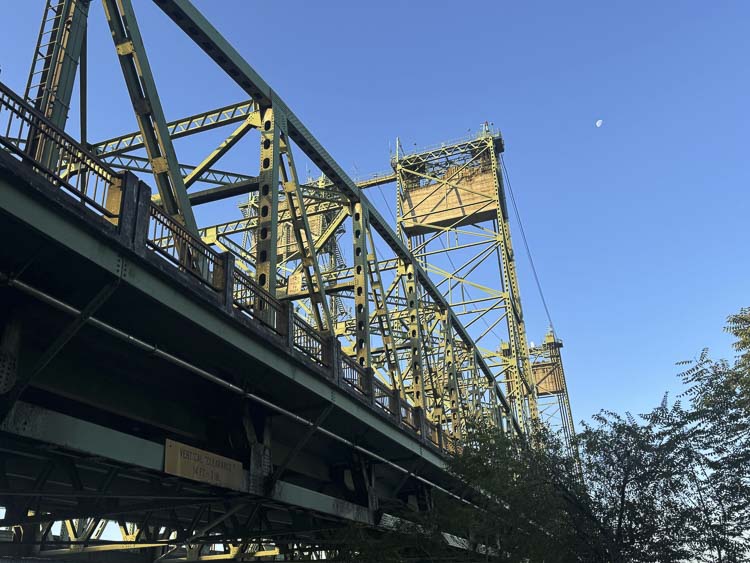
Rep. John Ley advocates for low cost and no tolls for the I-5 Bridge replacement project; which will leave money for many other much needed transportation projects around both Washington and Oregon
Rep. John Ley
for Clark County Today
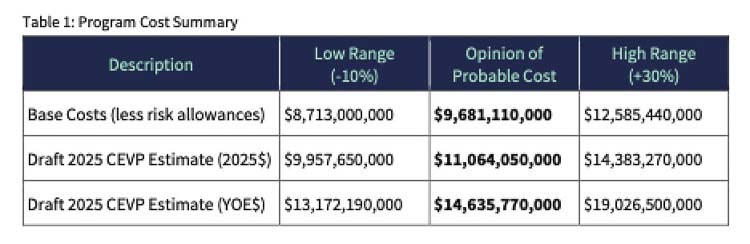
Last month, Gov. Bob Ferguson held a press conference sharing “updated” cost information for the I-5 Interstate Bridge Replacement Program (IBR). Portland economist Joe Cortright had revealed costs in January of up to $17.7 billion. The governor’s cost – a range between $13.5 billion and $15.2 billion, was over triple the original price tag of five years ago.

But who is minding the store or providing oversight on behalf of taxpayers? Former California Assembly Speaker Willie Brown was famous for saying this about public projects and costs. “In the world of civic projects, the first budget is really just a down payment. If people knew the real cost from the start, nothing would ever be approved. The idea is to get going. Start digging a hole and make it so big there’s no alternative to coming up with the money to fill it in.”
Citizens should be wary that the IBR doesn’t become a Boston “Big Dig” or a California High Speed Rail boondoggle. The governor and fawning crowd at the press conference spoke about “phasing” the project, but it is not clear what the phases are, let alone how much each phase will cost. But they should avoid digging a hole and making it so big there’s no alternative to coming up with the rest of the money.
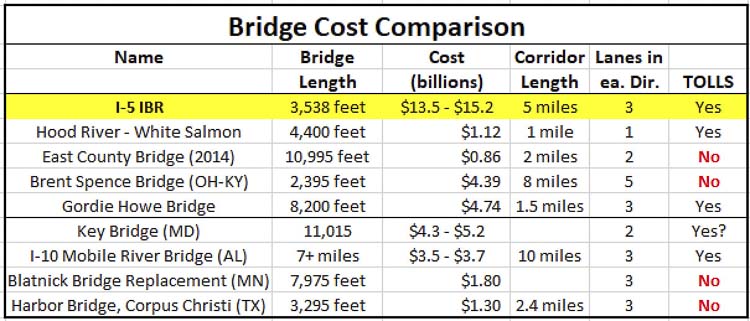
What is the cost to build a bridge on a major highway or interstate? That should be front and center in this discussion. Both WSDOT and ODOT are blaming “inflation” for the current IBR cost explosion, but that’s a red herring for the real problem – too many unnecessary additions to the bridge project.
The Hood River-White Salmon bridge replacement over the Columbia River is currently projected to cost $1.12 billion. This is for a 2-lane bridge, plus wide pedestrian and bike lanes. The bridge is roughly 25 percent longer than that proposed for the IBR. So if you were to double the width and cost to $2.3 billion, that should be a legitimate cost comparison.
A decade ago, Figg Engineering offered a fixed price $860 million East County Bridge, connecting 192nd Ave. in Vancouver to near 181st Ave. in Portland. The proposed bridge was 10,995 feet long – triple the length of the IBR. So double the cost to $1.72 billion to account for inflation, and we have another example for comparison.
Ohio and Kentucky are currently building a new, 10-lane bridge over the Ohio River on I-75/I-71. The two states are building a toll-free bridge for $4.39 billion, according to the Ohio Department of Transportation. Each state will cover the cost of their own highway work and share the cost of the companion bridge. The project upgrades eight miles of roadway in Ohio and Kentucky, including via a redesign of ramp configurations. It repurposes the old bridge as well.
Kentucky Gov. Beshear said: “But even more importantly, we’re keeping our promise to make the Brent Spence Corridor Project happen – without tolls!”
This contradicts Vancouver Mayor Ann McEnerny Ogle who told KGW news recently: “there isn’t a single project in the United States that doesn’t have tolling.” She’s aware of the Brent Spence Bridge project because it was competing for federal dollars at the same time as the IBR, and their refusal to rely on toll dollars has been mentioned multiple times at meetings the mayor has attended.
The original proposed cost of the IBR in 2020 was $3.2 billion to $4.8 billion. Note the cost range was 50 percent. The lower number included the cost of light rail. Two years later, the cost escalated to $5 billion to $7.5 billion, with another 50 percent range.
In January, Cortright revealed the high cost was $17.7 billion. That is more than the 2015 cost for dozens of statewide transportation projects in the Connecting Washington $16 billion package. And it’s more than the 2022 $17 billion Move Ahead Washington package. Both were supposed to last 16 years. The IBR is now 20 years of construction, possibly spending more for a single project than was spent for dozens of statewide projects.
Why?
The IBR “construction packages” (website) for contractors indicate the bridge itself will possibly cost $1 billion to $1.5 billion.The Cortright data from Sept. 2025 shows $1.8 billion.
The “approaches” were another $720 million to $1.1 billion. If you get rid of all the “extras” including light rail, the multiple bridges connecting Hayden Island to north Portland and the park and ride facilities in Vancouver, you have an affordable bridge in the range of $2 billion.
The two governors and Democrats controlling the process do not want to prioritize the project. It should be pared back to what is essential and what we can afford. A 5-through-lane bridge would actually ease traffic congestion – what the people expect for their transportation dollars.
Oregon is broke – unable to pass a new $4.3 billion transportation package without citizens revolting. The repeal of the package will be on their May ballot, six months ahead of the statewide election for governor.
Washington legislators were told in December the state has an unfunded $8 billion need for road and bridge maintenance, statewide.
If other states can build bridges for $1 billion to $5 billion that are longer and have more lanes, it’s time for taxpayers to say “No” and send a strong message to Olympia and Salem. “We don’t want to waste our scarce taxpayer dollars on a $15 billion light rail boondoggle.”
The two states should abandon the light rail – a $2 billion plus savings. An affordable $2-3 billion bridge would not need tolls! Low cost; no tolls; and money left for many other much needed transportation projects around both states.
As Clark County resident Steven Wallace said: “we need lanes, not trains” for the IBR.
Also read:
- Opinion: What is the cost of a bridge?
 John Ley argues the I-5 Bridge replacement’s soaring cost stems from costly extras like light rail, noting other states deliver larger, toll-free bridges for much less.
 - Letter: Vancouver Mayor Anne McEnerny-Ogle makes several serious and incorrect engineering statements
 Bob Ortblad critiques engineering claims by Vancouver Mayor Anne McEnerny-Ogle, highlighting cost and safety advantages of an immersed tunnel for the I-5 crossing.
 - Washington’s studded tire deadline is March 31
 Drivers must remove studded tires by March 31 or face a $137 fine, with WSDOT urging early action due to busy service centers and no planned deadline extension.
 - VIDEO: WA diesel hits record $6.53, crushing truckers and school budgets
 With diesel nearing $6.53 per gallon in Washington, trucking businesses and school districts now confront sharply higher fuel expenses affecting budgets and workers.
 - Opinion: In plain sight – yielding to pedestrians
 Drivers often fail to see pedestrians due to inattentional blindness, which highlights the need for more focused awareness at intersections and stronger safety practices.
