



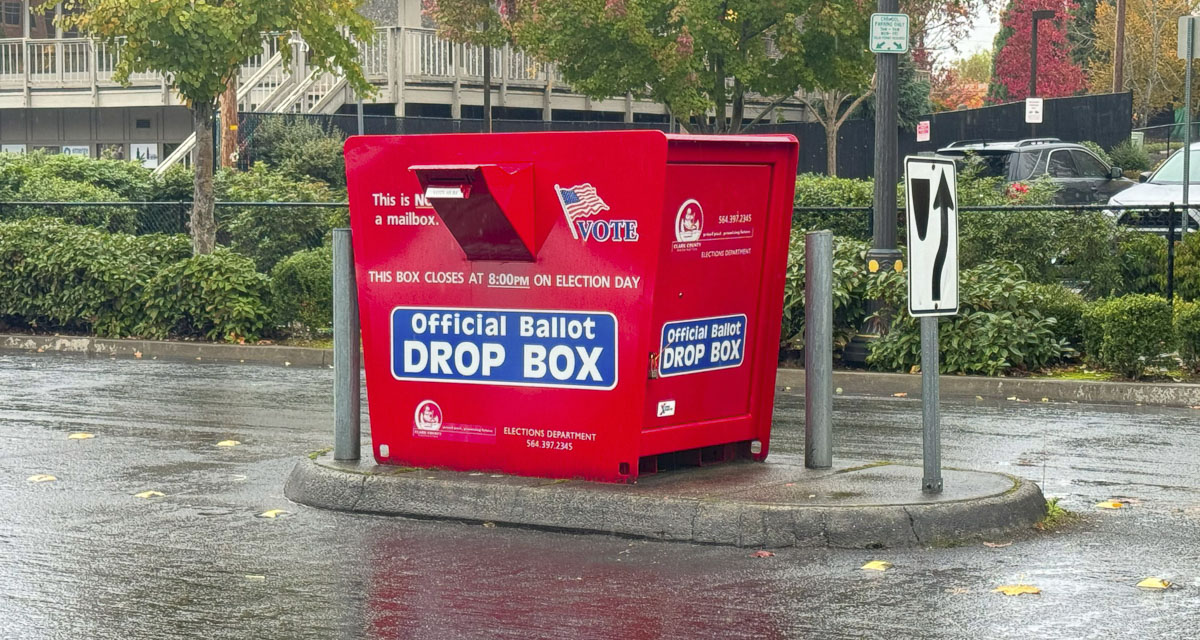
Across the United States, voting by mail faces a moment of uncertainty ahead of the midterm elections next year
Jonathan Shorman
Washington State Standard
 See Grok’s analysis of this story
Derrin Robinson has worked in Oregon elections for more than 30 years, long enough to remember when voters in the state cast their ballots at physical polling sites instead of by mail.
As the nonpartisan clerk of Harney County, a vast, rural expanse larger than Massachusetts, Robinson oversees elections with about 6,000 registered voters. Oregon has exclusively conducted elections by mail since 2000, a system he thinks works well, requires fewer staff and doesn’t force voters to travel through treacherous weather to reach a polling place.
“As you can tell, I’m not an advocate for going back,” Robinson said.
Not everyone agrees. An Oregon Republican lawmaker has introduced legislation to end the state’s mail voting law, and organizers of a ballot measure campaign seeking to ban mail-in voting say they have gathered thousands of signatures.
Across the United States, voting by mail faces a moment of uncertainty ahead of the midterm elections next year.
President Donald Trump has assailed mail-in voting and vowed this summer to lead a movement to eliminate the practice, promoting claims that mailed ballots are linked to widespread fraud. Some states are also reevaluating their mail-in voting laws, including shortening or ending grace periods that now require election officials to count mailed ballots that arrive after Election Day.
The U.S. Supreme Court in November agreed to take a case that could end ballot grace periods nationwide. A decision by the justices late next spring or early summer striking them down could affect 16 states and the District of Columbia, potentially upending the rules of elections as states prepare to hold primaries ahead of the November midterm elections that will determine control of Congress.
Mail-in voting surged in 2020 amid the COVID-19 pandemic, when 43% of voters cast their votes by mail. The percentage of voters mailing their ballots has fallen from that peak but remains above pre-pandemic levels. About 30% of voters cast mail ballots in 2024, according to data gathered by the U.S. Election Assistance Commission.
That’s 46.8 million voters, underscoring the electoral and political stakes involved in any major change to mail-in voting.
“THE MAIL-IN BALLOT HOAX, USING VOTING MACHINES THAT ARE A COMPLETE AND TOTAL DISASTER, MUST END, NOW!!!” Trump posted in August on his social media site, Truth Social.
Trump promised in the post to issue an executive order that would bring “HONESTY” to the midterm elections, but none has been forthcoming. In response to questions, the White House referred Stateline back to the president’s post.
Robinson, the president of the Oregon Association of County Clerks, emphasized the security of mail-in ballots, but acknowledged that the message has become a “hard sell.”
“We’ve done everything in our power to try to squash the myths and disinformation that it’s wrought with fraud, because it is not,” he said.
Ballot deadlines targeted
Amid scrutiny of mail-in ballots, Ohio is on the verge of eliminating its ballot grace period, potentially becoming at least the fifth state to tighten ballot arrival deadlines this year, along with Kansas, Minnesota, North Dakota and Utah.
The Republican-controlled Ohio legislature last month passed a bill that would require all ballots to be returned to election officials by the close of polls on Election Day to count, with exceptions for late-arriving military and overseas ballots. Under current law, the ballots must arrive by the fourth day after the election.
Ohio Republican Secretary of State Frank LaRose spearheaded the push for the change. He has argued that setting an Election Day deadline for the arrival of mailed ballots will minimize voter confusion and that uncertainty surrounding late-arriving ballots in a close contest risks damaging voter confidence.
LaRose has also suggested the U.S. Department of Justice would sue Ohio if it didn’t change its deadline.
During a legislative hearing in late October, LaRose told lawmakers that Assistant U.S. Attorney General Harmeet Dhillon, who leads the Justice Department’s Civil Rights Division, wrote in a Sept. 29 letter to Ohio Attorney General Dave Yost that Ohio should take immediate action to comply with federal law and “avoid costly litigation” in federal court.
“They identified what they consider to be a conflict between state and federal law as to the deadline for which absentee ballots must be returned by mail,” LaRose testified
The Justice Department indicated that Ohio law should match that of other states that require ballots to be returned by the close of polls on Election Day, LaRose said. He added that he asked for the opportunity to work with lawmakers to change the law in lieu of a lawsuit.
LaRose’s office didn’t respond to Stateline’s interview request. The Justice Department and Yost didn’t respond to requests for comment and for a copy of the September letter.
Ohio Republican Gov. Mike DeWine hasn’t said whether he will sign or veto the bill eliminating the grace period. A spokesperson for the governor said Monday that DeWine hadn’t yet received it.
During the 2024 election in Ohio, 8,335 mail ballots weren’t counted, or 0.8% of all mail ballots returned to election officials, according to the U.S. Election Assistance Commission. Nationwide, 584,463 mail ballots weren’t counted, 1.2% of those returned.
Nearly 18% of rejected mail ballots were rejected because they weren’t received on time, according to the commission’s data.
Debra Shankland, a 66-year-old Democrat in the Cleveland suburb of Brecksville, said she’s worked to register voters in public housing and other apartment buildings, giving her experience talking with people about voting by mail. Many people like mail ballots, she said, but want to drop them off instead of mailing them.
Shankland, who submitted written testimony to the state legislature opposing the elimination of Ohio’s grace period, wrote that she votes absentee because she’s a poll worker and therefore unavailable on Election Day. Instead, she places her ballot in a drop box (Ohio law limits drop boxes to one per county).
“I do know a lot of people are very leery of the mail and I am, too,” Shankland said in an interview, adding that she’s had mail stolen in the past.
The United States Postal Service has battled declining performance for years. Ahead of the 2020 election, then-Postmaster General Louis DeJoy rolled out a series of changes to mail service, including the removal of some mail-sorting machines and cuts to the number of the service’s ubiquitous blue public mailboxes. Amid criticism, DeJoy backed off the changes a few months before the election; he resigned earlier this year.
During peak mail season last year — Thanksgiving through New Year’s Eve — USPS missed five of six service performance targets, despite lowering the targets, according to a USPS Office of Inspector General report released in July.
But the postal service has touted its efforts to ensure rapid delivery of election mail, including ballots, during the 2024 election. USPS has said it delivered 99.88% of ballots to election officials within seven days, and 97.73% of ballots within three days. A USPS Office of Inspector General report from April found that the postal service “significantly exceeded service performance goals” for election mail and most political mail.
USPS has previously noted that election laws and procedures vary among the 50 states and the nearly 8,000 election jurisdictions in the country. “This can result in a mismatch of timeframes, deadlines, ballot return suggestions and the practical reality of using the mail,” the postal service said in a November 2024 report.
Supreme Court case looms
The U.S. Supreme Court may soon set a nationwide mail ballot arrival deadline.
The court will consider a dispute between the Republican National Committee and Mississippi, which requires mailed ballots to be counted if they are received within five business days of the election and are postmarked on or before Election Day. Postmarks act as a check against fraud, helping to ensure that ballots were placed in the mail before the end of the election — and not afterward in an attempt to alter the outcome.
The case cuts across partisan lines. Mississippi Secretary of State Michael Watson, a Republican who is defending the law, declined to comment, citing pending litigation. But in September, Watson told the Mississippi newspaper The Dispatch that “the policy decision should be made at the state level.”
At the core of the case is a question of whether a longstanding federal law that sets the Tuesday after the first Monday in November as Election Day for federal offices, preempts state laws that allow ballots cast by Election Day, but received later, to count.
And at the same time, the case asks: What does it mean to cast a ballot? Is putting it in the mail enough, or does it need to reach election officials?
The 5th U.S. Circuit Court of Appeals ruled in October 2024 that the law requires ballots to be received by Election Day. Trump likewise issued an executive order in March that attempted to require that mail ballots be received by the end of Election Day and to impose other election changes, but much of the order has been blocked by federal courts.
Caleb Hays, chief policy counsel at the Center for Election Confidence, a conservative-leaning legal advocacy group that opposes ballot grace periods, said Congress has the authority to set the date of congressional and presidential elections and had spoken. The center has filed court papers urging the Supreme Court to strike down the Mississippi law.
A requirement that all ballots must be received by the close of polls sets a “bright line rule” for election officials and voters, Hays said, making sure everyone has the same expectation about when ballots must be in.
“In this case, Election Day means Election Day,” Hays said.
In West Virginia, less than 3% of voters cast their ballots by mail in the 2024 election, according to the U.S. Election Assistance Commission. Only 247 mail ballots weren’t counted — 1.1% of the mail ballots received by election officials.
Still, West Virginia Republican Secretary of State Kris Warner said mail ballot arrival deadlines should be left to the states. In his state, ballots postmarked on or before Election Day must be received before the start of the canvass. He said the grace period is “working just fine the way it is right now.”
Warner said he would follow the law as interpreted by the U.S. Supreme Court but warned Trump against attempting to unilaterally change election procedures in West Virginia, where the president enjoyed a nearly 41% margin of victory in 2024.
“You know, across the bottom of my state flag is ‘Montani Semper Liberi’ and Mountaineers are always free and they’re not going to take kindly to an executive order by the president changing how we’re going to do our elections,” Warner said.
Back in Oregon, Robinson, the Harney County clerk, said he personally wouldn’t mind if the grace period goes away. Oregon currently counts ballots received within seven days of the election if they were postmarked by Election Day. More and more ballots are arriving during the grace period, he said.
“But we do what we’re told and follow the Constitution,” Robinson said.
Stateline reporter Jonathan Shorman can be reached at jshorman@stateline.org.
This story was originally produced by Stateline, which is part of States Newsroom, a nonprofit news network which includes Washington State Standard, and is supported by grants and a coalition of donors as a 501c(3) public charity.

This independent analysis was created with Grok, an AI model from xAI. It is not written or edited by ClarkCountyToday.com and is provided to help readers evaluate the article’s sourcing and context.
Quick summary
Voting by mail is facing nationwide uncertainty ahead of the 2026 midterms, with President Trump vowing to end the practice, states such as Ohio advancing bills to eliminate grace periods for late‑arriving ballots, and the U.S. Supreme Court set to rule on Mississippi’s five‑day grace period in a case that could affect up to 30 states. In Oregon, a Republican lawmaker’s bill and a ballot initiative seek to repeal universal mail voting, though they face strong opposition.
What Grok notices
- Outlines how mail voting surged in 2020 and remained at about 30 percent of ballots cast in 2024, giving context for why current legal fights carry significant stakes.
- Quotes local election officials, including Oregon’s Harney County Clerk Derrin Robinson, who describe practical benefits of mail voting in large rural counties.
- Includes viewpoints from advocates of stricter rules, such as Ohio Secretary of State Frank LaRose, alongside defenders of grace periods, showing competing arguments.
- References U.S. Postal Service performance data to illustrate how delivery times and processing standards factor into policy debates.
- Does not explore in depth how changing or eliminating grace periods may affect turnout or ballot rejection rates; readers may wish to review research on voter participation and rejected ballots.
Questions worth asking
- How might eliminating post‑Election Day grace periods affect turnout and ballot rejection rates in rural, military, or weather‑impacted areas?
- What evidence from audits, court cases, and academic studies supports or challenges claims of widespread fraud in mail‑voting systems?
- How do ballot rejection rates in states without grace periods compare to those in states that count ballots arriving after Election Day if postmarked on time?
- If grace periods are curtailed, what alternatives—such as secure drop boxes, extended early in‑person voting, or improved USPS service—could help maintain ballot access?
- How could a Supreme Court ruling on Mississippi’s deadline influence legislative efforts and ballot initiatives in states like Oregon?
Research this topic more
- U.S. Election Assistance Commission – national data on mail voting, rejection rates, and election administration
- Brennan Center for Justice – research on election security, mail voting, and grace‑period impacts
- National Conference of State Legislatures – 50‑state surveys of mail‑voting laws and recent legislative changes
- U.S. Postal Service – election mail service performance reports and guidance
Also read:
- Opinion: Is the cheap fast-food burger a thing of the past?
 Mark Harmsworth argues that rising minimum wages and B&O tax increases are driving higher food prices and squeezing low-income consumers and small businesses across Washington state.
 - Opinion: Blood on the highways fails to move Ferguson and Kotek
 Lars Larson criticizes Washington and Oregon governors over licensing policies he says are linked to deadly truck crashes and ongoing highway safety risks.
 - Letter: ‘When we curtail one group’s rights we leave open the door to losing our rights too’
 Camas resident Anthony Teso argues that constitutional protections apply to immigrants and warns that limiting one group’s rights risks undermining everyone’s civil liberties.
 - POLL: Do you agree that enforcing U.S. immigration laws is not an act of racism?
 This poll asks readers whether enforcing U.S. immigration laws should be viewed as a lawful responsibility rather than an act of racism.
 - Thousands under evacuation orders, as floodwaters crest in Washington rivers
 Thousands of Washington residents have been ordered to evacuate as rivers crest amid heavy rain, with officials warning of catastrophic flooding and seeking federal disaster assistance.
 - C-TRAN Board pays tribute to the late Molly Coston
 The C-TRAN Board of Directors honored the life and legacy of Molly Coston, remembering her leadership, compassion, and service to Washougal and the region.
 - Opinion: Should taxpayers walkout?
 Lars Larson argues that student walkouts and absenteeism in public schools raise questions about accountability for taxpayers who fund the education system.
