



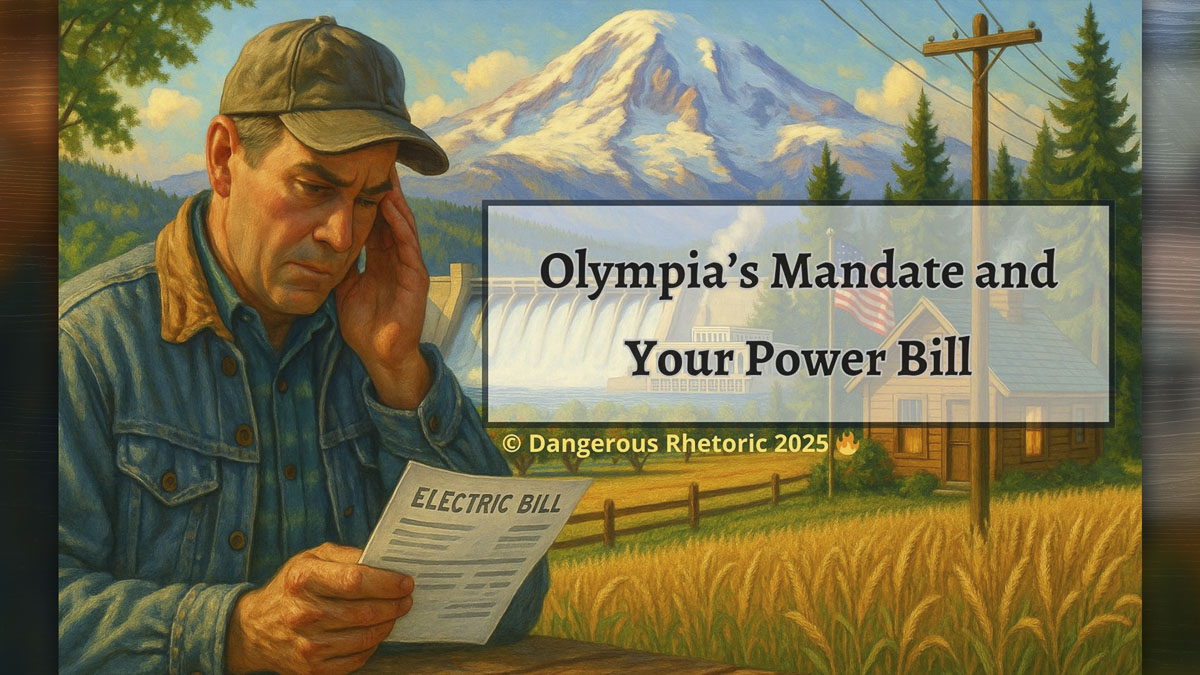
Nancy Churchill says HB 1903 would end the unfunded mandate hurting rural ratepayers
Nancy Churchill
Dangerous Rhetoric
 See Grok’s analysis of this story
In 2019, Washington Democrats passed the Clean Energy Transformation Act (CETA), a sweeping law that requires every public utility district, municipal utility, and co-op in the state to provide deep, ongoing bill discounts and weatherization aid to low-income households. As written, this bill covers all energy use. That means electric customers have to subsidize even carbon-emitting energy sources like propane, oil, natural gas, and wood.

Like many socialist ideas, the goal sounded noble, but the funding mechanism wasn’t. CETA is an unfunded mandate on local utilities and their customers. The state told every utility, including tiny rural PUDs, “You must do this. You must set up, administer, verify, report, and pay for all costs yourselves.”
Now in 2025, the numbers in northeast Washington are staggering. According to the Spokesman Review, Ferry County PUD had nearly 70% of customers eligible for the previous discount plan. Pend Oreille was at 62%. Stevens County sat at 57%. For the current CETA law, The Department of Commerce estimates that 37% of Ferry County households would qualify for ongoing low-income assistance, leaving each remaining ratepayer to cover an additional $740 or more per year.
The burden falls on the working class
So who’s picking up the tab? The rest of us, the portion still paying full price on our electric bill: builders, farmers, small family businesses, retirees and working families who barely miss the poverty cutoff. That’s not compassion. That’s reverse Robin Hood politics dressed up in green virtue.
Here’s what urban policymakers don’t seem to get: In rural counties where median income barely hits fifty grand, the state’s definition of “low income” now covers most people. A family of four earning up to $90,000 can qualify for a subsidy. That logger making $65,000 and paying child support? He’s now subsidizing a neighbor already receiving tribal assistance or Social Security.
A bill with real solutions
Thankfully, there’s a fix. House Bill 1903, Establishing a Statewide Low-Income Energy Assistance Program, is a practical, economical solution. It puts the state in charge of managing and funding its own mandate. Every rural resident should support this bill when it comes up in the 2026 session. Without it, utilities are legally required to pass the rising costs of this assistance program onto full-paying customers.
HB 1903 does three smart things:
First, it finally puts state money behind the state mandate. That way small utilities aren’t forced to rob Peter to pay Paul. Second, it creates a single statewide portal so applicants don’t have to submit multiple forms across multiple agencies. Third, it shifts the workload to the Department of Commerce, which will handle enrollment, call centers, translations and automatic enrollments through existing programs.
This means small utilities can opt in and receive funds upfront, instead of draining local budgets and praying for a reimbursement that may never come.
Same help, less bureaucracy, and far less waste. If we’re going to have a public assistance program, let’s run it efficiently so the right people get the help they need. That’s what responsible government looks like.
Rural money should serve rural people
Even better, the money is already in the bank. HB 1903 would use revenue from the Climate Commitment Act, the same fund Olympia’s been funneling into Seattle transit projects and other green agendas. This bill would send a fair share back to rural communities in the form of lower power bills.
It would be nice to know that the pain at the gas pump is being used to send some dollars back to rural areas to help our community members who are in need.
This solution is pro-family, pro-rural, and pro-taxpayer.
The Bigger Fight: Saving rural Washington
But this is about more than just one bill.
If we keep letting Olympia balance its green dreams on the backs of farmers, business owners, and working families who fall just outside the income cutoff, we’ll lose the next generation. When honest work doesn’t cover basic needs, freedom starts to slip away.
That decline is already happening in Ferry, Pend Oreille, and Stevens Counties. And the clock is ticking.
Time to act
Here’s your job this week, neighbor.
Visit the bill information page for HB 1903 and click “Send a comment to your legislators.” Just write a short note like, “Please support this bill to help reduce local power rates.” It helps lawmakers track what matters most to their constituents.
If you prefer the phone, call your state representatives and senator. Ask them to support HB 1903. Tell them rural Washington has carried Olympia’s burden long enough. You can find their contact info at leg.wa.gov.
Then talk to your neighbors. Do they know they’re paying higher power bills to fund this program? Share this article. Forward it to farmers, ranchers, loggers, and retirees. Post it at the feed store. Read it at your next community meeting. Chat with your PUD commissioners: you’ll get an earful. Ask everyone to comment on this bill.
Want to go a step further? Send a respectful note to the chair and ranking member of the House Appropriations Committee. For HB 1903 to move forward, it needs a public hearing. Ask them to give the bill a public hearing and work together to move it to a floor vote. You can reach Chair Timm Ormsby (D) at timm.ormsby@leg.wa.gov and Ranking Member Travis Couture (R) at Travis.Couture@leg.wa.gov.
Effective messages lead to better results
Since Democrats control Olympia, it helps to speak their language. Terms like climate, equity, and fairness go a long way. You might write something like:
“Please support HB 1903 because it delivers on the equity promise in the 2019 Clean Energy Transformation Act. In rural counties where 50–69% of households now qualify for assistance and still face energy burdens of 12–18%, small PUDs cannot raise enough from remaining customers to meet the mandate.
“This bill uses existing Climate Commitment Act revenue to provide monthly relief, creates single, trauma-informed, statewide enrollment portal that ensures rural seniors, farmworkers, and tribal families receive the help Democrats intended.
“Passing HB 1903 protects the legacy of the Clean Energy Transformation Act, prevents rate shock, and shows that climate policy can lift all communities, instead of leaving rural Washington behind.”
Changing the future starts with you
The future of Washington doesn’t rest in the governor’s mansion. It rests at kitchen tables and in county courthouses, where ordinary people decide enough is enough.
It’s time to take action. It really doesn’t take much time or effort, and our kids and grandkids are counting on us.
Nancy Churchill is a writer and educator in rural eastern Washington State, and the chair of the Ferry County Republican Party. She may be reached at DangerousRhetoric@pm.me. The opinions expressed in Dangerous Rhetoric are her own. Dangerous Rhetoric is available on Substack, X, and Rumble

This independent analysis was created with Grok, an AI model from xAI. It is not written or edited by ClarkCountyToday.com and is provided to help readers evaluate the article’s sourcing and context.
Quick summary
In this opinion column, Nancy Churchill argues that the 2019 Clean Energy Transformation Act’s low‑income assistance mandate unfairly burdens rural electric customers through higher rates and urges support for HB 1903, which would create a state‑funded, centralized program using Climate Commitment Act revenue.
What Grok notices
- Explains how CETA’s low‑income mandate is described as an unfunded requirement that shifts costs onto full‑paying rural ratepayers, with examples from Ferry, Pend Oreille, and Stevens counties where a large share of customers may qualify for assistance.
- Summarizes what HB 1903 proposes to change, including moving to a statewide assistance portal and using Climate Commitment Act revenue as the funding source.
- Reflects frustrations from rural residents and small public utility districts about how state‑level clean‑energy policy is being implemented in sparsely populated areas.
- Does not examine in detail how drawing on Climate Commitment Act funds might affect other programs supported by that revenue; readers may wish to review fiscal notes and budget projections.
- Provides specific suggestions for contacting legislators and supporting HB 1903, indicating an advocacy‑oriented tone rather than a neutral analysis of all policy options.
Questions worth asking
- How would HB 1903 change the allocation of Climate Commitment Act revenue and affect funding available for other climate and energy‑related priorities?
- What eligibility and verification processes would a statewide assistance portal use to coordinate with existing low‑income energy programs and avoid duplicate benefits?
- How do Washington’s approaches to funding low‑income energy assistance in rural areas compare with neighboring states that use different models?
- What portion of recent rate increases for rural customers is directly tied to CETA’s assistance mandate versus other cost drivers like infrastructure upgrades or wholesale power prices?
- How might moving from locally administered PUD programs to a centralized state program affect application timelines, outreach, and customer service for rural households?
Research this topic more
- Washington State Legislature – HB 1903 bill text, status, and fiscal notes
- Washington State Department of Commerce – CETA low‑income assistance guidelines and implementation reports
- Climate Commitment Act overview – revenue sources, allocations, and program funding
- Washington PUD Association – analyses and position papers on rural utility impacts and rate structures

Also read:
- Opinion: Is the cheap fast-food burger a thing of the past?
 Mark Harmsworth argues that rising minimum wages and B&O tax increases are driving higher food prices and squeezing low-income consumers and small businesses across Washington state.
 - Opinion: Blood on the highways fails to move Ferguson and Kotek
 Lars Larson criticizes Washington and Oregon governors over licensing policies he says are linked to deadly truck crashes and ongoing highway safety risks.
 - Letter: ‘When we curtail one group’s rights we leave open the door to losing our rights too’
 Camas resident Anthony Teso argues that constitutional protections apply to immigrants and warns that limiting one group’s rights risks undermining everyone’s civil liberties.
 - POLL: Do you agree that enforcing U.S. immigration laws is not an act of racism?
 This poll asks readers whether enforcing U.S. immigration laws should be viewed as a lawful responsibility rather than an act of racism.
 - Opinion: Should taxpayers walkout?
 Lars Larson argues that student walkouts and absenteeism in public schools raise questions about accountability for taxpayers who fund the education system.
