



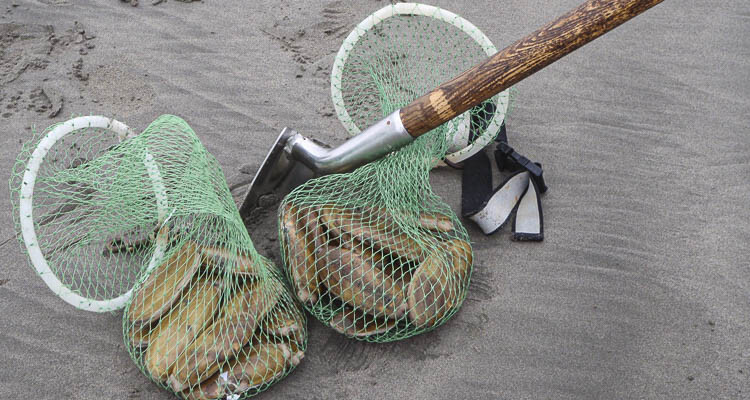
Additional digs planned for January and February
OLYMPIA – Razor clam diggers can look forward to more digging on coastal beaches beginning Jan. 9, Washington Department of Fish and Wildlife (WDFW) coastal shellfish managers confirmed today (Jan. 4).
“There was high surf during the last tide series of 2023, resulting in some difficult digging at times,” said Bryce Blumenthal, a WDFW coastal shellfish biologist. “Hopefully the start of 2024 brings better conditions and easier razor clam digging.”
Not all coastal beaches are open for every dig, so diggers are encouraged to make sure their intended destination is open before heading out. Optimal digging occurs between one and two hours before the listed time of low tide.
The following digs during afternoon and evening low tides (noon to midnight only) will proceed as scheduled, after marine toxin results from the Washington State Department of Health (DOH) showed razor clams are safe to eat:
- Jan. 9, Tuesday, 5:02 p.m.; -0.7 feet; Long Beach, Copalis
- Jan. 10, Wednesday, 5:46 p.m.; -1.2 feet; Long Beach, Twin Harbors, Mocrocks
- Jan. 11, Thursday, 6:28 p.m.; -1.5 feet; Long Beach, Twin Harbors, Mocrocks
- Jan. 12, Friday, 7:11 p.m.; -1.6 feet; Long Beach, Twin Harbors, Copalis
- Jan. 13, Saturday, 7:53 p.m.; -1.3 feet; Long Beach, Twin Harbors, Copalis
- Jan. 14, Sunday, 8:36 p.m.; -0.8 feet; Long Beach, Twin Harbors, Mocrocks
- Jan. 15, Monday, 9:19 p.m.; 0.0 feet; Mocrocks
The DOH requires test samples for marine toxins, and domoic acid levels must fall under the guideline level before a beach can open for digging. Domoic acid, a natural toxin produced by certain types of marine algae, can be harmful or fatal if consumed in sufficient quantities. Final approval usually occurs about a week or less – sometimes two to three days – before the start of each digging series. More information about domoic acid, as well as current levels at ocean beaches, can be found on the WDFW’s domoic acid webpage.
Additional tentative dates in January and February:
- Jan. 22, Monday, 4:28 p.m.; -0.1 feet; Mocrocks
- Jan. 23, Tuesday, 5:13 p.m.; -0.3 feet; Long Beach, Twin Harbors, Mocrocks
- Jan. 24, Wednesday, 5:53 p.m.; -0.4 feet; Long Beach, Twin Harbors, Copalis
- Jan. 25, Thursday, 6:28 p.m.; -0.4 feet; Long Beach, Twin Harbors, Copalis
- Jan. 26, Friday, 7:01 p.m.; -0.2 feet; Long Beach, Twin Harbors, Mocrocks
- Jan. 27, Saturday, 7:32 p.m.; 0.0 feet; Long Beach, Mocrocks
- Jan. 28, Sunday, 8:02 p.m.; 0.4 feet; Copalis
- Feb. 6, Tuesday, 3:52 p.m.; 0.0 feet; Mocrocks
- Feb. 7, Wednesday, 4:41 p.m.; -0.7 feet; Long Beach, Twin Harbors, Copalis
- Feb. 8, Thursday, 5:26 p.m.; -1.2 feet; Long Beach, Twin Harbors, Copalis
- Feb. 9, Friday, 6:09 p.m.; -1.4 feet; Long Beach, Twin Harbors, Mocrocks
- Feb. 10, Saturday, 6:49 p.m.; -1.4 feet; Long Beach, Twin Harbors, Mocrocks
- Feb. 11, Sunday, 7:29 p.m.; -1.0 feet; Long Beach, Twin Harbors, Copalis
- Feb. 12, Monday, 8:08 p.m.; -0.3 feet; Long Beach, Copalis
- Feb. 21, Wednesday, 4:56 p.m.; 0.2 feet; Long Beach, Twin Harbors, Mocrocks
- Feb. 22, Thursday, 5:33 p.m.; 0.1 feet; Long Beach, Twin Harbors, Mocrocks
- Feb. 23, Friday, 6:05 p.m.; 0.1 feet; Long Beach, Twin Harbors, Copalis
- Feb. 24, Saturday, 6:34 p.m.; 0.2 feet; Long Beach, Twin Harbors, Copalis
- Feb. 25, Sunday, 7:02 p.m.; 0.4 feet; Long Beach, Mocrocks
WDFW is accepting public comments on the alternative digging schedule change at Copalis and Mocrocks beaches during January and February. The public may email their feedback to razorclams@dfw.wa.gov.
On all open beaches, the daily limit is 15 clams per person. Each digger’s clams must be kept in a separate container, and all diggers must keep the first 15 clams they dig, regardless of size or condition, to prevent waste.
All diggers 15 or older must have an applicable fishing license to harvest razor clams on any beach. Licenses can be purchased from WDFW’s licensing website, and from hundreds of license vendors around the state. WDFW recommends buying your license before visiting coastal beach communities. Additional razor clam information is available on the WDFW razor clam webpage.
The Washington Department of Fish and Wildlife works to preserve, protect, and perpetuate fish, wildlife and ecosystems while providing sustainable fish and wildlife recreational and commercial opportunities.
Also read:
- WA Gov. Ferguson to meet with NBA commissioner as hopes rise for Sonics’ return
 The meeting this week comes before a vote that could clear the way for the league’s expansion to Seattle Jake Goldstein-StreetWashington State Standard Washington Gov. Bob Ferguson on Thursday previewed an upcoming meeting with NBA Commissioner Adam Silver ahead of a planned vote on league expansion that could bring men’s professional basketball back to Seattle. …
 - Plenty of NBA connections expected in town Sunday for Vancouver Bears game
 Former NBA stars Gary Payton and Robert Pack will coach opposite each other when the SuperHawks visit the undefeated Vancouver Bears in a marquee USBL matchup.
 - State’s umpire-in-chief goes on recruiting trip in his final season as a baseball umpire
 Tim Stevens is spending his last season traveling to every Washington umpire association, working to address the shortage of officials and encourage young people to join the ranks.
 - Clark County Baseball presents Baseballism Kickoff this week with action all over the region
 Thirty-six teams from across the Northwest, including two state champs, are competing in free high school baseball tournaments at local turf fields in Vancouver, Camas, and Ridgefield.
 - The Study of Sports Podcast March 13, 2026: We discuss the state basketball tournaments, the incredible run from Columbia River boys, the state placing for Evergreen girls, and more
 Reporter Paul Valencia and sports administrators Tony Liberatore and Cale Piland discuss a series of subjects around the WIAA’s state basketball tournaments, plus we get into some Mariners baseball talk and NFL free agency/trade cancellations
