


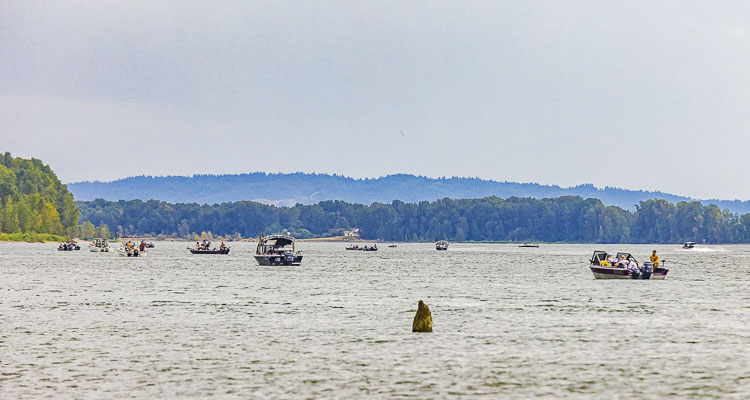
The river was closed to recreational salmon fishing below Bonneville Dam in early September due to concern over impacts to lower Columbia River “tule” Chinook salmon
OLYMPIA – The popular Buoy 10 fishery at the mouth of the Columbia River will reopen for hatchery coho salmon fishing beginning Sept. 15, while another section of the lower river will reopen for Chinook and hatchery coho on the same day, fishery managers from Washington and Oregon announced Tuesday.
The river was closed to recreational salmon fishing below Bonneville Dam in early September due to concern over impacts to lower Columbia River “tule” Chinook salmon, which are listed as threatened under the Endangered Species Act (ESA). Managers with the Washington Department of Fish and Wildlife (WDFW) and Oregon Department of Fish and Wildlife agreed that due to the migratory path and timing of these Chinook, some recreational fishing could resume with minimal additional impacts to ESA-listed fish.
“We believe this two-week closure accomplished its goal, which was to prevent any additional lower-river tule impacts to the recreational fishery,” said Ryan Lothrop, Columbia River fisheries manager with WDFW. “The coho run appears to still be coming in strong, and we hope anglers get out and take part in what should be some good fishing during the second half of September and into October.”
So far this fall, nearly 399,000 adult Chinook and 70,000 adult coho bound for the upper regions of the Columbia have passed over Bonneville Dam.
The section of the Columbia River from Buoy 10 to the Rocky Point/Tongue Point line will open for retention of hatchery coho beginning Thursday (Sept. 15), with an adult daily limit of three hatchery coho. Anglers must release all salmon and steelhead other than hatchery coho.
Also on Sept. 15, a section of river from the eastern tip of Reed Island to Bonneville Dam will open for retention of Chinook and hatchery coho, with an adult daily limit of two salmon, only one of which may be an adult Chinook. Anglers must release wild coho. To see all regulations and a map of the boundary line from the eastern tip of Reed Island, visit WDFW’s emergency fishing and shellfishing rules webpage.
The section of river from the Rocky Point/Tongue Point line to the East Reed Island boundary, including Camas Slough, remains closed to salmon fishing.
As always, anglers should be sure to check the 2022-23 Washington Sport Fishing Rules pamphlet to see permanent regulations for the section of river where they hope to fish, as well as WDFW’s emergency rules webpage for updates to this and other fisheries across the state.
The Washington Department of Fish and Wildlife works to preserve, protect, and perpetuate fish, wildlife and ecosystems while providing sustainable fish, wildlife, and recreational and commercial opportunities.
Also read:
- Opinion: Were Republican voters just sleeping during the August primary election?
 CCRP Chairman Matt Bumala says 60% of primary no-shows in the 17th and 18th districts were Republicans.
 - High school football: New coach prepares for long-term success at Prairie High School
 James Young-Lewis, a Clark County native who graduated from Evergreen in 2009, became Prairie’s head coach in May after working as an assistant coach across various programs since 2015, joining Prairie’s staff in 2024.
 - Cost to battle 20 wildfires in WA has topped $200M
 Twenty wildfires have cost Washington $207M in one month, more than two-thirds of what DNR spent all last fiscal year.
 - Opinion: WA Cares’ launch showcased care WA Cares did not provide
 Gov. Ferguson showcased a caregiving arrangement at the WA Cares launch that the program had not paid for a single day of.
 - Former State Rep. Liz Pike provides update on husband Neil Cahoon
 Neil Cahoon, a Camas resident, has undergone multiple surgeries including five on Aug. 15 after the Aug. 10 crash near La Center’s Daybreak Airport.
 - Opinion: Portland’s War on Cars Part 4 – A smarter automobile strategy to end gridlock
 O’Toole argues fuel wasted in Portland-area congestion has sextupled since 1982, generating 250,000 tons of extra greenhouse gases annually.
 - $1,000 first prize for Camas Plein Air Art Event honoring Marquita Call on Sept. 26
 Plein air artists compete Sept. 26 in Camas for $1,000 first prize honoring gallery founder Marquita Call.