



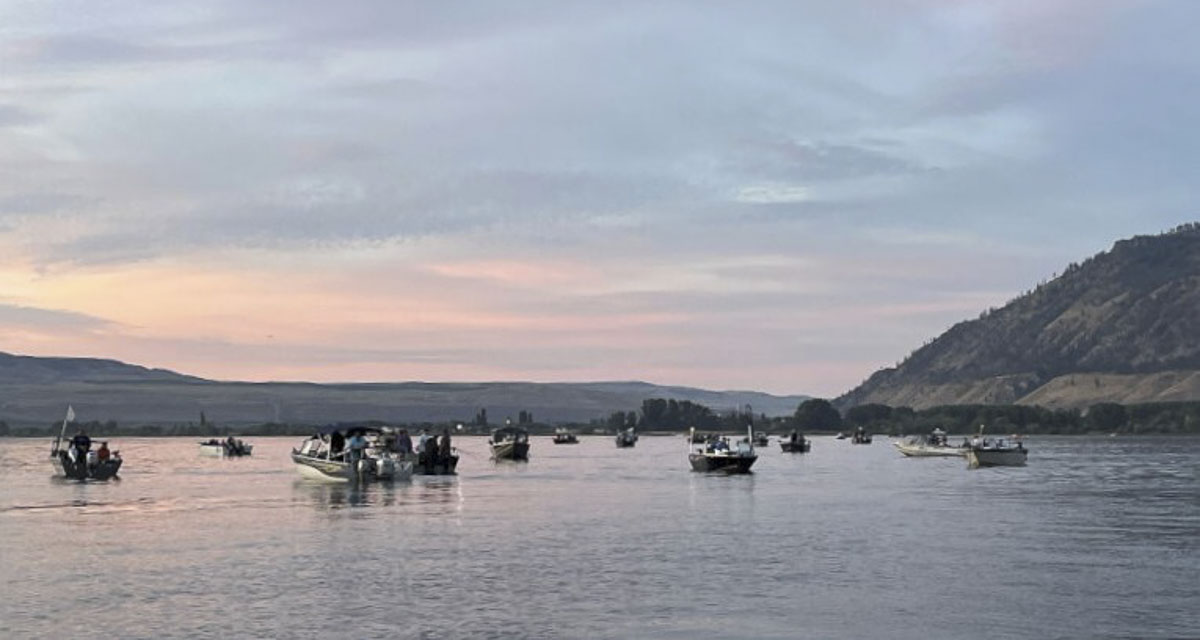
The endorsement requirement applies to more than 50 rivers, lakes, and other waters
OLYMPIA – Beginning Jan. 1, all anglers age 15 and older must buy a Columbia River salmon and steelhead endorsement (CRSSE) to fish recreationally for salmon and steelhead in the Columbia River and many of its Washington tributaries. The endorsement requirement applies to more than 50 rivers, lakes, and other waters, with a full list of affected waters available on the Washington Department of Fish and Wildlife (WDFW) website.
Fish and Wildlife Officers may check anglers at these locations to confirm CRSSE compliance. Officers will be using discretion when appropriate and educating anglers about the newly implemented endorsement requirement.
“This reinstated endorsement mirrors the program anglers were familiar with before 2019,” said Kelly Cunningham, WDFW fish program director. “Revenue from the fee is dedicated exclusively to Columbia River salmon and steelhead fisheries by state law and cannot be diverted elsewhere.”
The original CRSSE was enacted by the Washington State Legislature in 2009 and was in effect through 2019. The Legislature reinstated the CRSSE in 2025, helping to offset funding reductions to Columbia River fisheries work amid the state’s budget shortfall. Fees collected from the endorsement will be placed into the Columbia River recreational salmon and steelhead endorsement program account. Expenditures from this account may only be used to facilitate recreational salmon and steelhead fishing opportunities on the Columbia River and its Washington tributaries.
The total cost of the endorsement is $8.75 for resident and non-resident anglers 16 years old and older. The endorsement fee is $7.10 for 15-year-olds and resident seniors 70 years and older. Anglers can buy the CRSSE anywhere fishing licenses are sold – online, by phone, or at hundreds of license vendors statewide. Refer to the WDFW website to learn more about buying the CRSSE.
Endorsements purchased prior to March 31, 2026, are valid through the 2025-26 license year. Anglers will need to buy a new endorsement for the 2026-27 license year after April 1, 2026.
Licensed anglers fishing in the Columbia River or its Washington tributaries who are targeting species other than salmon or steelhead (e.g., sturgeon, trout, shad, walleye, or bass) do not need the CRSSE.
The Washington Department of Fish and Wildlife works to preserve, protect and perpetuate fish, wildlife and ecosystems while providing sustainable fish and wildlife recreational and commercial opportunities.
Also read:
- White House govt. Funding request for 2027 cuts $73 billion
 President Trump’s budget seeks to boost defense funding while cutting $73 billion from agencies like the EPA, NASA, and Agriculture, prompting sharp criticism from Democratic leaders.
 - Heywood asks WA Supreme Court to allow referendum effort on income tax
 Brian Heywood is petitioning the state Supreme Court after the Secretary of State rejected a referendum to repeal Washington’s new 9.9% tax on income over $1 million.
 - Opinion: Half the road, full stop – Understanding pedestrian right-of-way
 Doug Dahl explains how Washington’s law requires drivers to stop when a pedestrian is within one lane of their half of the road, not just when directly in front.
 - Clark County seeks volunteer for Law and Justice Council
 Applicants with experience in mental health services are encouraged to help guide Clark County’s coordination of local criminal justice and corrections planning.
 - VIDEO: Families at center of WA transgender sports debate face-to-face with OSPI
 Two Washington high school students and their parents met with Superintendent Chris Reykdal to discuss concerns about sports policies after one student faced an investigation for harassment.
 - As Washington lawmakers punt on school cellphone ban, some want more action
 At Robert Eagle Staff Middle School, all-day phone removal led to fewer conflicts and more student engagement, but some parents and lawmakers argue a ban should not be imposed statewide.
 - Opinion: The state’s RFK-proofing bill comes with a cost
 Mandates like HB 2242 can lead to higher premiums as insurance companies absorb costs for new preventive services, affecting affordability statewide.
