



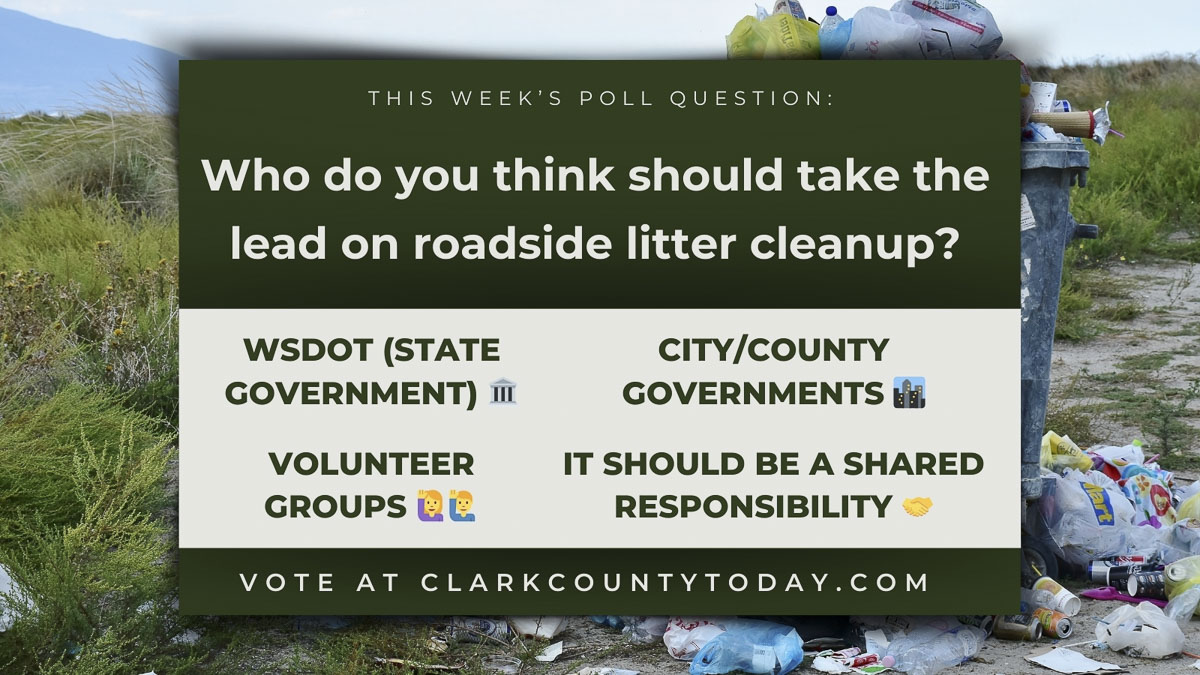
As litter continues to pile up along Clark County’s freeways and state routes, frustration is growing among residents. While the Washington State Department of Transportation (WSDOT) says it’s working to address the issue, limited budgets and staffing make cleanup a challenge. Some say it’s the state’s job, others think local governments or volunteers should step in. What do you think?
More info:
WSDOT responds to complaints about litter along area freeways, highways
WSDOT responds to litter complaints, citing budget and safety concerns in cleanup delays.
Read more
Also read:
- Opinion: ‘If they want light rail, they should be the ones who pay for it’
 Clark County Today Editor Ken Vance argues that supporters of light rail tied to the I-5 Bridge replacement should bear the local cost of operating and maintaining the system through a narrowly drawn sub-district.
 - Opinion: IBR falsely blaming inflation
 Joe Cortright argues that inflation explains only a small portion of the IBR project’s cost increases and that rising consultant and staff expenses are the primary drivers.
 - Letter: The Interstate Bridge Replacement Program’s $141 million bribe can be better spent on sandwich steel-concrete tubes
 Bob Ortblad argues that an immersed tunnel using sandwich steel-concrete tubes would be a more cost-effective alternative to the current Interstate Bridge Replacement Program design.
 - A sub-district vote could be a way to go to pay O&M costs associated with light rail
 Clark County Council members heard details on how a voter-approved C-TRAN sub-district could be created to fund long-term operations and maintenance costs for light rail tied to a new Interstate Bridge.
 - Letter: British Columbia’s new immersed tunnel can solve Interstate Bridge Replacement Program’s $17.7 billion problem
 Bob Ortblad argues that an immersed tunnel similar to a project underway in British Columbia could significantly reduce costs and impacts associated with the Interstate Bridge Replacement Program.

Are their fines for littering? What is the status of the bottle bill to deter people from tossing out cans and bottles out the window? An Ounce of prevention is worth a pound of cure.
Wonder why this issue is so difficult for our state to manage. A recent trip through Tennessee, Georgia, and Florida found the roads spotless, smooth, shoulders were neatly landscaped and maintained and very nice rest areas. It’s disappointing.
the state should take care of the highways, the county take care of their roads and the city take care of theirs. put crews working off fines back out doing it like was done for years and please don’t say it’s degrading to make people got out to pick up roadside trash.
Washington state , counties and cities need to have inmates , and work crews back out on the roads cleaning up like they use to. Community service for people paying off their fines . As tax payers we deserve the right to live in a community we can be proud of not the trash pit it has become.
Anyone take a good look at your property tax bill this year? More and more taxes are being taken out of your pocket by whom? The State and local governments. Letting them get off on picking up roadside trash is just another way to allow decay in our communities. Inmates and I would suggest kids who are expelled from school can do community service. But wait, I bet they have rights too? Then lower our taxes if you’re not going to provide service Washington State and local govts.
Litter, one BIG problem. I worked for WA State Fish and Wildlife Police for 35 years retiring here in Clark County February 1998. Besides the fish and wildlife arrests and citations over the years, one of the most satisfying citations was for littering. During the heat of the summer a person throwing a lighted cigarette out the window was a $500 citation. The bail was high to get the offender before the judge. Throwing beverage bottles or cans out of a boat was another favorite citation. However, on WDFW lands like Shillapoo Access off of LaFrambois Rd in Vancouver, I would have a Reserve Deputy with me. We parked in a farmer’s driveway along the access road, usually after 10PM. We watched for pickup trucks taking a load of garbage, to dump on the access to avoid fees at the county garbage center on Lower River Road. We would have activity any night of the week. We would follow the suspect vehicle down to the boat launch where the driver and helper would usually stop. We would watch (night goggles) them unload. We would stop them coming out. We would issue criminal citations to each ($500 bail) and require them to clean it up. Occasionally a warrant hit would come back from WSP dispatch and we would “cuff up the one with the warrant” and book him into the jail. If the offender was by himself (seldom) his vehicle would be towed and he would have to come back and clean it up. Littering is a DIRTY habit. Each agency has to take responsibility. The problem – not enough law enforcement officers to enforce litter laws in any jurisdiction. AND now we have the homeless camps and the resulting garbage.