



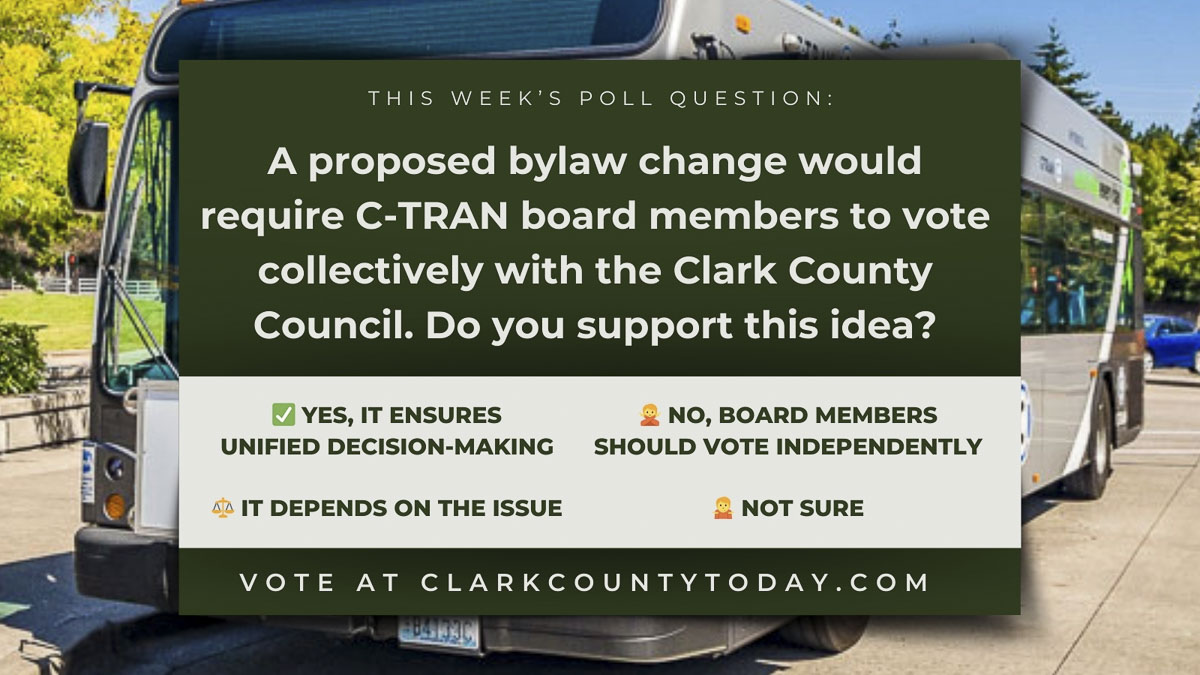
This week’s poll dives into a major debate surrounding the C-TRAN Board of Directors. Clark County Council recently removed Michelle Belkot from the board after she refused to align with the council’s stance on light rail funding. Now, a proposed bylaw change could require board members to vote collectively with the council, potentially limiting independent decision-making. Supporters argue that a unified vote ensures consistency and accountability, while critics say it strips board members of the ability to represent their constituents. What do you think? Should C-TRAN board members be required to vote as a bloc, or should they maintain their independence? Cast your vote and let us know your thoughts!
More info:
Michelle Belkot speaks out after Clark County Council kicks her off C-TRAN board

Clark County Council removed Michelle Belkot from the C-TRAN Board of Directors after she opposed funding light rail operations and maintenance.
Read more

Also read:
- Opinion: Passing a cyclist – Law, myth and a little patience
 Most drivers can’t legally pass cyclists in-lane due to vehicle width versus road measurements.
 - Opinion: The path to real tax reform requires a spending limit
 Washington Policy Center director argues constitutional spending caps would force real budget tradeoffs instead of endless tax increases.
 - Opinion: ‘Both states know they have seriously flawed voter registration’
 Lars Larson argues Oregon and Washington are suing DOJ to avoid cleaning up fraudulent voter rolls before elections.
 - Letter: Compassion without accountability is failing Clark County
 Sarah Mittelman calls for clear standards and measurable results in homelessness spending.
 - Letter: ‘This is the worst thing that ever happened to the region’
 A Hayden Island resident Sam Churchill is criticized in a letter calling the $14 billion Interstate Bridge Replacement project a “boondoggle” that destroys local businesses.
 wpDiscuz
