



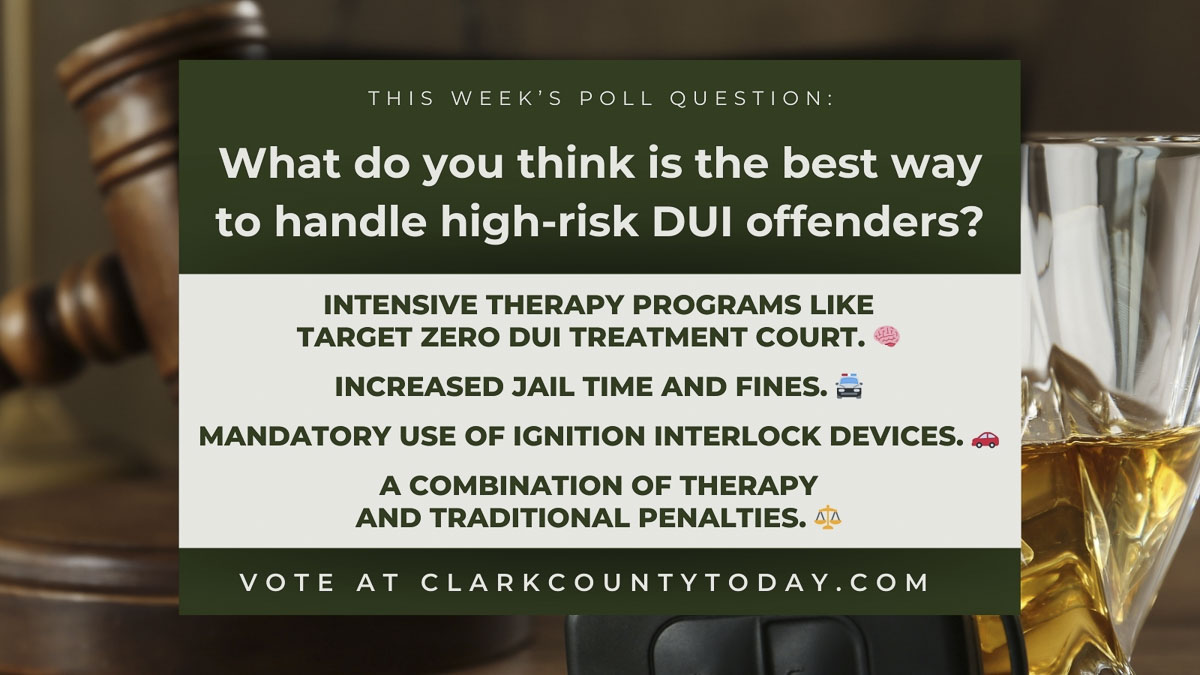
This week’s poll focuses on exploring the best ways to handle high-risk DUI offenders. As detailed in our recent story, the Target Zero DUI Treatment Court is one of the intensive therapy programs designed to address the root causes of dangerous driving behaviors. However, there are other methods to consider, such as increased jail time and fines or mandatory ignition interlock devices to prevent repeat offenses. Some believe that a combination of therapy and traditional penalties might be the most effective solution. We want to hear your thoughts—cast your vote and let us know what you think could best reduce DUI incidents and make our roads safer!
Read more about these approaches in the two-part story here:
Target Zero: DUI Treatment Court provides intense therapy for high-risk offenders

Clark County's DUI Treatment Court offers intensive therapy to high-risk offenders.
Read more
Vancouver man turns his life around, with help from DUI Treatment Court

Vancouver man Mack White turns his life around through Clark County's DUI Treatment Court.
Read more

Also read:
- Opinion: Someone explain the Democrat Party to me please
 Lars Larson criticizes Democrat politicians for shutdown threats, Homeland Security funding refusals, and positions on election laws, housing, and gun rights.
 - POLL: Do you agree with requiring board members to follow council direction?
 Disagreement among county councilors centers on whether C-TRAN board members should reflect the council’s collective wishes or act independently, highlighting ongoing concerns about public accountability.
 - Opinion: In plain sight – yielding to pedestrians
 Drivers often fail to see pedestrians due to inattentional blindness, which highlights the need for more focused awareness at intersections and stronger safety practices.
 - Opinion: The legislature has committed $2.4 billion to recurring pension increases since 2018
 Six legislative COLAs have raised public employer costs by $2.38 billion since 2018, driving up unfunded pension liabilities and increasing burdens on county and city budgets.
 - Opinion: ‘Just because they got away with it doesn’t mean they weren’t wrong’
 A Skamania County deputy’s report found violations of county rules and the Open Public Meetings Act, but no prosecutor acted on the findings.
 wpDiscuz
