



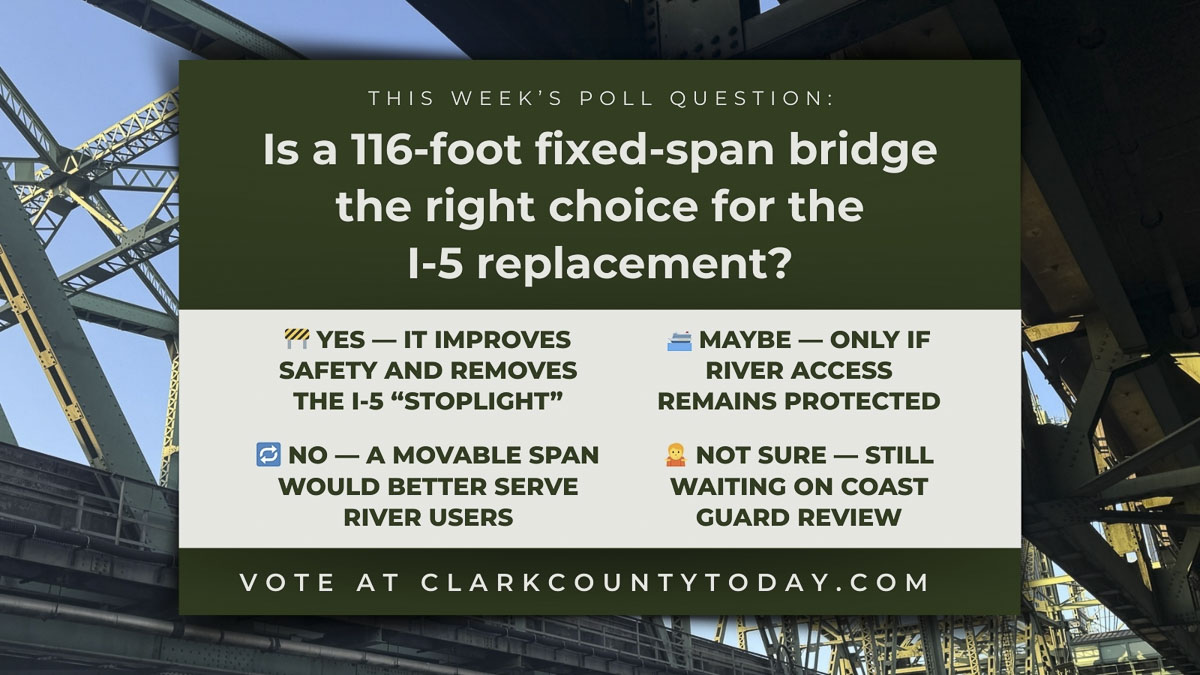
New agreements with affected river users move the I-5 Bridge project closer to a fixed-span design, raising questions about whether 116 feet of clearance is the right solution
Oregon and Washington transportation officials have signed agreements with the four river users identified as impacted by the proposed 116-foot fixed-span I-5 Bridge replacement, clearing a major hurdle as the project heads to the U.S. Coast Guard for review. Supporters say the taller fixed span would eliminate the only “stoplight” on I-5 between Canada and Mexico, improve reliability, and avoid the higher construction and long-term maintenance costs associated with a movable bridge. The agreements — totaling $140 million, paid only if the Coast Guard approves the design and construction begins — are intended to address economic impacts to river users and demonstrate project readiness. With the Coast Guard’s decision expected in early 2026, this week’s poll asks: is a 116-foot fixed span the right choice for the I-5 replacement?
More info:
Agreements reached with four river users identified as impacted by proposed I-5 Bridge replacement
Also read:
- VIDEO: WA diesel hits record $6.53, crushing truckers and school budgets
 With diesel nearing $6.53 per gallon in Washington, trucking businesses and school districts now confront sharply higher fuel expenses affecting budgets and workers.
 - Opinion: In plain sight – yielding to pedestrians
 Drivers often fail to see pedestrians due to inattentional blindness, which highlights the need for more focused awareness at intersections and stronger safety practices.
 - Expect delays on SR 14 in Vancouver for guardrail repairs Wednesday
 State Route 14 travelers in Vancouver should plan for morning delays as WSDOT will close two eastbound lanes for guardrail repairs, affecting mileposts 6.0 to 7.0.
 - Overnight closure planned on westbound SR 14 Camas Slough Bridge Tuesday
 WSDOT crews will close westbound SR 14 at Exit 14 in Camas to collect bridge deck samples and plan future repairs; detours will be in effect.
 - Opinion: Stay in your lane – seriously, it’s the law
 Drivers must choose the nearest lane when turning in Washington, and left turns bring added risk. Even with signals, every driver must help prevent crashes by following law.
