



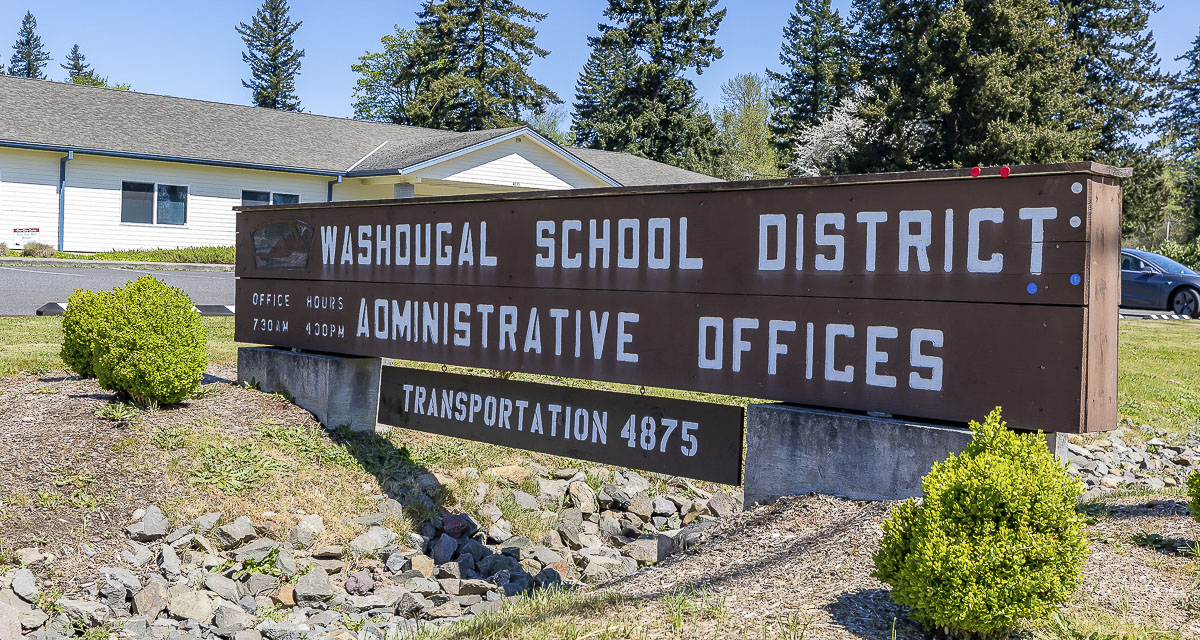
Clark County resident Dick Rylander offers his insight on the Washougal School District levy requests in the upcoming Feb. 10 special election
Dick Rylander
for Clark County Today
 See Grok’s analysis of this story
Until a year ago anyone could write the pro/con on a school board levy or bond if no one in the district volunteered to write one of the positions. The Democrats in the Washington State Legislature decided it was better to have nothing written rather than let someone outside the district step up.

It’s important to look at both sides of levies. So, if you were going to consider voting NO why might you do that? I offer the following information for your consideration. Whether you vote yes or no please take the time to vote. Let’s start with the last 3-year levy report we published so you have a historical perspective: https://swweducation.org/washoughal-school-district-levys-round-2-april-2023/
These special levies are run in February for several reasons. First, if a levy fails the school board can come back to the public a total of two times. If the levy(s) fail in February, April almost always becomes the second effort date. Why Feb and April? The district must notify the unions by mid May if they plan on RIFs (Reduction in Force). The annual school budget must be in place before school starts in the Fall so time is tight. Because it’s a special election many people don’t pay attention leading to a low turnout rate which favors the Pro or “Yes” voters.
Let’s first look at the previous levies. It was for three years (2023-2024-2025). Two levies? Yes. One is called the EP&O Levy (Educational Programs & Operations ) which is intended mostly for operations (upkeep) and paying for things the state doesn’t cover or provides less than the district thinks it needs. The majority goes to personnel. The last three-year levy was $31 million. The other levy is called a “Capital Levy” and is being billed for “Tech” use. The expiring Tech Levy was $9,050,000 (which was a 246% increase from the previous three-year levy).
The new three-year EP&O Levy is $32,439,972 which is an increase of $1,439,972. The new Capital Tech Levy is $10,312,341 which is an increase of $1,262,341. The combined increases are $2,702,313.
They say that these are “replacement” levies but how can they be if there are increases? Why not just come out and say there are increases … unless … they are hoping to distract voters?
So how is the district delivering quality education? We turned to the OSPI (State Superintendent) website. Here’s a link to the data reported: https://reportcard.ospi.k12.wa.us/ReportCard/ViewSchoolOrDistrict/100286 It’s important to understand that OSPI changed how it reports data in this past year. Basically they used to say a Level 3 was passing. Now they use Level 2 to try and claim students are doing better. This is a massive re-write because so many students are failing they need to misdirect voters.
What does the OSPI data show in its “re-write”?
Headcount has fallen over the past 10 years: They are down 448 students in the past 10 years. At a teacher to student ratio of 1:20 they need 22 fewer teachers. [The state reported ratio is actually 1:16] They get a little over $12,000 per student per year from the state which means they have lost over $5,376,000 dollars which they need to make up from? Taxpayers?
Here’s a link to the newest salary data (which is at least 2 years out of date). Choose your district: https://fiscal.wa.gov/K12/K12Salaries
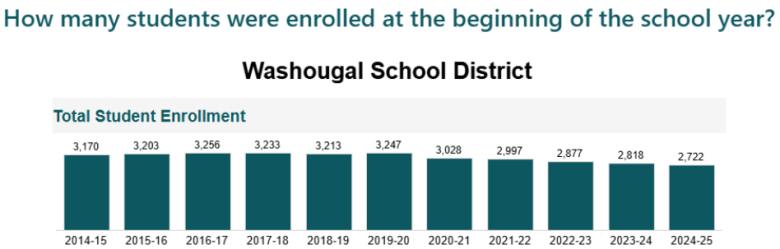
Absences have increased…why?
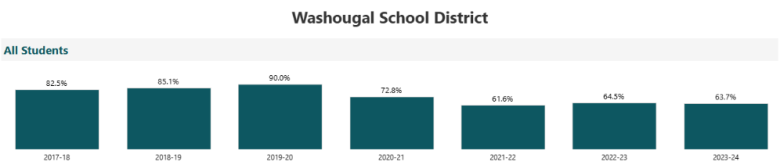
Spending per student is among the highest in Southwest Washington (two year old data):
Please take the time to look at the State and National 4th and 8th grade test results data. You may have significant questions and concerns. Note: Level 2 was previously below expectations but has now been added to Level 3 and 4 to make the numbers look better.
Finally, here is a link to a website that contains virtually every data point reported by OSPI. You can dig in as much as you want and come to your own conclusions: https://schooldataproject.com/washougal%20school%20district
You be the judge. DEI? Trans sports? Pronouns? Is it time to get back to basic learning? Ask questions of the district leadership and school board. Are you getting what you expect? The amount of money spent per student is passing $20,000/year in Washington State and has doubled in the last 10 years. 52% of our property taxes go to schools. How much more and will it ever be enough?
Either raise all money locally from levies and bonds or provide all money from what the State collects. Local means more control. State funded means no local control. Splitting, as it is now, doesn’t solve the problem.
What’s the estimated cost to the district to run this ballot?
The estimated cost per school district for the February 2026 Special Election is below:
- Battle Ground School District – approximate allocated cost is between $210,000-230,000.
- Hockinson School District – approximate allocated cost is between $25,000-35,000.
- Washougal School District – approximate allocated cost is between $ 60,000-70,000.

This independent analysis was created with Grok, an AI model from xAI. It is not written or edited by ClarkCountyToday.com and is provided to help readers evaluate the article’s sourcing and context.
Quick summary
In this opinion column, Clark County resident Dick Rylander argues against voting “yes” on Washougal School District’s Feb. 10, 2026 special‑election levies. He highlights proposed increases of about $1.4 million for the Educational Programs & Operations levy and about $1.3 million for the Technology Capital levy, and he connects those requests to concerns about declining enrollment, high per‑student spending, and academic performance measures he attributes to OSPI data.
What Grok notices
- Breaks down the two levy proposals by purpose and dollar amounts and compares the current request with prior levy levels to support the argument that the district is seeking meaningful increases.
- Links its critique to publicly available data sources, including OSPI‑related metrics on enrollment trends and academic performance, encouraging readers to verify the figures independently.
- Discusses special‑election timing and the cost of holding the election (estimated in the column at roughly $60,000–$70,000), arguing that lower‑turnout elections can affect outcomes.
- Directs readers to a “School Data Project” site (as described) for broader district metrics beyond the highlights emphasized in the column.
- Reflects the author’s framing that voters should evaluate “value for tax dollars,” including how state funding and local levy requests interact with rising costs and enrollment changes.
Questions worth asking
- If approved, how would the proposed levy funds be allocated to address specific gaps in student proficiency, and what measurable targets would the district use?
- How is community input incorporated into district budget priorities, and what changes (if any) could be made to increase transparency around levy spending?
- If one or both levies fail, what specific staffing, class, or program impacts would be expected, and what contingency plans exist?
- In comparable districts, what evidence exists that prior levy increases led to improved academic outcomes, technology readiness, or operational stability?
- What policy changes—state or local—could increase local control or clarity over how education funding decisions are made and communicated to voters?
Research this topic more
- Office of Superintendent of Public Instruction – district finance, enrollment, and performance reports
- Washington State Legislature – RCW statutes governing school levies and local funding
- Washington State School Directors’ Association – levy guidance and election resources
- Washington Education Association – background on education funding and levies
- Fiscal.WA.gov – K‑12 expenditure data and dashboards

Also read:
- Opinion: Defend bail now or face more chaos on our streets
 A proposed Washington court rule would cap bail for most misdemeanors and allow defendants to bypass bondsmen, raising concerns about accountability and public safety.
 - Opinion: Someone explain the Democrat Party to me please
 Lars Larson criticizes Democrat politicians for shutdown threats, Homeland Security funding refusals, and positions on election laws, housing, and gun rights.
 - POLL: Do you agree with requiring board members to follow council direction?
 Disagreement among county councilors centers on whether C-TRAN board members should reflect the council’s collective wishes or act independently, highlighting ongoing concerns about public accountability.
 - Opinion: In plain sight – yielding to pedestrians
 Drivers often fail to see pedestrians due to inattentional blindness, which highlights the need for more focused awareness at intersections and stronger safety practices.
 - Opinion: The legislature has committed $2.4 billion to recurring pension increases since 2018
 Six legislative COLAs have raised public employer costs by $2.38 billion since 2018, driving up unfunded pension liabilities and increasing burdens on county and city budgets.
 wpDiscuz
