



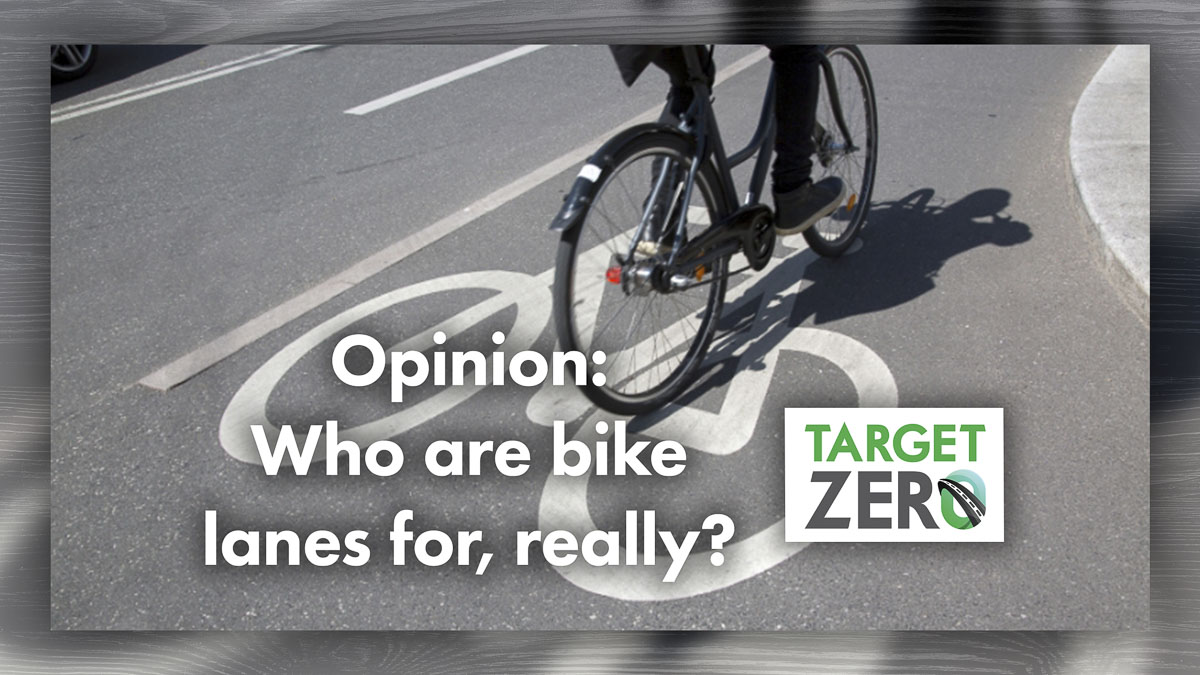
Doug Dahl discusses the rules on what bike lanes can be used for
Doug Dahl
The Wise Drive
Q: What are the rules on what bike lanes can be used for? I’ve scoured state and local codes and can find no mention of this. Surely, they are reserved at least to some degree for bikes.
A: Obviously, you can’t drive in a bike lane, right? That would defeat the whole point of having them. But where does the law say that? You’d think there would be a law in the traffic code that says, “Don’t drive in the bike lanes.” If there is, I couldn’t find it. But it must be on the books somewhere, because the Washington Driver Guide says it’s not allowed: “Do not drive in a bicycle lane except when making a turn or when you need to cross the bicycle lane to park near the curb.”

Locally, some cities in Washington have local laws prohibiting driving in bike lanes. In Seattle’s traffic code you’ll find, “The operator of a motor vehicle shall not drive in a bicycle lane except to execute a turning maneuver, yielding to all persons riding bicycles thereon.” I’ll note that violating this law is a traffic infraction. That’ll be important in a minute.
Washington’s traffic code does have a law that prohibits riding a moped on a bike path, so it seems reasonable to infer that other motorized vehicles would also be prohibited. And the Rules of the Road at least acknowledge that there are “parts of roadways set aside for the exclusive use of bicycles.”
But oddly, if we search outside the traffic code we’ll find what we’re looking for. In RCW Title 35, which is mostly about municipal budgets and infrastructure, there’s a law, originally from 1899, that says, “It shall be unlawful for any person to lead, drive, ride, or propel any team, wagon, animal, or vehicle other than a bicycle, electric personal assistive mobility device, or similar vehicle upon and along any bicycle path.” (The electric part was added in 2002.)
The motivation for this law 125 years ago wasn’t protecting cyclists from cars (at least as we know them today). Cars were barely a consideration in 1899. That year, US car manufacturers produced a total of only 2500 vehicles, and these cars had a top speed of somewhere around 12 mph.
Maybe you’re wondering if this law is still relevant, given its origins. Based on more recent action by our legislators, I’d say it is. Their addition of the electric personal assistive mobility device (EPAMD) as an allowed vehicle signals that it still applies to modern bike lanes. (By the way, an EPAMD is essentially a Hoverboard or Onewheel.) I’ll add that most comparable traffic violations are civil infractions (Like Seattle’s law), but this one is a crime. Ouch.
Drivers don’t belong in bike lanes, but can anyone else use them? The law allows vehicles that are “similar” to bikes and EPAMDs. I don’t know how broad a net the word “similar” casts; I’m guessing it may include human-powered and electric vehicles of comparable size and speed. The law I mentioned earlier that prohibits mopeds does allow electric bikes and motorized foot scooters in bike lanes, with some limitations.
How about pedestrians? Maybe, again with limitations. Pedestrians are allowed to walk in the roadway when there are no sidewalks or shoulders, with a requirement that they’re “as near as is practicable to the outside edge of the roadway facing traffic,” which is where the bike lane is. Realistically though, do any roads without sidewalks and shoulders have a bike lane?
To sum it up, bike lanes are for bikes (and similar vehicles).
The Wise Drive is hosted by Doug Dahl, a Target Zero manager for the Washington Traffic Safety Commission.

Also read:
- Opinion: Sheriffs fight back
 Four county sheriffs are suing to block a new law giving a governor-appointed board power to decertify and remove sheriffs, bypassing voter oversight in Washington.
 - Opinion: The growing gap between public voice and political power
 Todd Myers describes how large-scale protest and sign-ins often fail to sway state leaders, and argues authentic influence is most likely found through local action.
 - Opinion: Who is winning the race for affordable power?
 Hydroelectric power keeps Washington competitive, but new laws and carbon pricing are driving up electricity costs for residents each year.
 - Opinion: Half the road, full stop – Understanding pedestrian right-of-way
 Doug Dahl explains how Washington’s law requires drivers to stop when a pedestrian is within one lane of their half of the road, not just when directly in front.
 - Opinion: The state’s RFK-proofing bill comes with a cost
 Mandates like HB 2242 can lead to higher premiums as insurance companies absorb costs for new preventive services, affecting affordability statewide.
