



Paul Guppy of the Washington Policy Center says ‘thanks to the Supreme Court, citizens will no longer be required to politely bow in deference to obscure alphabet agencies run by nameless government bureaucrats’
Paul Guppy
Washington Policy Center
The Loper family own Loper Bright Enterprises, a modest New England-based fishing business. They pursue the same dream shared by many Americans – to provide their customers with quality service at a fair price while making a good living.

Recently, however, the bureaucrats at the National Marine Fisheries Service had other ideas. The agency’s budget was tight, so they decided to make the Lopers, along with similar family-owned businesses, pay for a government on-board inspector by charging them $710 a day.
When the Lopers protested the bureaucrats at NMFS had a pat answer. They claimed that when Congress passed the Magnuson-Stevens Fisheries Conservation and Management Act the bill said nothing about on-board government inspectors or making private companies pay for them.
Since the law was “vague” (that is, completely silent) on the matter agency officials said they could insert their own interpretation. Marine Fisheries also cited the U.S. Supreme Court’s 1984 Chevron decision, which said the courts, the Lopers and all other Americans must show “deference” to the agency and accept without question its interpretation of the law.
Since then supporters of freedom and representative democracy have pushed to get the “Chevron deference” rule overturned, so that Congress, not agency bureaucrats, decide what the law says, and that courts, not agency bureaucrats, settle any questions about interpretation.
On June 28th that day came. In Loper Bright Enterprises v. Raimondo et al. the Supreme Court in a 6 – 3 decision corrected the mistake it made in 1984. In response to criticism that the reversal violated stare decisis, the idea that past decisions shouldn’t be disrupted, Chief Justice Roberts noted that application of “Chevron deference” had been continuously altered by subsequent cases, government agencies had cited it more than 18,000 times, and had become completely unworkable.
The three dissenting justices argued that Chevron should be upheld because agency rules should “reflect what Congress would want…” But that’s just the problem. Voters don’t want unelected bureaucrats to guess what Congress might want. (And this assumes that bureaucrats act in good faith and don’t have their own agendas, which of course they often do.) Voters want government agencies to carry out honestly what Congress directed clearly in the law, and if the law is not clear it’s up to Congress to fix it.
Further, defenders of Chevron act as if Congress isn’t in on the game. Over the last 40 years it has simply been too tempting for politicians to pass intentionally vague laws, knowing their ideological buddies in the agencies will enforce tough, unpopular rules, like banning natural gas stoves. Then members of Congress can plausibly tell voters they had nothing to do with it.
Last week’s Loper decision puts an end to all that. Now Congress must pass clear, direct legislation and be accountable to the public for it. And when regulators arbitrarily go beyond the law to infringe on the right to run a business, own property, speak freely, own a firearm, build a home, earn a living or exercise other basic freedoms, citizens can seek justice in the courts.
That’s a victory for representative democracy. Thanks to the Supreme Court, citizens will no longer be required to politely bow in “deference” to obscure alphabet agencies run by nameless government bureaucrats.
Paul Guppy is a senior researcher at the Washington Policy Center.

Also read:
- Opinion: Were Republican voters just sleeping during the August primary election?
 CCRP Chairman Matt Bumala says 60% of primary no-shows in the 17th and 18th districts were Republicans.
 - Opinion: WA Cares’ launch showcased care WA Cares did not provide
 Gov. Ferguson showcased a caregiving arrangement at the WA Cares launch that the program had not paid for a single day of.
 - Opinion: Portland’s War on Cars Part 4 – A smarter automobile strategy to end gridlock
 O’Toole argues fuel wasted in Portland-area congestion has sextupled since 1982, generating 250,000 tons of extra greenhouse gases annually.
 - Opinion: The Tooth Fairy’s secrets to making brushing & flossing magical
 Delta Dental of Washington’s Tooth Fairy Experience offers free resources to help children build lifelong brushing and flossing habits.
 - Opinion: Transit ridership trends are dismal but regional plans are oblivious
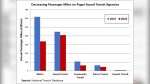 Puget Sound transit passenger-miles fell 31% from 2015 to 2024 despite a half-million-resident population increase.