



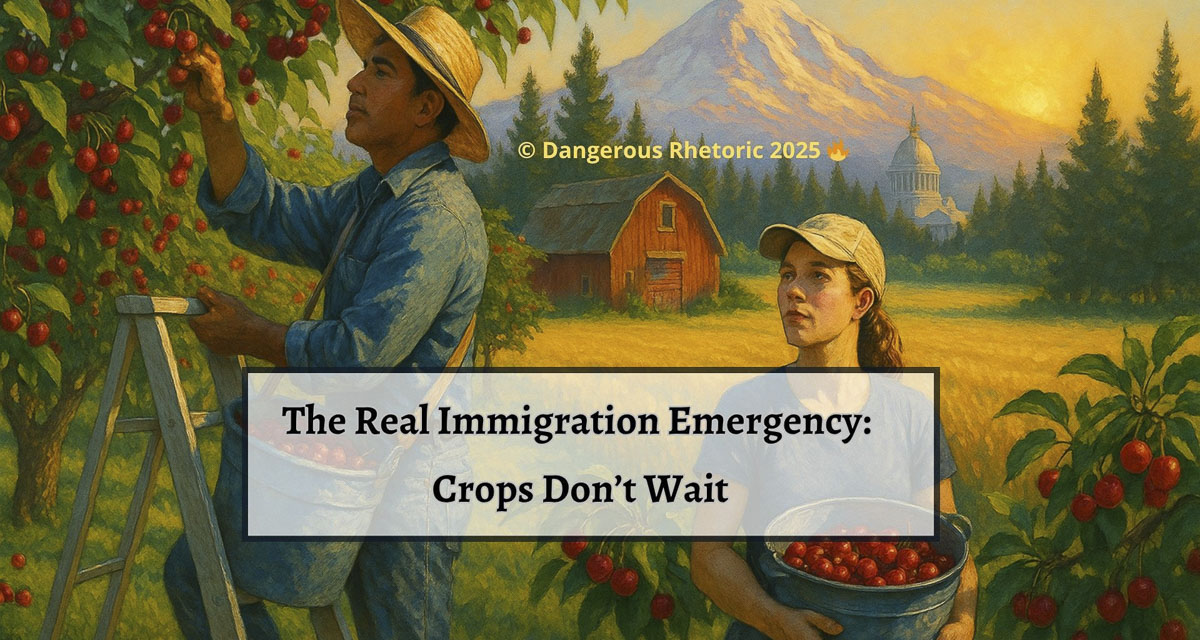
The Farm Workforce Modernization Act and the OBBB — a lifeline for WA agriculture
Nancy Churchill
Dangerous Rhetoric
While politicians in Olympia and D.C. play games with immigration policy, the real crisis is already in full swing in eastern Washington. Cherries will be ripe soon, and there may not be enough hands to harvest them. This isn’t theoretical. Farming is physical, seasonal, and brutally unforgiving. When a crop is ready, it won’t wait for Washington’s red tape to catch up. If labor doesn’t show up, the fruit rots — simple as that. That’s not just money lost. It’s a hit to food security for every American family. So let’s ask the only question that really matters: Are we getting food on the table, or not?

Here’s the truth: Washington’s agricultural economy depends on legal foreign labor, brought in through programs like H-2A. These aren’t unskilled jobs. Fruit picking is demanding, precision work that takes training, speed, and endurance. Contrary to popular myth, not just anyone can pick fruit effectively. It’s physically taxing, time-sensitive labor that takes training and experience.
No future on the farm?
The sad reality is that we’ve spent more than half a century discouraging our own young people from pursuing agricultural work. We told the kids farming had no future. We sent them to college and encouraged desk jobs. Now, with nearly three generations removed from the land, we’re shocked to find that few Americans are willing — or able — to return to the fields.
This isn’t an argument for permanent reliance on foreign workers. It’s a call for realism. We need to rebuild a domestic farm labor force. But that takes time — years of investment in education, vocational training, and a serious cultural shift. You don’t fix that overnight by pulling the plug and pretending a solution will sprout up in the meantime. What farmers need is a strategic transition — not a blind leap.
Strategic transition: Certified Ag worker
Here’s where nuance gets lost. Yes, illegal immigration must be stopped—period. We need full enforcement, aggressive deportations, and border control. President Trump and Secretary Brooke Rollins are right: Law and order comes first. But shutting down illegal immigration doesn’t mean killing the few legal pathways that keep our farms running. Both things can be true. Both must be done.
And right now, the H-2A visa system is a broken mess. It’s been flooded with applications because desperate growers have no better options. The Biden administration made it worse — expanding the program while ignoring its flaws. Even Democrats admit it’s failing. That’s why Rep. Dan Newhouse’s Farm Workforce Modernization Act (FWMA) is back. It offers a new “Certified Agricultural Worker” status for those already here legally and aims to fix the H-2A process. It’s not perfect, but it beats the chaos we’ve got now.
Still, policy Band-Aids aren’t enough. Without border enforcement and deportation of criminal aliens, guest worker reforms become just another magnet for abuse. That’s why Trump’s dual-track approach — secure the border, and modernize legal labor — is the only path that actually protects American food security interests.
Saving the family farm with the OBBB
Meanwhile, there’s a much-needed boost coming from the One Big Beautiful Bill (OBBB). This isn’t about visas — it’s about survival. The OBBB cuts farm taxes by over $10 billion. It protects family farms from the death tax. It updates risk tools and doubles Section 179 deductions so farmers can buy equipment, hire workers, and stay in the game. For the 98% of farms taxed like small businesses, this is do-or-die.
Critics mock these tax cuts like they’re some kind of luxury item. But they miss the point entirely. You can’t rebuild the American farm workforce if farms can’t afford to exist. Profit is what pays wages. Profit is what lets farmers train new hires. If we want our own citizens back in the fields, we need farms to survive long enough to hire them.
Those shelves don’t stock themselves
Let’s be honest: urban elites don’t know where their food comes from. They think grocery shelves fill themselves. But in Eastern Washington, we live the reality. We grow it. We pick it. We pack it. And if we don’t get the support we need, this whole system breaks down.
The OBBB is a lifeline — one that gives Eastern Washington farmers breathing room to fix the deeper problems. To stabilize the labor market. To bring American workers back into agriculture. And to do it without sacrificing food security in the process.
We need immigration enforcement. We need a labor transition. And we need the political will to do both at the same time. This isn’t about being nice. It’s about being smart. It’s about survival.
Nancy Churchill is a writer and educator in rural eastern Washington State, and the chair of the Ferry County Republican Party. She may be reached at DangerousRhetoric@pm.me. The opinions expressed in Dangerous Rhetoric are her own. Dangerous Rhetoric is available on Substack, X, thinkspot and occasionally Rumble.
Also read:
- White House govt. Funding request for 2027 cuts $73 billion
 President Trump’s budget seeks to boost defense funding while cutting $73 billion from agencies like the EPA, NASA, and Agriculture, prompting sharp criticism from Democratic leaders.
 - Heywood asks WA Supreme Court to allow referendum effort on income tax
 Brian Heywood is petitioning the state Supreme Court after the Secretary of State rejected a referendum to repeal Washington’s new 9.9% tax on income over $1 million.
 - Opinion: Half the road, full stop – Understanding pedestrian right-of-way
 Doug Dahl explains how Washington’s law requires drivers to stop when a pedestrian is within one lane of their half of the road, not just when directly in front.
 - Clark County seeks volunteer for Law and Justice Council
 Applicants with experience in mental health services are encouraged to help guide Clark County’s coordination of local criminal justice and corrections planning.
 - VIDEO: Families at center of WA transgender sports debate face-to-face with OSPI
 Two Washington high school students and their parents met with Superintendent Chris Reykdal to discuss concerns about sports policies after one student faced an investigation for harassment.
 - As Washington lawmakers punt on school cellphone ban, some want more action
 At Robert Eagle Staff Middle School, all-day phone removal led to fewer conflicts and more student engagement, but some parents and lawmakers argue a ban should not be imposed statewide.
 - Opinion: The state’s RFK-proofing bill comes with a cost
 Mandates like HB 2242 can lead to higher premiums as insurance companies absorb costs for new preventive services, affecting affordability statewide.
 wpDiscuz
