



Ryan Frost says legal challenges over a graduated income tax are certain
Ryan Frost
Washington Policy Center
The Washington State House of Representatives passed ESSB 6346 after the longest floor debate in state history, a marathon that stretched past 24 hours. The final vote was 51-46, strictly partisan. Every Republican voted no, and eight Democrats crossed party lines to join them. If Governor Ferguson signs the bill, and he has said he will, he will have enacted a brand-new income tax and the largest tax increase in Washington history, all before finishing his second year in office.

The real-world fallout did not wait. Democrats spent hours on the floor arguing that wealthy residents would not leave. Two hours after the vote, Starbucks founder Howard Schultz announced he was moving his family to Miami. After 44 years in Washington, one of the state’s most prominent taxpayers walked out the door, a one-man rebuttal to the “tax-them-and-they’ll-stay” talking point. Schultz follows Jeff Bezos, the state’s former top earner, who left for Florida after the capital gains tax passed.
If I could teach tax supporters one basic economic lesson, it would be this: you get less of what you tax. Tax high earners, and high earners leave.
Republicans introduced more than fifty amendments to soften the bill. Democrats rejected nearly all of them. Among the proposals voted down:
- locking the income threshold at $1 million and capping the rate at 9.9%
- creating sales tax holidays
- exempting baby formula
- funding universal school lunch
- removing the marriage penalty
- exempting military veterans
The rhetoric on the floor often ran headfirst into the actual votes. Majority members kept calling this a “tax on millionaires.” Yet forty-nine of those same members voted against an amendment that would have constitutionally locked the tax to that specific group. Income tax supporters also claimed that public pensions were safe. But the bill amends more than a dozen pension statutes to fold them into the definition of “adjusted gross income.” That is a clear setup for taxing pension benefits down the road.
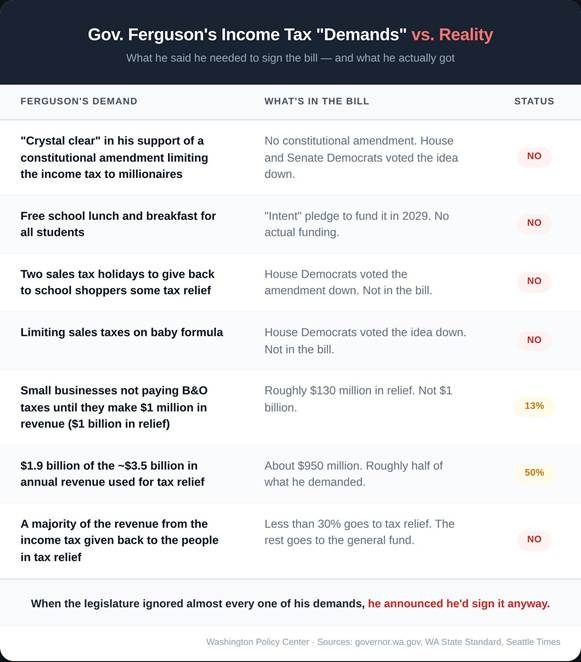
Governor Ferguson’s own conditions for supporting the bill were largely ignored. He asked for a billion dollars in B&O tax relief for small businesses. He got $130 million. He wanted a majority of the new tax revenue directed toward tax relief. The bill delivers roughly 27%. His push for free school lunches was downgraded to “intent” language, which carries no legal weight whatsoever. Another empty promise from a legislature that specializes in them.
Despite the Legislature brushing aside nearly every condition he set, the Governor said he would sign it anyway.
Washington is now an outlier in the wrong direction. South Carolina just passed a bill to phase out its income tax entirely. Washington leapfrogged nearly every other state by jumping from zero to 9.9%.
Supporters say the state needs the revenue for “stability.” Pew Charitable Trusts data says otherwise. Washington has had the best revenue stability in the country over the past five years. The multi-billion-dollar deficits the Legislature keeps pointing to are a product of spending, not volatility.
The bill now goes back to the Senate for concurrence before reaching the Governor’s desk. Legal challenges over a graduated income tax are certain. But the more immediate reckoning will come at the ballot box. Washington voters have rejected income tax proposals eleven times. The Legislature may have the votes in Olympia, but the people of Washington will have the final say.
Ryan Frost is the director of Budget and Tax Policy at the Washington Policy Center.

Also read:
- Opinion: Were Republican voters just sleeping during the August primary election?
 CCRP Chairman Matt Bumala says 60% of primary no-shows in the 17th and 18th districts were Republicans.
 - Opinion: WA Cares’ launch showcased care WA Cares did not provide
 Gov. Ferguson showcased a caregiving arrangement at the WA Cares launch that the program had not paid for a single day of.
 - Auditor, auditor candidate address scrutiny over job title
 Greg Kimsey says roughly 40 county employees hold the deputy county auditor designation Kelly used in his campaign.
 - Opinion: Is Mitchell Kelly misleading voters with his ‘deputy auditor’ claim?
 Clark County HR records show no position called “Deputy County Auditor” has ever existed, Anderson argues.
 - Opinion: Democrats rig the ballot to save their income tax
 Churchill argues the ballot disclosure warning voters of education cuts describes revenue never collected and not yet allocated.