



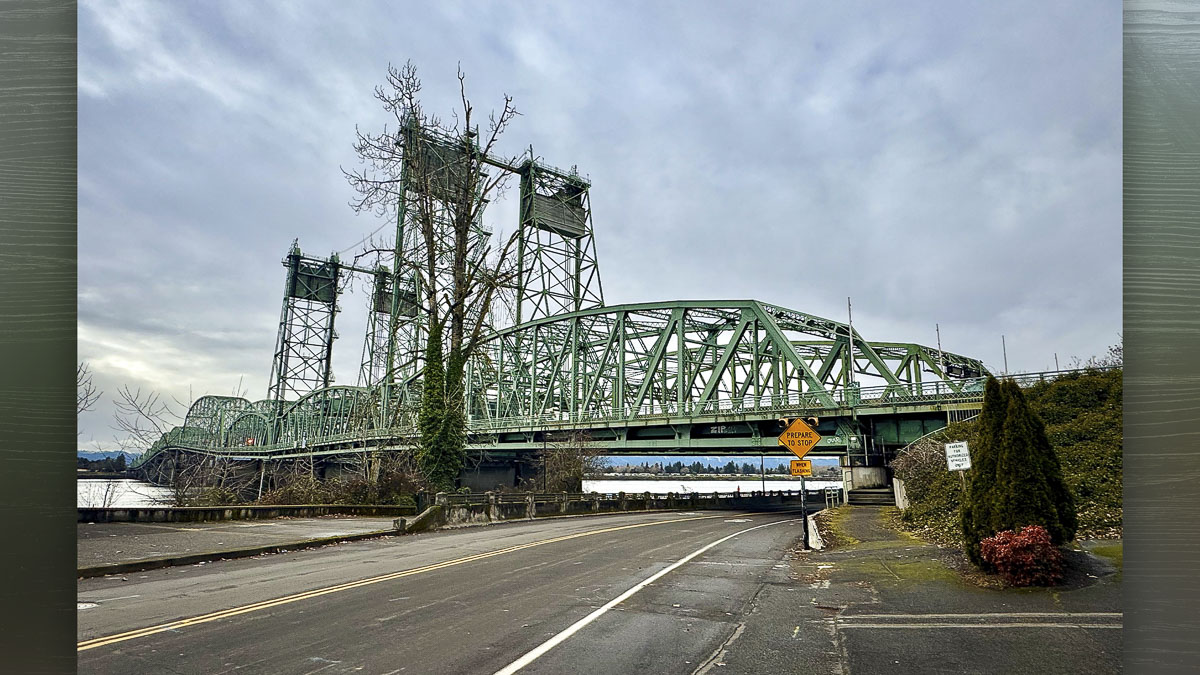
Clark County Editor Ken Vance shares elements of a report from Oregon Journalism Project reporter Nigel Jaquiss that provides evidence that IBR staff members weren’t truthful with legislators at a Dec. 15 meeting regarding updated costs of the I-5 Bridge replacement project
Ken Vance, editor
Clark County Today
For years, those of us who have covered the Interstate Bridge replacement project have been frustrated with the staff at the Interstate Bridge Replacement Program (IBR). Getting information from the IBR team is difficult. It is a slow, cumbersome process. Often, requests for information are never fulfilled. Of a much more serious nature, many of us in the media and elected officials have flat out asserted that the IBR staff was not being truthful with us, and the taxpayers who will be on the hook for the massive project.
Those assertions have now been proven accurate. It is fact not fiction. The IBR team has been withholding information from us, and thanks to a veteran Oregon journalist, we now have the smoking gun.
Tuesday’s report
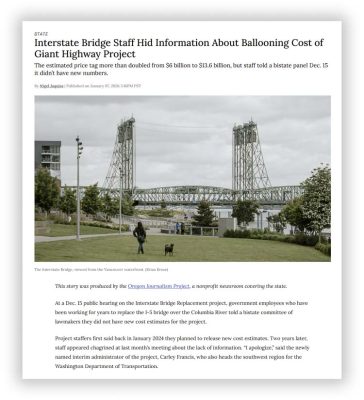
Nigel Jaquiss spent 27 years with Willamette Week before recently joining the Oregon Journalism Project. On Tuesday, Jaquiss shared a report via Willamette Week with evidence that the IBR team has been withholding information from the public.
“At a Dec. 15 public hearing on the Interstate Bridge Replacement project, government employees who have been working for years to replace the I-5 bridge over the Columbia River told a bistate committee of lawmakers they did not have new cost estimates for the project,’’ Jaquiss reported. “Project staffers first said back in January 2024 they planned to release new cost estimates. Two years later, staff appeared chagrined at last month’s meeting about the lack of information.’’
As Clark County Today reported at the time, Jaquiss reported Tuesday that “the lack of cost information came as unwelcome news to the 16-member panel, who expected updated numbers. (The most recent estimates date back to December 2022, when staff said the project would cost $6 billion.)

“Documents recently obtained by the Oregon Journalism Project, however, show the staff’s claim it couldn’t provide new cost estimates was false,’’ Jaquiss reported Tuesday. “In fact, Interstate Bridge Replacement project consultants had completed highly detailed, updated cost estimates for the project by Aug. 15 — four months before the December meeting.
“And the new estimates are ugly: The cost of a fixed-span bridge over the Columbia River that would not have to open and close for ships — the design IBR staff favors — had ballooned from $6 billion to $13.6 billion.’’
Jaquiss has acquired a project document called “IBR Program-Fixed Span Cost Estimate,’’ dated Aug. 15. It shows a low-range estimate of just under $12.25 billion, a probable cost of $13.6 billion and a high range of $17.69 billion.
Lawmakers’ respond
On Tuesday, Jaquiss shared the new cost estimates with Rep. John Ley (Republican, Clark County) and Oregon Rep. Thuy Tran (Democrat, North Portland). Both said they felt IBR staff had betrayed them and the people of Oregon and Washington.
“Frankly, it is shocking to realize that they lied, on the record, not only to me, but to the committee and, by extension, the public at large,” Tran told OJP.
Ley told OJP he suspected IBR staffers at the December meeting were withholding what they knew. Now, he knows they were.
“I am outraged,” Ley said. “They have the tools to provide us cost updates monthly if they wanted to — it’s insanity that they don’t.”
The IBR response
The OJP Tuesday report included a response from Carley Francis, the top IBR administrator, and the top administrator for the Southwest Region for the Washington State Department of Transportation. Jacquiss reported that Francis said she had done nothing wrong, was not hiding anything from the public, and that the new, higher numbers in the IBR document merely represent a preliminary draft.
“The document you received is a draft basis of estimate, not a completed cost estimate validation process (CEVP). CEVP is a time-intensive process that involves several iterations,” Francis said in a statement to Jaquiss and OJP. “The cost estimate is not complete, and this work is ongoing. The program is working through validation of risks and associated costs. We do not yet have a new cost estimate.”
The long history of the project
Washington and Oregon taxpayers have been at the mercy of two projects to replace the I-5 Bridge. The Columbia River Crossing project died at the hands of the Washington State Senate in 2013 after the expenditure of more than $200 million in taxpayer dollars.
In 2019, the I-5 Bridge replacement project was reborn by Washington Gov. Jay Inslee and Oregon Gov. Kate Brown. The IBR was formed, and the result was virtually the same project that was previously defeated. Now, more than $500 million has been spent on the two projects and it is clear to everyone with an ounce of objectivity that the current project is destined to meet the same fate as the CRC.
The IBR team has never been interested in building the project the taxpayers want. Clark County voters have said no to light rail on the project in three separate advisory votes. The 1.83-mile extension of TriMet’s Yellow Line into downtown Vancouver would cost more than $2 billion, making it the most expensive light rail project in the world.
IBR officials have been honest that the current project will do nothing to improve the transportation congestion issues in the region. They extol the virtue of the project as securing the safety of the crossing over the Columbia River in the event of a major seismic event, which most experts believe is more than a century away.
A much better, and less expensive idea
I’ve stated in this space many times: What we need is more crossings over the Columbia River, something that was acknowledged by transportation officials in 1982 when the I-205 Glenn Jackson Bridge opened.
The original East County Bridge project was a proposal, first introduced 15 years ago, to build a third toll-free bridge across the Columbia River. It would be situated four miles east of the I-205 Glenn Jackson Bridge at 192nd Avenue and SR-14. For more information, go to EastCountyBridge.com.
The vision for this bridge was embraced by Clark County citizens in two separate advisory votes, one that voters approved in the November 2013 General Election that asked voters county-wide if the Board of County Commissioners (now Clark County Council) should work to get a real proposal that would include an actual design, a maximum price less than $900 million, flexible financial terms, and an achievable time frame. The majority of voters said yes and directed their Clark County Commissioners to lead that charge. If successful, the plan was that those specifics would be proposed to the voters for their approval in 2014.
A proposal was successfully completed. Bridge builder Figg Engineering stepped up and provided a real design, quoted a price guaranteed to be less than the preferred maximum, offered pre-approved multi-year financing, and guaranteed that everything would be completed – including all design, permits, and construction – within five years of receiving the green light. The builder also promised to cover against any cost overruns.
Those specifics were presented to Clark County voters in the November 2014 General Election. Voters again said yes and directed their county commissioners to provide the local leadership, champion the project, share the vision, and build the support to succeed. However, even though the majority of citizens throughout Clark County and in the city of Vancouver supported the proposal, the Vancouver City Council opposed it, preferring the Columbia River Crossing (CRC) project instead, including light rail and tolling. The interchange at SR-14 and 192nd Avenue, where the proposed East County Bridge would connect, lies within Vancouver city limits, so that option was effectively dead.
Conclusion
The I-5 Bridge replacement project is essentially dead. Too many taxpayers and elected officials on both sides of the river don’t want to spend $13.6 billion for a project that does not provide the one thing drivers are clamoring for – traffic congestion relief. The majority of us on this side of the river know there simply isn’t the demand for a light rail extension that will cost at least $2 billion. C-TRAN’s bus service will easily meet the needs of cross-river travelers.
We need a third and fourth crossing over the Columbia River. And when it comes time to replace the I-5 Bridge, we need to do it in a fiscally responsible way without the inclusion of light rail.
Also read:
- 49th Legislative District Democrats share their reasons for backing state income tax at Town Hall
 Three Democrat legislators defended the new income tax affecting only those earning over $1 million annually.
 - Letter: Freeze the scope and build the bridge
 Vancouver resident calls for project discipline after 22 years of planning and nearly half a billion in costs.
 - Opinion: ‘When are we going to get the full and complete details of the Interstate Bridge Replacement Program’s I-5 Bridge replacement project?’
 IBR team buried key details about light rail ending at waterfront with massive elevator system required.
 - POLL: Do you support extending light rail beyond the waterfront to connect with C-TRAN at Library Square?
 Readers can weigh in on Anne McEnerny-Ogle’s proposal to extend light rail beyond the waterfront to Library Square for improved C-TRAN connections.
 - Opinion: Passing a cyclist – Law, myth and a little patience
 Most drivers can’t legally pass cyclists in-lane due to vehicle width versus road measurements.
 wpDiscuz
