


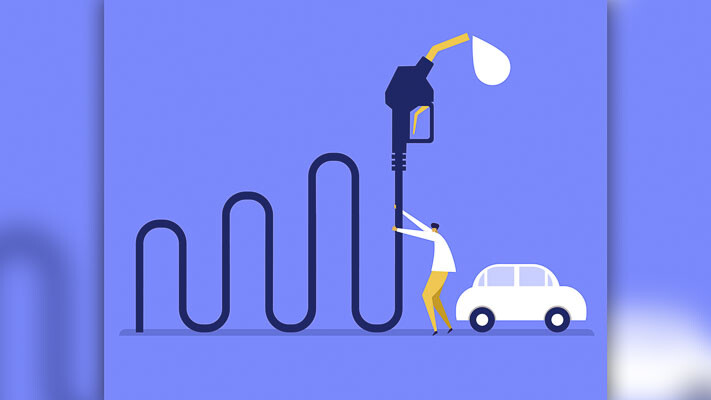
Todd Myers, of the Washington Policy Center, provides essential context to the governor’s Thursday statement
Todd Myers
Washington Policy Center
Thursday, Governor Inslee, Sen. Nguyen and Rep. Fitzgibbon announced a proposal that blames oil companies for Washington’s highest-in-the-nation gas prices. However, key policy decisions have raised fuel prices, were intended to do so, and by amounts that were easily projected using a basic formula involving the added cost of the new tax on carbon emissions. The following is essential context to today’s story:

Washington’s average gas prices have been the highest in the nation for nearly a month. The state’s new tax on CO2 emissions has increased gas prices by about 40 cents per gallon compared to neighboring states.
Utilizing the same formula used by the State of California and energy economists, on July 12 of last year, we predicted that if state projections on the cost of a metric ton of carbon were correct, Washington’s new tax on CO2 emissions would increase gas prices by about 46 cents per gallon. That projection has turned out to be almost exactly accurate.
Between Washington’s gas tax of 49.4 cents per gallon (third highest in the country) and the tax on CO2 of about 44.3 cents per gallon (which is the highest in the Americas), Washington state collects nearly 94 cents in taxes for every gallon of gas.
As climate economists have acknowledged, the purpose of taxing CO2 emissions is to raise gas prices and make EVs more attractive. One of the original architects of California’s CO2 cap noted that this was “beyond controversy.” Even Climate Solutions – which lobbied for the tax – told the Everett Herald the purpose of the tax on CO2 was to raise prices.
The politics of gas prices, however, have caused the governor, Department of Ecology staff, and others to deny the impact of the tax on CO2 emissions or blame others, and even scrub their previous inaccurate predictions from the state’s web page.
In the last year, the governor, his administration, and activists have changed their tune several times. For example, they:
- Claimed the impact of the new tax would be “pennies” on gas prices.
- When prices increased, said that the increase in prices was nothing unusual.
- They then argued that the price increases since January 1 were due to a 3-day closure of the Olympic Pipeline.
- They falsely claimed that oil companies make 80 cents per gallon in profit in Washington state – which was contradicted by the source cited by the governor and Climate Solutions.
- Just one week later claimed that rather than knowing exactly how much profit oil companies make, “we have no visibility” on how much profit is made.
Seattle Times columnist Danny Westneat argued that these consistently false claims (what he called “strategic misinformation” from the governor) were intentionally dishonest but necessary to pass the climate law.
Given the long history of inaccuracy and dishonesty by the governor and other legislators on this issue, here are some questions that Governor Inslee, Sen. Nguyen, and Rep. Fitzgibbon should be expected to answer:
- Two weeks ago, the Governor told KIRO TV that oil companies were making 80 cents in profit per gallon. The source the governor cited says this is false. Does the governor stand by his number?
- Does the Governor still claim that his tax on CO2 emissions increases gas prices only “pennies”?
- Between the state gas tax and the tax on CO2 emissions, Washington takes about 94 cents per gallon from the price of every gallon of gas. What is his plan to reduce that amount?
- Two weeks ago Sen. Nguyen said he knew down to the penny per gallon how much profit oil companies make in Washington. Then, last Friday he told the Seattle Times, “we have no visibility” about profits. Which is it?
- Rep. Fitzgibbon has said several times in the past the purpose of the tax on CO2 emissions is to increase gas prices. Does he think gas prices should be lower?
Todd Myers is the director of the Center for the Environment at the Washington Policy Center.

Also read:
- Opinion: Workers need their wages more than the state’s paid-leave program does
 Washington’s paid-leave payroll tax stands at 1.13% and is projected to hit its 1.2% cap by 2027, with some lawmakers eyeing a 2% rate.
 - Opinion: Fatal flaws of Socialism – The knowledge problem
 Cargill argues no government, committee, or computer can possess the dispersed knowledge that markets coordinate through prices.
 - Opinion: ‘It may be time for McCleary 2.0’
 Dick Rylander examines the Battle Ground School District’s proposed $116,830,000 three-year EP&O levy heading to the November 2026 ballot.
 - Opinion: Were Republican voters just sleeping during the August primary election?
 CCRP Chairman Matt Bumala says 60% of primary no-shows in the 17th and 18th districts were Republicans.
 - Opinion: WA Cares’ launch showcased care WA Cares did not provide
 Gov. Ferguson showcased a caregiving arrangement at the WA Cares launch that the program had not paid for a single day of.