



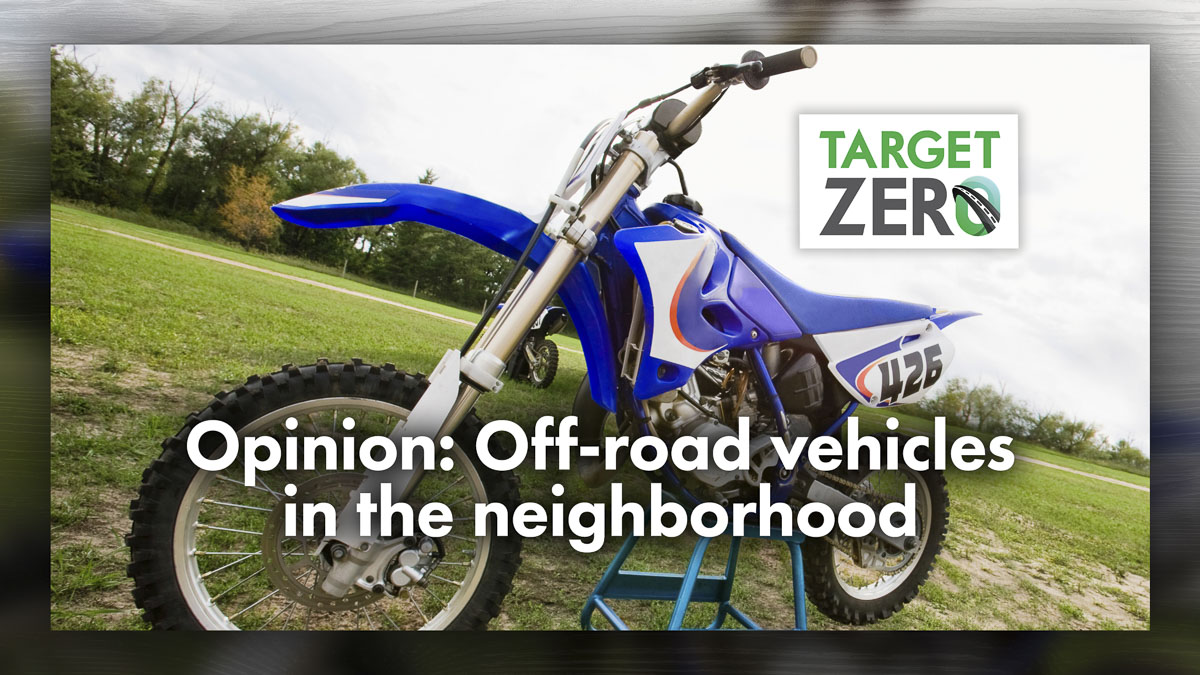
Target Zero Manager Doug Dahl answers a question about the use of off-road vehicles in neighborhoods
Doug Dahl
The Wise Drive
Q: I live in a neighborhood in the county, and we have people who race up and down our streets on mini-bikes, dirt bikes, and three- and four-wheelers, often after dark with no lights. These vehicles are loud, none of them are licensed, and some of the riders are too young to even get a driver’s license. All I can see is a disaster happening. Are these vehicles legal on neighborhood streets?
A: This might set a new record for most laws broken in one question. If I make a few assumptions, I think I can easily get to nine. My first assumption: You used “race” to mean “willfully compare or contest relative speeds” as described in the law. It’s never been legal to race on public roads but, as of 2023, the law says it constitutes reckless driving (which is a crime).

It’s possible that you used “race” figuratively, to mean they’re driving faster than they should. We all know exceeding the speed limit is a violation of the law, so there’s violation number two.
This next one could be multiple violations, but I’m going to count it as one. Off-road vehicles, like the ones you listed, don’t typically come with things like mirrors, fenders, turn signals, and other safety equipment that is unnecessary on a trail but critical and required by law when driving on a public road.
Of course, if a vehicle doesn’t have the required safety equipment, you wouldn’t be able to register it for road use. Without registration, it’s not legal to operate a motor vehicle on a public street.
Among the vehicles listed in your question, one of them could conceivably be operated on a public road. A four-wheeler that meets the legal requirements for a wheeled all-terrain vehicle, including all the safety equipment, after going through the registration process, can be driven on some roads, with limitations. Unless your county has a population of less than 15,000 or an ordinance allowing it, the four-wheeler probably has to stay on the trails.
Driving at night without headlights is a violation of the law when you’re driving a car, but for motorcycles and wheeled all-terrain vehicles, headlights are actually required whenever the vehicle is being ridden on a road, day and night.
The law requires that motor vehicles have a working muffler that prevents excessive noise, defined at anything above 82 decibels (measured at 50 feet) for motorcycles. Without a device to measure the sound of the motorcycles it’s hard to know for sure how loud they are, but vehicles built for off-road use aren’t bound by that rule and likely exceed that limit.
The under-age riders would be in violation of the law that says, “No person may drive a motor vehicle upon a highway in this state without first obtaining a valid driver’s license,” as well as the one that prohibits people under the age of sixteen from operating an off-road vehicle on a public road. For the ones riding two- and three-wheeled vehicles I suppose we could add on the requirement for a motorcycle endorsement.
I could probably find more violations, but instead I want to end with some thoughts about the under-age riders. If you’re 32 years old and riding an unlicensed off-road vehicle on a public road at night with inadequate safety equipment and no headlight, that’s on you. But kids, they need boundaries set by grown-ups who have their long-term best interests in mind. Per mile traveled, more people die on motorcycles than any other vehicle. By a lot. Don’t let a kid ride one on a public street.
The Wise Drive is hosted by Doug Dahl, a Target Zero manager for the Washington Traffic Safety Commission.

Also read:
- Opinion: Defend bail now or face more chaos on our streets
 A proposed Washington court rule would cap bail for most misdemeanors and allow defendants to bypass bondsmen, raising concerns about accountability and public safety.
 - Opinion: Some worker rights get a poster, others get fine print
 Elizabeth New questions why Washington state highlights some workplace protections while Janus First Amendment rights for public employees remain hidden in official materials.
 - Opinion: Someone explain the Democrat Party to me please
 Lars Larson criticizes Democrat politicians for shutdown threats, Homeland Security funding refusals, and positions on election laws, housing, and gun rights.
 - POLL: Do you agree with requiring board members to follow council direction?
 Disagreement among county councilors centers on whether C-TRAN board members should reflect the council’s collective wishes or act independently, highlighting ongoing concerns about public accountability.
 - Opinion: In plain sight – yielding to pedestrians
 Drivers often fail to see pedestrians due to inattentional blindness, which highlights the need for more focused awareness at intersections and stronger safety practices.
