


🎧 Sound Transit’s $35B Hole and What It Costs You
Bob Pishue outlines an example of the new transit taxes Southwest Washington hasn’t seen before, and will be required to pay for the extension of TriMet’s light rail to Clark County
Bob Pishue
Mountain States Policy Center
As Mountain States Policy Center reported earlier, Sound Transit is in a massive fiscal hole – again. Agency officials recently announced the Sound Transit 3 (ST3) rail program is short a whopping $35 billion, equaling $10,294 for every person in Sound Transit’s district. The news sent shockwaves throughout communities around the Puget Sound, who are nervous about deleted projects, a high tax burden, and future promises made on car tab relief.

Bob Pishue
Sound Transit already imposes a myriad of taxes across the Puget Sound for its rail program, including a 1.4% sales tax, a 1.1% Motor Vehicle Excise Tax (MVET) based on the exaggerated value of a vehicle, property taxes, and a rental car tax. The local taxes are boosted by state policies, which include cheap land acquisition and favorable airspace leases, along with billions paid by federal taxpayers to subsidize the program.
Similar to past voter-approved rail plans for Sound Transit, officials floated the idea of cutting promises, including eliminating the Ballard line, the Kirkland-Issaquah line, and the spine to Tacoma, among others. In addition, officials sought Sound Transit-friendly bills in the state legislature, including plans to borrow from taxpayers until the 22nd Century.
Rail boosters are already lobbying for more state money for Sound Transit in the next legislative session. The Northwest Progressive Institute, a big-government “strategy center” that provides “imaginative advocacy,” recently penned an article saying state taxpayers, including those in the Tri-Cities, Spokane, and the San Juan Islands, should be on the hook for Seattle’s rail debacle.
One promise Sound Transit officials made to taxpayers that must be nonnegotiable is the plan to reduce the MVET it imposes by 0.3% to 0.8% of a vehicle’s value in 2028. In addition, the exaggerated Sound Transit depreciation schedule is set to revert to the less-exaggerated Washington state depreciation schedule during the move. Keeping more money in taxpayers’ wallets instead of Sound Transit.
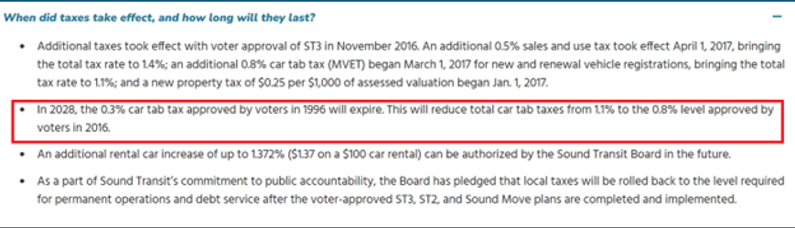
Sound Transit’s Car Tab Rollback Promise (soundtransit.org)
Given the agency’s long history of broken promises and significant cost escalations – and quite frankly, the lack of car tab relief despite multiple public votes – drivers are naturally skeptical of Sound Transit’s plan to reduce the car tab tax as promised.
This skepticism is warranted, as the agency continues to overpromise and underdeliver. This is common among big transportation projects, according to the most-cited scholar on megaprojects, Professor Bent Flyvberg. He says that oftentimes agency officials use “strategic misrepresentation,” a.k.a. lying, to gain public support for big transportation projects. He argues that if the public knew the real cost at the beginning, the project likely wouldn’t get built at all.
Sound Transit officials owe the public needed protections against runaway cost-inflation and more spending on an already outdated rail program. Other steps the agency or state government could take include:
- Require a full performance audit of the agency, outlining costs, performance, and feasibility of the rail program. A forensic audit may also be necessary given the astronomical cost overruns of the program;
- Change the governance structure of the Sound Transit Board to an elected board, as the current board awards too much power to the King County Executive; and
- Prohibit Sound Transit from issuing bonds past the normal 30-year bonding period. Sound Transit already has tools to increase debt capacity – it can ask voters within the district for the ability to do so.
Instead of dumping more local, state, and federal cash into Sound Transit’s coffers, public officials should adopt these reasonable measures to ensure taxpayers are protected from Sound Transit’s inability to manage its finances. Taxpayers want to get off this endless express train to their hard-earned money.
This opinion was first published by the Mountain States Policy Center. Bob Pishue is a visiting fellow at the Mountain States Policy Center.

Also read:
- Opinion: Were Republican voters just sleeping during the August primary election?
 CCRP Chairman Matt Bumala says 60% of primary no-shows in the 17th and 18th districts were Republicans.
 - Opinion: WA Cares’ launch showcased care WA Cares did not provide
 Gov. Ferguson showcased a caregiving arrangement at the WA Cares launch that the program had not paid for a single day of.
 - Auditor, auditor candidate address scrutiny over job title
 Greg Kimsey says roughly 40 county employees hold the deputy county auditor designation Kelly used in his campaign.
 - Opinion: Is Mitchell Kelly misleading voters with his ‘deputy auditor’ claim?
 Clark County HR records show no position called “Deputy County Auditor” has ever existed, Anderson argues.
 - Opinion: Democrats rig the ballot to save their income tax
 Churchill argues the ballot disclosure warning voters of education cuts describes revenue never collected and not yet allocated.