


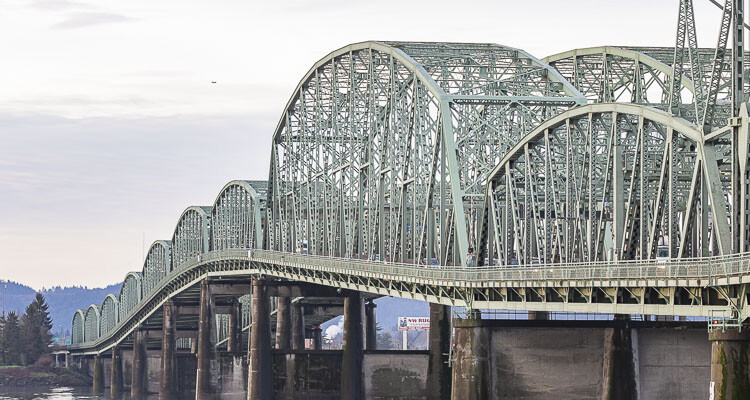
The Interstate Bridge should be left alone for now and ODOT should be directed to start planning for two new bridges
John Charles
Cascade Policy Institute
Over the next four weeks, the Oregon Legislature will decide whether to make a down payment of $1 billion to replace the I-5 Interstate Bridge connecting Portland with Vancouver. The total cost of the bridge is unknown but is estimated to be around $6 billion.
The Legislature should reject this allocation and shut down planning altogether on the Interstate Bridge Replacement Project (IBRP).
The No. 1 concern for the public when it comes to highway planning is traffic congestion and there is no way a single replacement bridge on I-5 could ever reduce congestion. The entire I-5 corridor from Wilsonville to Vancouver is over-subscribed for about 12 hours per day and this will only get worse as the region grows.
The Interstate Bridge should be left alone for now and ODOT should be directed to start planning for two new bridges — one upstream from the Glenn Jackson I-205 bridge and one downstream from the I-5 Interstate Bridge. The new crossings would eliminate most congestion on the existing bridges, while providing essential redundancy in the event of a catastrophic earthquake.
We especially need a new Columbia River bridge with a direct connection to Highway 26 near Hillsboro. Not only would this reduce the total amount of driving for thousands of westside motorists – who now have to drive to Portland just to get to Vancouver — it would provide much-needed congestion relief at three current bottlenecks: the Sylvan hills tunnels on Highway 26, the Fremont Bridge and I-5 in north Portland.
Planners and their political allies seem to be missing a central truth about river-based cities: they need lots of bridge crossings. In downtown Portland, we have two interstate highway bridges over the Willamette River, plus many local crossings including the Burnside, Steel, Morrison and Hawthorne bridges.
Each crossing serves a market and is necessary for the proper functioning of the city. If we applied ODOT’s logic for the IBRP, we’d tear down all the local Willamette River bridges and just keep the Marquam and Fremont Bridges.
Of course, we’re not going to do that because it would be insane. But it’s considered brilliant planning for the Columbia River.
Planning for a new Interstate Bridge began in 1997, and 25 years later we have nothing to show for it. Legislators should chart a new course by withholding the requested $1 billion and ordering ODOT to start planning for new bridges and highways outside the I-5 corridor.
John A. Charles, Jr. is president and CEO of Cascade Policy Institute, Oregon’s free market public policy research organization.

Also read:
- Opinion: Were Republican voters just sleeping during the August primary election?
 CCRP Chairman Matt Bumala says 60% of primary no-shows in the 17th and 18th districts were Republicans.
 - Opinion: WA Cares’ launch showcased care WA Cares did not provide
 Gov. Ferguson showcased a caregiving arrangement at the WA Cares launch that the program had not paid for a single day of.
 - Opinion: Portland’s War on Cars Part 4 – A smarter automobile strategy to end gridlock
 O’Toole argues fuel wasted in Portland-area congestion has sextupled since 1982, generating 250,000 tons of extra greenhouse gases annually.
 - Opinion: The Tooth Fairy’s secrets to making brushing & flossing magical
 Delta Dental of Washington’s Tooth Fairy Experience offers free resources to help children build lifelong brushing and flossing habits.
 - Opinion: Transit ridership trends are dismal but regional plans are oblivious
 Puget Sound transit passenger-miles fell 31% from 2015 to 2024 despite a half-million-resident population increase.
 wpDiscuz