




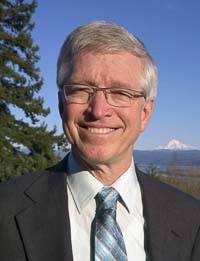
Clark County resident John Ley believes the RTC Board, C-TRAN Board, Vancouver City Council and Port of Vancouver should rescind their approval of the IBR’s Locally Preferred Alternative
John Ley
for Clark County Today
Four Southwest Washington government bodies have the ability to reject the Interstate Bridge Replacement (IBR) Program’s Locally Preferred Alternative. I believe the Regional Transportation Council (RTC), C-TRAN, the Port of Vancouver, and Vancouver City Council have an obligation to stop theft, graft, or corruption and protect the taxpayers of Southwest Washington.
TriMet, through the Interstate Bridge Replacement program, is demanding a $2 billion, 1.9 mile MAX light rail extension. That is ONE BILLION per mile; five times the per mile cost of the 2015 TriMet Orange Line. The Orange Line included a new bridge over the Willamette River.
In Seattle, Sound Transit just opened its Lynnwood light rail extension. It cost $353 million per mile. TriMet and the IBR are proposing the world’s most expensive rail extension on a per mile basis; and that’s comparing high speed rail, heavy rail, and light rail systems.
There is no legitimate justification for 19 new light rail vehicles on a 1.9-mile MAX Yellow Line extension. That is 10 vehicles per mile that TriMet is demanding the IBR purchase for them. TriMet wants Washington taxpayers to replace worn out vehicles, to serve other parts of its light rail system. TriMet has never paid to replace worn out C-TRAN buses.
TriMet is seeking between $190 million and $290 million to buy those new light rail vehicles. That’s $10 to $15 million per vehicle. This is a huge ripoff, when TriMet just paid $4.5 million each, for four new vehicles for its 10-mile “Better Red” extension to Hillsboro. The agency paid $4 million each, for 26 new vehicles ordered a decade ago.
Clearly TriMet will steal from taxpayers with grossly inflated light rail vehicle prices. The IBR team apparently doesn’t care about being ripped off by TriMet.
Why do light rail train cars cost $4.5 million each for the Better Red project, but between double and triple that amount when submitted to the IBR? Why were only four new vehicles needed for a 10-mile extension of the Red Line, but 19 are needed for a 1.9-mile extension of the Yellow Line?
Additionally, TriMet is demanding new taxes from Washington to pay for its Operations and Maintenance (O&M) of the MAX light rail extension. The agency demands $21 million per year, triple its current light rail O&M costs.
C-TRAN wants 8 zero-emission double decker buses paid for by the IBR, for its Bus on Shoulder service into Portland. These would carry up to 100 people. That’s ridiculous when the RTC reported there is “a new normal” of reduced transit ridership and more people working from home. C-TRAN carries 525 people a day on its I-5 express buses.
Five years ago, C-TRAN offered seven “express” bus routes over the Columbia River. Today there are three. There is so little demand for cross-river transit that TriMet does not offer bus service to Clark County. There is no current need for any “high capacity” transit over the river.
The RTC Board, C-TRAN Board, Vancouver City Council and Port of Vancouver should rescind their approval of the IBR’s Locally Preferred Alternative. The $2 billion transit component is over one quarter the cost of the $7.5 billion boondoggle.
The IBR is allocating 54 percent of the bridge for transit, bikes and pedestrians. Instead of more transit, we need more bridges and more lanes for freight haulers and vehicles over the Columbia River.
Also read:
- VIDEO: WA diesel hits record $6.53, crushing truckers and school budgets
 With diesel nearing $6.53 per gallon in Washington, trucking businesses and school districts now confront sharply higher fuel expenses affecting budgets and workers.
 - Opinion: In plain sight – yielding to pedestrians
 Drivers often fail to see pedestrians due to inattentional blindness, which highlights the need for more focused awareness at intersections and stronger safety practices.
 - Expect delays on SR 14 in Vancouver for guardrail repairs Wednesday
 State Route 14 travelers in Vancouver should plan for morning delays as WSDOT will close two eastbound lanes for guardrail repairs, affecting mileposts 6.0 to 7.0.
 - Overnight closure planned on westbound SR 14 Camas Slough Bridge Tuesday
 WSDOT crews will close westbound SR 14 at Exit 14 in Camas to collect bridge deck samples and plan future repairs; detours will be in effect.
 - Opinion: Stay in your lane – seriously, it’s the law
 Drivers must choose the nearest lane when turning in Washington, and left turns bring added risk. Even with signals, every driver must help prevent crashes by following law.
 wpDiscuz
