


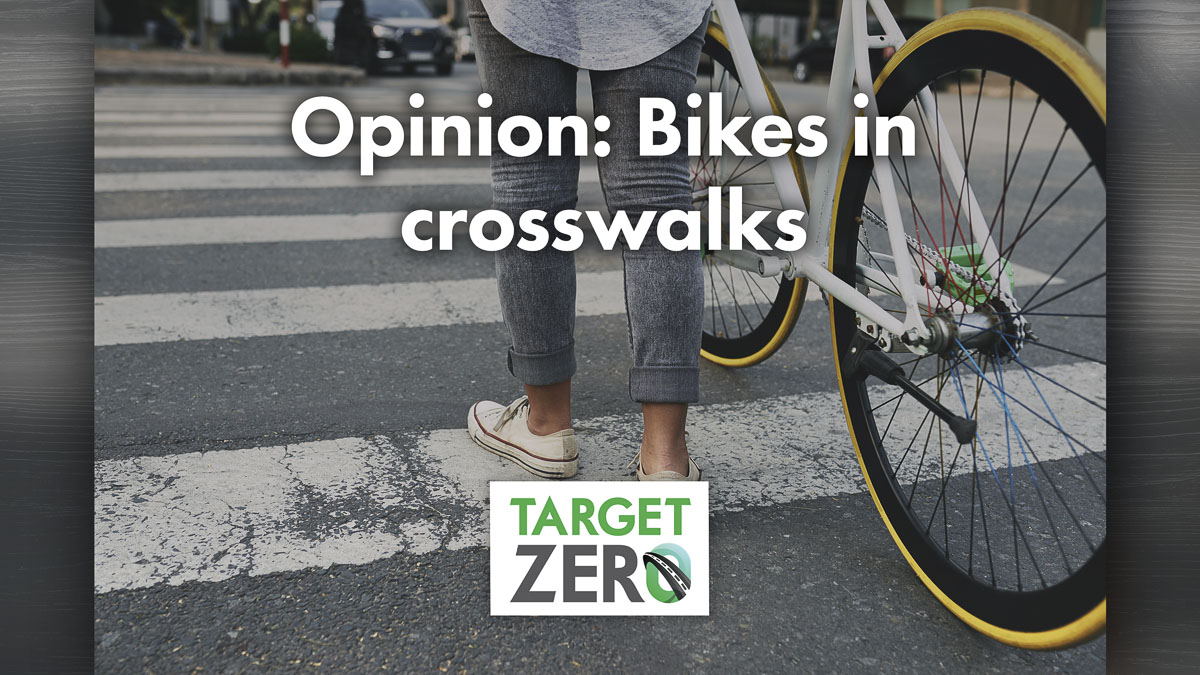
Target Zero Manager Doug Dahl says that in law, bicycles are a sort of hybrid form of transportation
Doug Dahl
The Wise Drive
Q: Is it no longer advised to walk your bike in a crosswalk? If there was a bike safety class presented by a public agency, would kids be taught to dismount and wait until they see motorists stopping for them, then walk it across? Or stop then ride?
A: I remember being taught to walk my bike in a crosswalk. That was a long time ago, but there’s still a good chance that if a public agency offered a bike safety class for kids, they’d teach them to walk their bikes in crosswalks. Or at least, there are plenty of public agencies making that recommendation on their websites.
That doesn’t make it a law (even if a bike safety website lists it under “Rules of the road for bike riding.”) Still, for kids new to bike riding, it’s smart advice. You don’t want a wobbly five-year-old cyclist losing their balance and veering into traffic. So parents, this one’s up to you. If you have a child learning to ride, you get to set the expectations. Maybe you’ll start by having them walk their bike in every crosswalk. As their skills improve, you might require they walk their bike only on busier streets. Eventually you hope they reach a maturity level where they’re making their own safety decisions based on trustworthy advice you’ve given them.
In the law, bicycles are a sort of hybrid form of transportation. If you’re riding on the roadway, a bicycle is considered a vehicle and “shall be granted all of the rights and shall be subject to all of the duties applicable to the driver of a vehicle.” If you’re riding on the sidewalk or crosswalk, you follow pedestrian rules.
For cyclists who choose to ride on the sidewalk or crosswalk, there’s a bit of right-of-way hierarchy. The roller yields to the walker. While it’s mostly legal to ride a bike on a sidewalk, cities can prohibit it in business districts. Even when you can ride a bike on a sidewalk, it’s not always the right move.
As a traveler who can function both as a pedestrian and a vehicle, how you ride should determine where you ride. Inexperienced, slow, and casual? You probably belong on the sidewalk. Daily commuter trying to make time? If you’re too fast to avoid conflict with pedestrians, leave the sidewalk to the slower folks and use the road.
Of course, our infrastructure isn’t perfect, so there might be times when a bike commuter decides to use the sidewalk because a stretch of road doesn’t feel safe. But that doesn’t mean hopping back and forth between the road and the sidewalk willy-nilly (to use the language of Shakespeare.)
Predictability and expectations are important parts of traveling safely.
That’s why it’s important for drivers to understand the law too. As drivers, we should be looking for pedestrians as we approach an intersection. But if your concept of a pedestrian is limited to people on their feet, you might not notice a person riding a bike (or using a wheelchair, scooter, or other non-walking kind of movement.)
It’s possible to look right at something and not perceive it. It’s called inattention blindness. When you’re looking for a specific thing (in this case, a person walking in the crosswalk), your brain may filter out all the things you’re not looking for (like a person riding a bike in the crosswalk). That’s how you get people saying things like, “I don’t know how it happened, officer. I look both ways and didn’t see them, and then they were right in front of my car.”
Also read:
- Opinion: Portland’s War on Cars Part 4 – A smarter automobile strategy to end gridlock
 O’Toole argues fuel wasted in Portland-area congestion has sextupled since 1982, generating 250,000 tons of extra greenhouse gases annually.
 - Opinion: Transit ridership trends are dismal but regional plans are oblivious
 Puget Sound transit passenger-miles fell 31% from 2015 to 2024 despite a half-million-resident population increase.
 - Interstate Bridge Replacement Program seeks qualified firms for bridge replacement contract
 The CRBR project is backed by $5.7 billion from state funds, federal grants, and future tolling.
 - Opinion: Bankrupt – A $3.5 billion Rose Quarter Freeway widening project
 Joe Cortright argues ODOT’s Rose Quarter project has grown from a $450M approval to a $3.5B estimate, with a $2B funding gap.
 - Opinion: Portland’s War on Cars 3 – Ending the war on automobiles
 O’Toole argues Portland should add toll lanes, fix safety hazards, and redesign TriMet routes to end its anti-auto policies.