



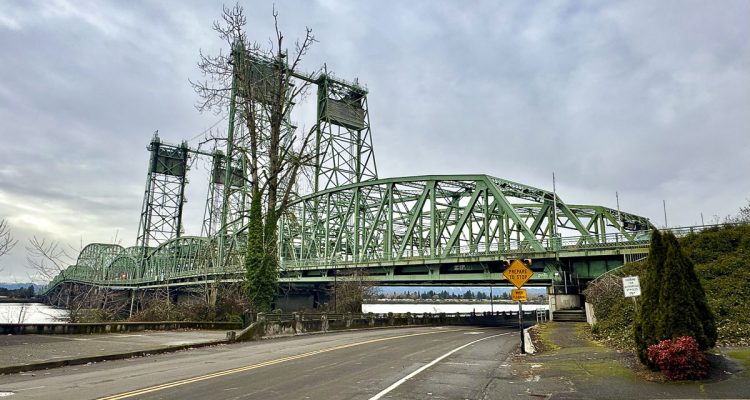
Rep. John Ley shares Transportation architect Kevin Peterson’s vision for transportation solutions in Southwest Washington
Rep. John Ley
for Clark County Today
Overwhelmingly, the people in the Portland/Vancouver area told Administrator Greg Johnson and the Interstate Bridge Replacement Program (IBR) team that reducing traffic congestion and saving time is their top priority for the project. Not surprisingly, their own surveys report that 72 percent of regional citizens want this. The Portland metro area has had the nation’s 7th worst traffic congestion.
Yet the IBR has designed a project that allocates just 46 percent of the bridge surface to cars and trucks. The remaining 54 percent is allocated to bikes, pedestrians, and transit. Morning commute times from Salmon Creek to the Fremont Bridge will double from 29 minutes today to 60 minutes in 2045. There’s clearly a disconnect between what the people want and what the program is proposing.
There are several alternatives including a third bridge either west of the current I-5 corridor or east of I-205. But on the current corridor, an Immersed Tube Tunnel (ITT) has been proposed by retired engineer Bob Ortblad, and validated by Bob Wallis. Transportation architect Kevin Peterson now provides another option.
His goal: achieve an affordable project that improves the movement of people and freight over the river that offers the same 144-foot clearance for marine vessels as the I-205 Glenn Jackson Bridge.
“This is betterment for three billion dollars,” Peterson says. “Spending more than this for a project offering no congestion relief is to strip funding capacity (tax money) from meaningful future mobility improvements.
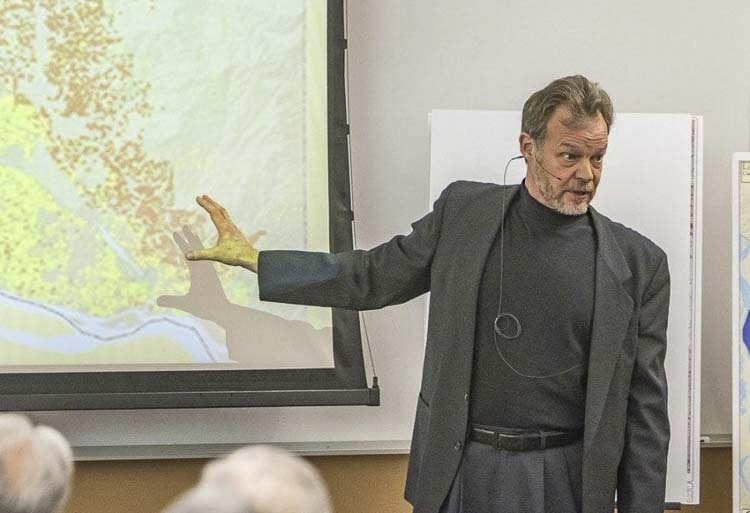
“Ten billion dollars deprives three generations of financial resources that could alleviate mobility bottlenecks crossing the river,” Peterson notes. “Three billion dollars (the Peterson proposal) allows the next generation to invest in corridors to the east and west that can alleviate mobility bottlenecks and provide flexibility and redundancy in the system.”
The Regional Transportation Council (RTC) “Visioning Study” in 2008 identified the need for two additional new crossings.
One of the major problems with the current I-5 bridges is there are seven interchanges within a 5-mile area. Too much merging and weaving causes significant slowdowns. Peterson therefore proposes a 3-lane (each direction) “express” bridge for longer distance interstate travel. He repurposes the existing two bridges as a “collector distributor” for local traffic between downtown Vancouver and Hayden Island.
He recommends the high-level express bridge be configured to accommodate three 13-foot wide lanes plus one HOV/BRT (Bus Rapid Transit) or possible Light Rail Transit (LRT) lane in the future. The existing bridges could be slowed to arterial speeds of 45 mph. The idea is capable of moving 8,000 to 9,000 vehicles per hour he estimates.
Nearly two decades ago, Peterson scrutinized all the traffic projection data submitted by the RTC for the now failed Columbia River Crossing. He calculated that the I-5 corridor would need five lanes in each direction by 2030 to handle 184,000 daily vehicle movements. By 2060, the prediction was for 288,000 daily movements or over eight lanes in each direction.
Although he feels this projection greatly overestimates needs, it does point to the need for additional roadway capacity and transit. A transportation platform capable of at least 8,000 transit and general-purpose vehicles per hour per direction, requiring six lanes, is a better investment.
Because the current IBR proposal offers only three through lanes, (plus a single auxiliary lane), which does nothing to reduce traffic congestion or save people time, Peterson adds lanes to the corridor. The final result adds vehicle capacity over the river, improving travel times while also providing flexibility and redundancy to the system.
The idea is a straight-aligned six lane “express” high-level bridge with at least a 142-foot navigation channel clearance, (possibly higher with a few adjustments). To accomplish this the threshold at Pearson Airport reverts to the east, where it was a couple decades ago, to meet airspace requirements. One building must be removed to accomplish this.
The idea will offer the Vancouver side a 450-foot green lid that connects downtown Vancouver with Fort Vancouver. This reduces the negative impact of the freeway dividing the city in two.
Peterson, whose career involved the planning and design of many major rail transit systems throughout the world, points out that the Yellow Line currently has a maximum of 4,000 people on trains during the morning period. This is called the “link load,” that point in the line where the greatest number of people will sit or stand in a train. Normally the peak morning hour is 16 percent of daily ridership, suggesting 32 percent of the morning ridership will be on trains in the peak hour, or currently 1,280 people.
This is contrasted with C-TRAN’s current experience where there are about 525 daily boardings or roughly 263 people using their express bus service to Portland. If you add in its Route 60 Delta Park bus ridership, less than 1,000 people per day use mass transit on the I-5 corridor over the river.
The IBR’s 6.7-minute headways (9 trains per hour) planned for the Yellow Line would provide capacity for about 2,230 people an hour. That’s over 10 times beyond current daily transit demand.
Peterson is concerned that the Project Office’s statement that nine trains leaving Clark County in the peak hour may be far too optimistic. Trains operating in mixed traffic and sharing track with the Clackamas Green Line for all its downtown routing are subject to Green Line needs, delays and bunching. They also share the track over the Steel Bridge with the Blue and Red lines, adding to MAX train congestion problems.
BRT can operate buses with 90 seats. A policy where all Clark County peak hour transit users are seated, as opposed to a policy where half the people are standing on MAX, would require three to seven buses leaving Clark County every hour if transit demand rose to IBR projections.
Peterson points out that transit must provide a better choice before the average commuter opts to use the service. To do this, transit must be competitive with the car by offering a pleasant and attractive commute even though it may take 50 percent longer than by car. Transit must be able to grow to meet demand. BRT can easily increase capacity, whereas LRT will require billions of dollars to meaningfully increase capacity. It likely requires underground rail in downtown Portland to accommodate four car trains and eliminate mixed-traffic road conflicts to increase headways.
Peterson reminds us that urban planning encouraging transit use is good. However, a denser urban environment is not achieved with an inadequate transit plan or a plan that spends billions for a short line with severe capacity constraints. Long term thinking is needed to grow transit use with complimentary urban density. To spend a couple billion precious taxpayer dollars extending the Yellow Line, with little potential to meet both short term and long term needs, is most odd.
The IBR proposal also flies in the face of falling transit ridership both nationally and locally following the pandemic. More people are working from home and more are using their cars. The RTC says the decline in transit ridership is “permanent.”
Keep in mind that the IBR team have spent over $235 million through the end of June and only have produced a 30 percent design “concept.” This concept cost taxpayers nothing.
Also read:
- VIDEO: WA diesel hits record $6.53, crushing truckers and school budgets
 With diesel nearing $6.53 per gallon in Washington, trucking businesses and school districts now confront sharply higher fuel expenses affecting budgets and workers.
 - Opinion: In plain sight – yielding to pedestrians
 Drivers often fail to see pedestrians due to inattentional blindness, which highlights the need for more focused awareness at intersections and stronger safety practices.
 - Expect delays on SR 14 in Vancouver for guardrail repairs Wednesday
 State Route 14 travelers in Vancouver should plan for morning delays as WSDOT will close two eastbound lanes for guardrail repairs, affecting mileposts 6.0 to 7.0.
 - Overnight closure planned on westbound SR 14 Camas Slough Bridge Tuesday
 WSDOT crews will close westbound SR 14 at Exit 14 in Camas to collect bridge deck samples and plan future repairs; detours will be in effect.
 - Opinion: Stay in your lane – seriously, it’s the law
 Drivers must choose the nearest lane when turning in Washington, and left turns bring added risk. Even with signals, every driver must help prevent crashes by following law.
 wpDiscuz
