



Bob Ortblad believes an immersed tunnel alternative will be safer, have environmental benefits, be faster to build, be more earthquake resilient, and save billions of dollars
Editor’s note: Opinions expressed in this letter to the editor are those of the author alone and may not reflect the editorial position of ClarkCountyToday.com
The Interstate Bridge Replacement Program (IBR) plans to solicit design-build bids for a bridge and approaches. The Federal Highway Administration, the U.S. Coast Guard, and the Joint Oregon-Washington Legislative Oversight Committee should require the IBR to also solicit design-build bids for an immersed tunnel. An immersed tunnel alternative will be safer, have environmental benefits, be faster to build, be more earthquake resilient, and save billions of dollars.
In July 2021, the IBR fraudulently disqualified an immersed tunnel with an error-filled “Tunnel Concept Assessment” report. One year later, in June 2022, the U.S. Coast Guard informed the IBR that the vertical navigation clearance must be 178 feet, and a tunnel or lift bridge must be evaluated. The IBR is ignoring the Coast Guard’s tunnel directive and continues to cite its fraudulent tunnel evaluation.
The IBR, Vancouver, and Portland should study Antwerp’s immersed tunnels. Twice, Antwerp rejected a bridge and selected an immersed tunnel. Vancouver, B.C., has also rejected a bridge design and is now building an eight-lane immersed tunnel under the Fraser River.
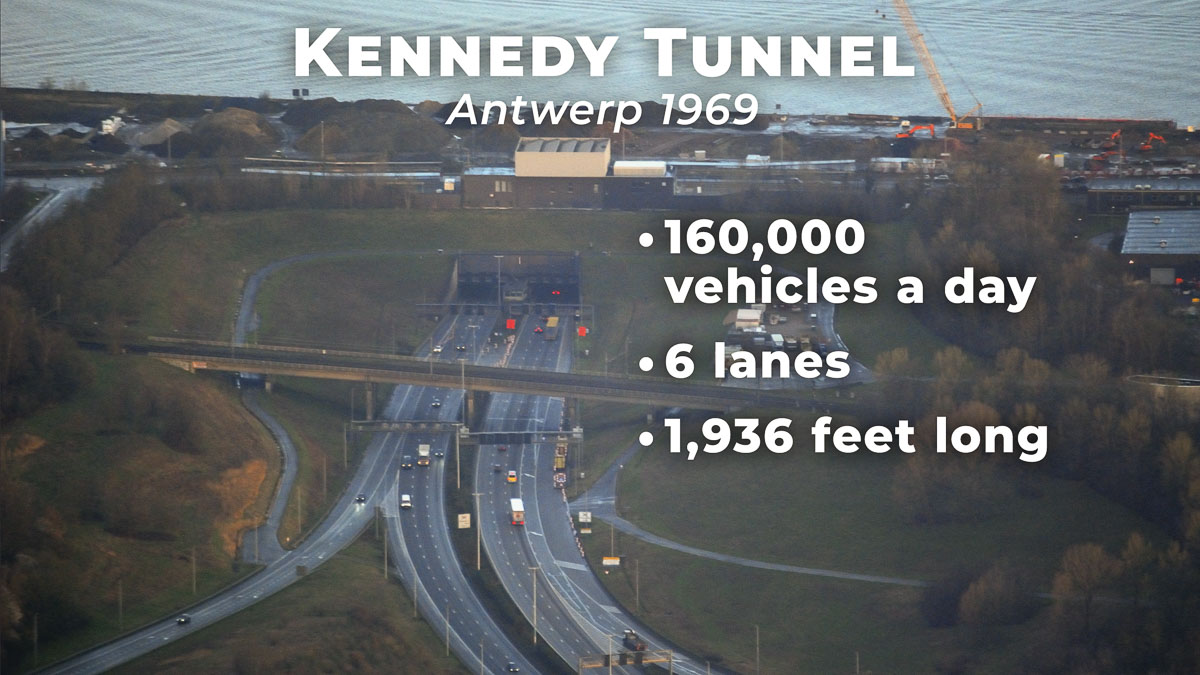
On a recent vacation to Belgium, I drove through Antwerp’s Kennedy Tunnel, a six-lane immersed tunnel. It was opened in 1969 and has 160,000 vehicles crossing a day. In 1963, an invitation to tender was issued for the construction of a bridge or a tunnel; technical experts decided in favor of a tunnel.
In 2009, the citizens of Antwerp approved a referendum, the first in the city’s history, that rejected a massive bridge design in favor of an immersed tunnel. Antwerp’s Scheldt Tunnel is currently under construction, and four of its eight segments have been placed. It will have six lanes with eight immersed segments, totaling 4,200 feet, which is 50% longer than the 2,700 feet needed for an I-5 Columbia River immersed tunnel. This tunnel is being built for $670 million, a fraction of IBR’s $3 billion for bridge and approaches.
The IBR’s massive bridge design has a long list of problems that can be avoided with an immersed tunnel.
- Too low for the U.S. Coast Guard 116’, required 178’
- Dangerously steep 3%, north-facing, elevated S-curve
- Rebuilt antiquated cloverleafs
- Steep 7% curved off ramp to SR-14
- A dozen 50-foot-wide bridge piers that alter river currents and harbor predatory fish
- 160 costly 10-foot diameter drilled shafts into an unpredictable river bottom
- 20 acres of massive, elevated bridge approaches that will devastate Fort Vancouver, downtown, and Hayden Island
- Icy elevated bridge approaches
- Elevated bridge approaches with earthquake risk.
- Noise and toxic pollution from approaches and the bridge
- Crosswinds on a high bridge
- Dangerous in river construction
- Unnecessary demolition of current bridges
- Demolition of the six-story Hurley Building
- Demolition of 43 homes
- Demolition of 35 businesses
- Half-mile-long spiral bike ramp
- 90-foot-high transit station
- 6 acres of Vancouver for parking for 1,270 vehicles
Bob Ortblad MSCE, MBA
Seattle
Also read:
- Letter: ‘This is the worst thing that ever happened to the region’
 A Hayden Island resident Sam Churchill is criticized in a letter calling the $14 billion Interstate Bridge Replacement project a “boondoggle” that destroys local businesses.
 - Opinion: Half the road, full stop – Understanding pedestrian right-of-way
 Doug Dahl explains how Washington’s law requires drivers to stop when a pedestrian is within one lane of their half of the road, not just when directly in front.
 - Opinion: What is the cost of a bridge?
 John Ley argues the I-5 Bridge replacement’s soaring cost stems from costly extras like light rail, noting other states deliver larger, toll-free bridges for much less.
 - Letter: Vancouver Mayor Anne McEnerny-Ogle makes several serious and incorrect engineering statements
 Bob Ortblad critiques engineering claims by Vancouver Mayor Anne McEnerny-Ogle, highlighting cost and safety advantages of an immersed tunnel for the I-5 crossing.
 - Washington’s studded tire deadline is March 31
 Drivers must remove studded tires by March 31 or face a $137 fine, with WSDOT urging early action due to busy service centers and no planned deadline extension.
 wpDiscuz

