


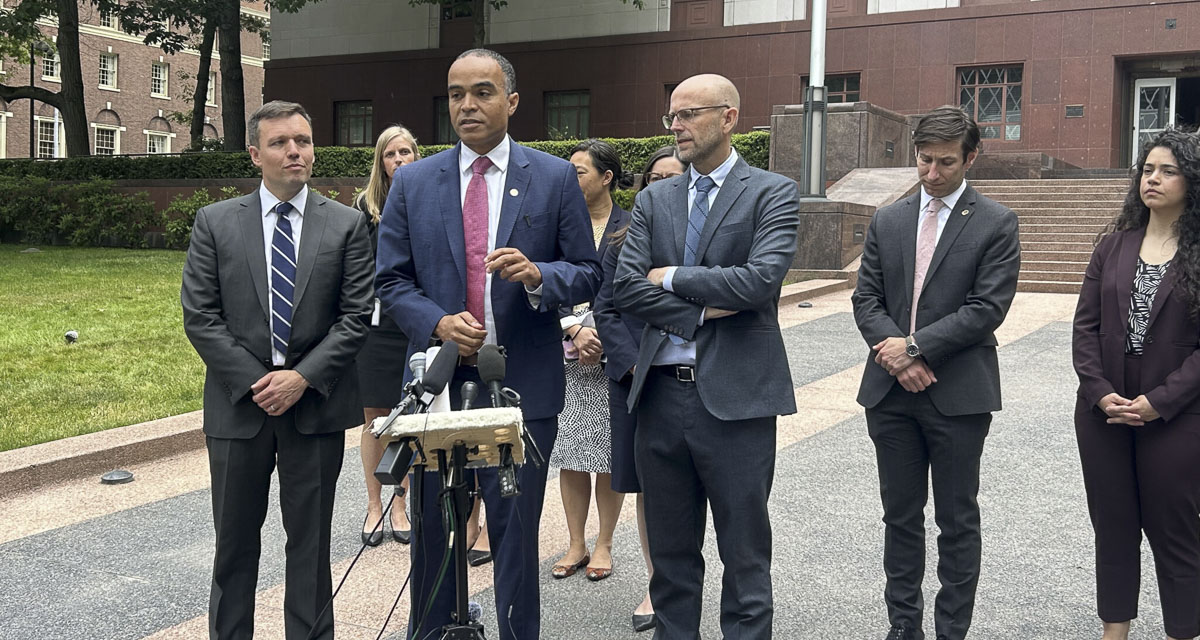
The state of Washington still intends to seek a nationwide block of the president’s order to restrict birthright citizenship
Jake Goldstein-Street
Washington State Standard
Despite a U.S. Supreme Court ruling in favor of the Trump administration on Friday, the state of Washington still intends to seek a nationwide block of the president’s order to restrict birthright citizenship.
“Washington still plans to seek relief for all its harms — that is what we argued for and won in the trial court,” attorney general’s office spokesperson Mike Faulk said in an email Friday.
Washington Attorney General Nick Brown, alongside attorneys general from Oregon, Arizona and Illinois, had argued nationwide relief was necessary while litigation plays out over the order.
But in a 6-3 ruling in the case on Friday, the Supreme Court imposed new limits on lower court judges issuing nationwide injunctions.
Under the ruling, President Donald Trump’s order could go into effect in 30 days in states that didn’t sue, raising the possibility that babies born to immigrant parents in Washington would be U.S. citizens, while those born in neighboring states like Idaho would not be.
The high court did not rule on the merits of Trump’s executive order. Further legal battles over the order, including with the lawsuit backed by Washington, still lie ahead.
Brown has argued previously that the state, instead of the federal government, would have to pay for social services for babies born in other states without birthright citizenship who later move to states like Washington.
In his Feb. 6 injunction, U.S. District Court Judge John Coughenour in Seattle agreed, ordering that anything less than nationwide relief is “ineffectual.” Coughenour’s order was one of three nationwide injunctions the Supreme Court considered.
Brown, in a statement, noted that the justices “confirmed that courts may issue broad injunctions when needed to provide complete relief to the parties.”
“We continue to believe that President Trump’s unconstitutional and cruel order must be stopped across the country to guarantee protection for Washington and its residents,” he continued.
Washington’s case currently sits at the 9th U.S. Circuit Court of Appeals after arguments in Seattle this month. Whether the Supreme Court’s ruling sends the case back to Coughenour is unclear. Faulk said the attorney general’s office expects more clarity on this question soon.
Trump’s executive action aims to end birthright citizenship for babies born to a mother and father who are not U.S. citizens or lawful permanent residents.
In 2022, about 4,000 babies were born in Washington to two parents without legal immigration status, according to the states’ lawsuit.
This report was first published by the Washington State Standard.
Also read:
- Opinion: Were Republican voters just sleeping during the August primary election?
 CCRP Chairman Matt Bumala says 60% of primary no-shows in the 17th and 18th districts were Republicans.
 - High school football: New coach prepares for long-term success at Prairie High School
 James Young-Lewis, a Clark County native who graduated from Evergreen in 2009, became Prairie’s head coach in May after working as an assistant coach across various programs since 2015, joining Prairie’s staff in 2024.
 - Cost to battle 20 wildfires in WA has topped $200M
 Twenty wildfires have cost Washington $207M in one month, more than two-thirds of what DNR spent all last fiscal year.
 - Opinion: WA Cares’ launch showcased care WA Cares did not provide
 Gov. Ferguson showcased a caregiving arrangement at the WA Cares launch that the program had not paid for a single day of.
 - Former State Rep. Liz Pike provides update on husband Neil Cahoon
 Neil Cahoon, a Camas resident, has undergone multiple surgeries including five on Aug. 15 after the Aug. 10 crash near La Center’s Daybreak Airport.
 - Opinion: Portland’s War on Cars Part 4 – A smarter automobile strategy to end gridlock
 O’Toole argues fuel wasted in Portland-area congestion has sextupled since 1982, generating 250,000 tons of extra greenhouse gases annually.
 - $1,000 first prize for Camas Plein Air Art Event honoring Marquita Call on Sept. 26
 Plein air artists compete Sept. 26 in Camas for $1,000 first prize honoring gallery founder Marquita Call.