



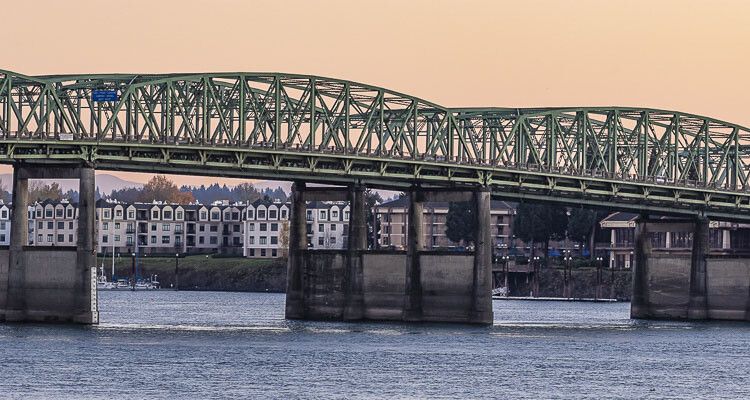
The bridge replacement program is now undertaking a draft Supplemental Environmental Impact Statement Process that will, in part, examine the various design concepts
TJ Martinell
The Center Square Washington
With funding commitments secured from both Washington and Oregon for the new I-5 Bridge between Vancouver and Portland, the Joint Legislative Action Committee is now looking at potential designs for the replacement bridge that differ in their aesthetic style and functionality.
Although Oregon Gov. Kate Brown has yet to sign it, a bill passed this session by the State Legislature committed a total of $1 billion in the form of $250 million in bonds during this biennium and another three rounds of bond sales for each subsequent biennia. The Washington Legislature allocated $1 billion for the new bridge as part of the Move Ahead Washington transportation package.
Washington Department of Transportation Program Administrator Greg Johnson told the bi-state action committee at its July 28 meeting that the state’s combined financial commitment was vital before approaching the federal government for grant funding. The project aims to secure $1 billion alone from the federal government through its Capital Investment Grant (CIG) Program managed by the Federal Transit Administration (FTA), with another $860 million-$1.8 billion obtained from other available federal grants.
“We are looking to position ourselves as a project of national significance,” Johnson said. “The federal dollars are generally the last dollars. They want to see the commitment from the states. That has happened. Now we are pointing in a much more competitive situation as we start going after federal grants.”
The bridge replacement program is now undertaking a draft Supplemental Environmental Impact Statement Process that will, in part, examine the various design concepts that range in differences from the material used to how high it is. One design has towers and is supported by cables, while another design has no towers. One has two levels that would allow for bicyclists to travel below car traffic.
Among the potential designs at the request of the Coast Guard is a movable bridge that would rise 178 feet, though other designs with a clearance of 116 feet would negate the need for them to be movable. If chosen, the movable bridge would be one of the largest of its kind in the world, according to Johnson, who said there are “tradeoffs with any of these concepts.”
One of the tradeoffs for the movable bridge design is the cost difference. According to Johnson, it would add an estimated $400-500 million compared to the non-movable bridge designs.
A decision on the final bridge design will be made in 2024.
This report was first published by The Center Square Washington.
Also read:
- Opinion: ‘When are we going to get the full and complete details of the Interstate Bridge Replacement Program’s I-5 Bridge replacement project?’
 IBR team buried key details about light rail ending at waterfront with massive elevator system required.
 - POLL: Do you support extending light rail beyond the waterfront to connect with C-TRAN at Library Square?
 Readers can weigh in on Anne McEnerny-Ogle’s proposal to extend light rail beyond the waterfront to Library Square for improved C-TRAN connections.
 - Opinion: Passing a cyclist – Law, myth and a little patience
 Most drivers can’t legally pass cyclists in-lane due to vehicle width versus road measurements.
 - Vancouver mayor counters IBR’s proposal for the only light rail stop to be at the waterfront
 Vancouver’s mayor wants light rail extended beyond the waterfront to connect with C-TRAN buses at Library Square.
 - Letter: ‘This is the worst thing that ever happened to the region’
 A Hayden Island resident Sam Churchill is criticized in a letter calling the $14 billion Interstate Bridge Replacement project a “boondoggle” that destroys local businesses.
