


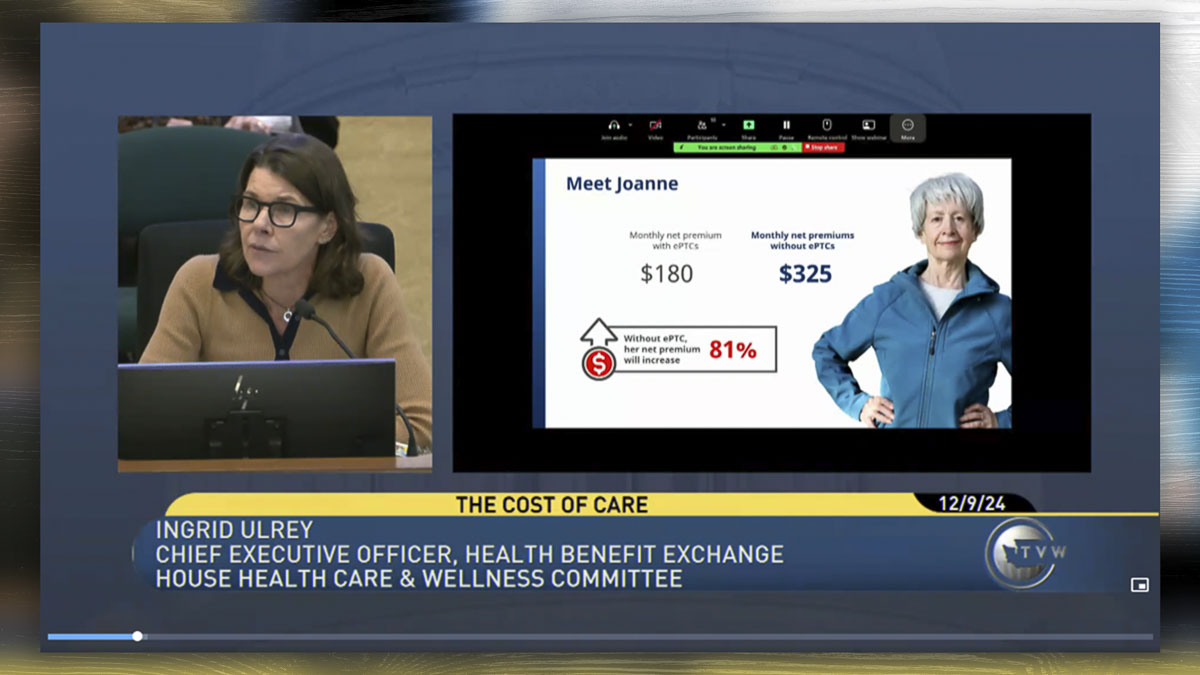
On Monday, the CEO of the HBE told members of the House Healthcare and Wellness Committee that they are on track for record numbers for the open enrollment period which ends Jan. 15, 2025
Carleen Johnson
The Center Square Washington
Halfway through open enrollment for Washington’s marketplace for health and dental insurance, called the Washington Health Benefit Exchange (HBE), executives are urging lawmakers to ensure state subsidies are part of upcoming budget plans for the 2025 legislative session.
During a Monday work session, Ingrid Ulrey, CEO of the HBE, told members of the House Healthcare and Wellness Committee that they are on track for record numbers for the open enrollment period which ends Jan. 15, 2025.
“We are smack dab in the middle of open enrollment and it’s going incredibly well because both the federal and state supports continue to be in place,” said Ulrey. “We expect to max our record to have 300,000 people covered for 2025.”
Ulrey told lawmakers their only ask for the upcoming session is that state level subsidies, called Cascade Care Savings, that help cover premiums for people covered by the HBE are fully funded, as federal tax credits are set to expire at the end of 2025.
“The two subsidy programs I want to talk to you about are critical because they take a gross premium on average in our market of over $600 per month and they make it affordable for many Washingtonians,” said Ulrey. “80% of the people in our market access either the federal or state subsidy, or both.”
During the COVID pandemic, federal officials offered tax credits to ensure people with individual (non-employer) healthcare plans could keep them.
“Federal officials were worried about people being able to keep their coverage, so they enhanced the level of the federal tax credit to cover more people and for a more generous amount,” said Ulrey, who explained Washington is one of a handful of states that layers on top of the federal support with state subsidies.
Ulrey gave the example of a woman on the individual market who currently pays $160 a month for coverage, receiving the enhanced federal premium tax credit.
“If and when Congress lets the tax credit expire, she would be paying $325 per month,” said Ulrey.
She continued: “If it goes away, premiums would go up an average of 72% for 80% of those people covered,” she said adding that their independent actuaries are predicting that 70,000 people would experience premium increases so steep that they would forgo coverage and become uninsured.
Ulrey said the loss of the federal tax credit would amount to losing $250 million for Washington state per year.
“We can’t subsidize our way out of this, but it’s also mission critical that we keep these subsidies in place,” said Ulrey who told lawmakers over 100,000 customers in the state exchange are benefiting from Cascade Care Savings.
“37,000 customers have a plan they pay less than $25 a month for,” she added.
Elizabeth New, director of the Center for Healthcare at the Washington Policy Center think tank watched the Monday work session and emailed comments in response to The Center Square.
“Washington cannot afford and should not afford such generous health insurance subsidies for people who make more than 400% of the federal poverty level,” wrote New. “Not only would doing so harm taxpayers, many of whom are trying to keep up with their own health care costs, we need more people, not fewer, invested in health care costs to help with health care cost containment.”
New continued: “Safety nets for people in need are important, and we have those. Continuing overly generous subsidies that hurt taxpayers is unwise. Washington state is becoming reliable for requiring lower-income taxpayers to help pay the way for those with higher incomes and more resources.”
As previously reported by New and The Center Square, Washington taxpayers are also footing the bill for an expansion of a Medicaid-like program for low-income adults who are undocumented immigrants.
Unlike Medicaid, the program, called Apple Health Expansion, is shouldered by Washington taxpayers, while Medicaid is funded at the state and federal level and is not available for people who entered the country illegally.
According to New, the Washington State Healthcare Authority said $72 million had been allocated for the program.
An October 2024 report from HBE on Immigrant Health Coverage (IHC) showed approximately 42,100 IHC customers have applied for coverage through Washington Healthplanfinder since Nov. 1, 2023, with 75% income eligible for the Apple Health Expansion, which again is funded by taxpayers.
This report was first published by The Center Square Washington.
Also read:
- Opinion: Were Republican voters just sleeping during the August primary election?
 CCRP Chairman Matt Bumala says 60% of primary no-shows in the 17th and 18th districts were Republicans.
 - High school football: New coach prepares for long-term success at Prairie High School
 James Young-Lewis, a Clark County native who graduated from Evergreen in 2009, became Prairie’s head coach in May after working as an assistant coach across various programs since 2015, joining Prairie’s staff in 2024.
 - Cost to battle 20 wildfires in WA has topped $200M
 Twenty wildfires have cost Washington $207M in one month, more than two-thirds of what DNR spent all last fiscal year.
 - Opinion: WA Cares’ launch showcased care WA Cares did not provide
 Gov. Ferguson showcased a caregiving arrangement at the WA Cares launch that the program had not paid for a single day of.
 - Former State Rep. Liz Pike provides update on husband Neil Cahoon
 Neil Cahoon, a Camas resident, has undergone multiple surgeries including five on Aug. 15 after the Aug. 10 crash near La Center’s Daybreak Airport.
 - Opinion: Portland’s War on Cars Part 4 – A smarter automobile strategy to end gridlock
 O’Toole argues fuel wasted in Portland-area congestion has sextupled since 1982, generating 250,000 tons of extra greenhouse gases annually.
 - $1,000 first prize for Camas Plein Air Art Event honoring Marquita Call on Sept. 26
 Plein air artists compete Sept. 26 in Camas for $1,000 first prize honoring gallery founder Marquita Call.